

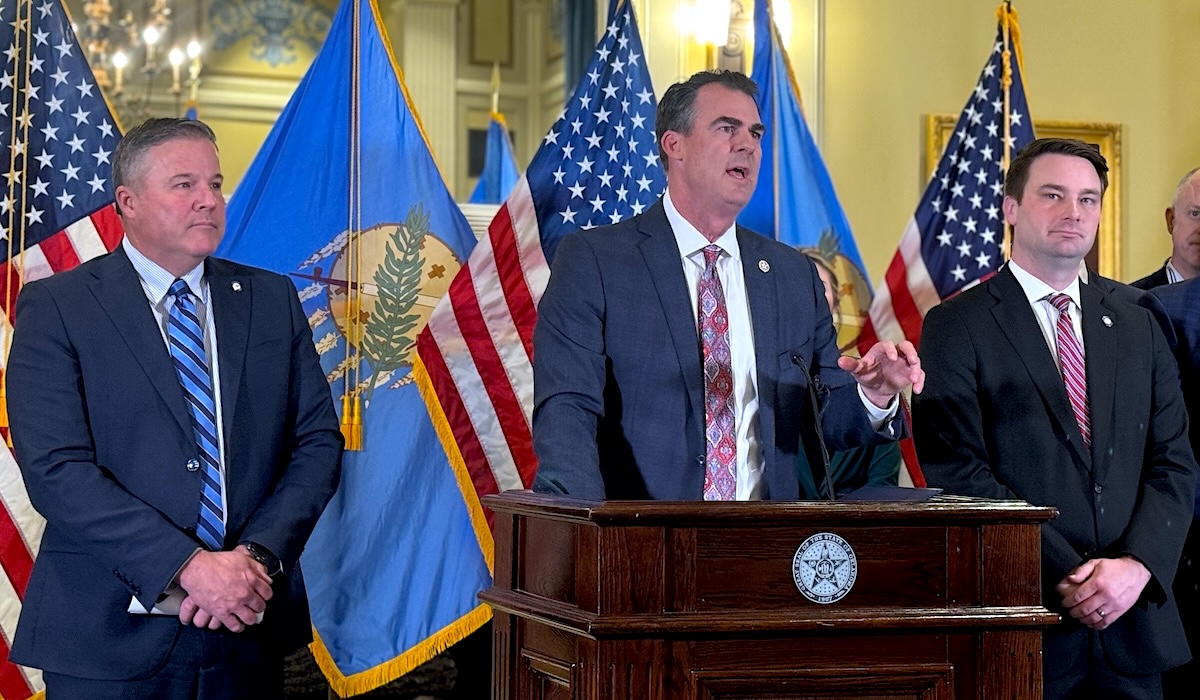

In a significant step toward avoiding a repeat of the 2024 budget negotiation debacle that kept lawmakers at the Capitol through May and away from their districts during reelection campaigns, Oklahoma legislative leaders joined Gov. Kevin Stitt in a press conference today announcing a Fiscal Year 2027 budget agreement largely aimed at avoiding cuts, attempting to fill a mental health agency funding gap and funding a $2,000 pay raise for most teachers.
“I’m so proud that, we’re finishing my eight years — this is my last budget — and we’re putting Oklahoma in a great place,” Stitt said. “I get to end my time serving the people of Oklahoma leaving behind a legacy of conservatism and amazing economic growth and really set up the next administration and the speaker and the pro tem to have a great next few years.”
Wednesday’s announcement potentially puts lawmakers on a path to adjourn session by the end of the month and return to their districts early in an election year — something they failed to do in 2024 when the House’s budget chairman and the Senate’s leader-designee were defeated by GOP challengers who ran to their right.
Wednesday also marked the first of three days worth of formal candidate filing for Oklahoma’s 2026 election cycle, which features primary contests June 16, runoffs Aug. 25 and a Nov. 3 general election. To that end, House Republican leaders held a political action committee fundraiser Tuesday night in the OKC Boathouse District, exercising a loophole in state ethics requirements that prohibit individual legislators from raising money during session but allow PAC checks to be written by individuals and interest groups seeking influence over the final weeks of session.
Now, legislators are positioned to begin hearing dozens of budget-related bills through the chambers’ Joint Committees on Appropriations and Budget Committee process Monday. That would position the budget bills to reach the governor’s desk by Thursday afternoon, although the measures are still being drafted.
“We’re going to stay true to, hopefully, a 24-hour posting notice — or quicker — if we absolutely can,” Senate Appropriations and Budget Committee Chairman Chuck Hall (R-Perry) said after Wednesday’s press conference.
Moments before Wednesday’s press conference, the House and Senate budget portals were updated to reflect the agreement struck by House, Senate and gubernatorial negotiators, who fast-tracked their annual process beginning last fall and punctuated by Tuesday lunches once session began in February.
“I was asking the pro tem and the speaker, I was like, ‘What are we going to do the rest of April and May? I mean, we’re not going to have anything to argue about if we get the budget done so early,'” Stitt quipped. “But I am so excited to get this thing done early and get it locked down.”
Representatives for all three legs of the Capitol stool reported smooth discussions this year, with not even Stitt’s request to purchase a new state plane derailing this week’s final negotiations. Similarly, certain agency cuts that had been penciled in at roughly 2 percent levels as late as Tuesday were backed out in the final announcement, with the governor advocating for “flat” budgets compared to trims proposed by at least one legislative chamber — a political swap of their generally historic roles.
“It was an absolute pleasure to work with the governor and his staff and the speaker and his staff,” Senate President Pro Tempore Lonnie Paxton (R-Tuttle). “When everybody sees the budget and what we’re doing, I think you’re going to be pleased with it.”
Ultimately, the proposed appropriated budget — a fraction of the state’s overall agency funding — arrived at $12.79 billion, a 1.3 percent increase from FY 2026, albeit one largely created by a decision to redirect $200 million from the state’s Revenue Stabilization Fund to a new Taxpayer Endowment Trust Fund, which Stitt said will receive an unspecified dedicated revenue source to grow above $1 billion.
“This is a fund to lock up savings for future generations. The Taxpayer Endowment Trust Fund is going to lock up $200 million in existing savings for investing. Just like sovereign wealth funds in other states like Alaska, Texas and Wyoming, we think it’s really important that we protect this savings account and we invest in future Oklahomans,” Stitt said. “As a result, within the next decade, this account will start delivering earnings to support the state’s general revenue, and it’s going to lock up savings today as we are protecting future core services to serve the people of Oklahoma — and protecting our progress to become a zero income tax state sometime in the future.”
To discuss their $12.7 billion in decisions, Stitt and legislative leaders took questions on their announcement for 11 minutes, largely bogging down on education funding and the complex decision to fund roughly half of what the governor’s Cabinet secretary of health said was needed to avoid Medicaid service or payment reductions.
“Those are all on actuarial studies. Maybe it’s $490, maybe it’s $250. But $250 million is a big chunk of money to add to that welfare-type program,” Stitt said. “It is what it is. It’s a zero-sum game. There’s not an empty checkbook in the government. We have to have a balanced budget, and we can’t open up our checkbook and say, ‘We’re going to spend whatever amount that we get bills from the hospitals for these things.'”
FY 2027 budget deal details

As outlined through Wednesday’s press conference, other conversations with lawmakers and the online portals, the FY 2027 budget deal — if passed — would:
- Keep most state agency budgets flat;
- Raise teacher pay by $2,000 ($85 million) and dedicate nearly $80 million to literacy initiatives, reading tutors and math tutors;
- Fund cost of living adjustments — or COLAs — in seven state pension system payments for retired public employees, including teachers, firefighters, law enforcement personnel and state employees. Retirees’ monthly payments would increase 3 percent if they have been retired between 10 and 19 years or 6 percent if they have been retired at least 20 years;
- Increase longevity pay for state employees (through SB 169);
- Provide $6.7 million to fund a new trooper academy for the Oklahoma Highway Patrol; and
- Create a new “sovereign wealth fund” governed by the Invest in Oklahoma board. The new fund would receive $200 million from the Revenue Stabilization Fund to pursue high-dividend investments to create a new revenue stream for annual appropriations. (Lawmakers are also advancing a plan to repurpose the Tobacco Settlement Endowment Trust to support college scholarships and common education funding.)
While Wednesday’s announcement — apparently not a grand April Fool’s Day gag — positions lawmakers to complete their work as early as the end of the month, it has also revived a regular criticism of Republican leaders: that their decisions were made primarily through private conversations instead of the public-facing practices of the last two years that were aimed at increasing transparency.
“We are not seeing transparency from our Republican colleagues,” Senate Minority Leader Julia Kirt (D-OKC) said in press conference with Democratic colleagues Tuesday that discussed the looming Medicaid funding gap. “The only solution we’ve seen the GOP put forward is to cut working Oklahomans off of Medicaid.”
On Wednesday, Republicans pushed back on the notion that their process lacked transparency.
“To my knowledge, unless and until somebody tells me differently, this is the earliest budget announcement that people can recall,” said House Speaker Kyle Hilbert (R-Bristow). “Why I mention that is because we are transparently, as the Republican leadership of the state, putting out our budget — what we propose for the state of Oklahoma and doing it in an early fashion, not where it’s crammed down everyone’s throat at the very last minute at the end of the legislative session.”
Other components of the FY 2027 budget deal — above FY 2026 allocations — appear to include:
- $40 million from the Legacy Capital Financing Fund to Oklahoma State University for a new agronomy program building;
- $20 million through LCF to the University of Oklahoma’s Price College of Business;
- $20 million through LCF to OU to support dormitory construction, contingent upon private fundraising benchmarks;
- $28 million through LCF to fund a new headquarters and warehouse for the Oklahoma Bureau of Narcotics and Dangerous Drugs;
- $25 million through LCF to increase the cap of the Parental Choice Tax Credit from $250 million to $275 million;
- $14 million through LCF to make repairs at the Oklahoma State Bureau of Investigation’s Forensic Center in Edmond;
- $6.2 million through LCF to build a new evidence evidence warehouse for OSBI;
- $8.2 million for Service Oklahoma to purchase its current building;
- $12.5 million for “DREAM” savings accounts for Oklahoma children
- $3 million to Langston University to expand agriculture extension services to a half-dozen new communities for the purpose of developing and supporting micro-farming operations;
- $15 million to the Department of Commerce for 2028 Olympic Games;
- $12 million to the State Election Board for voting software upgrades;
- $3 million for a new airplane for the governor’s office, which has not possessed a plane since Stitt ordered the sale of the office’s old jet as one of his first actions in 2019;
- More than $3 million to expand Dolly Parton Imagination Libraries across the state and to implement the Just Right Readers phonics education program;
- $38.9 million to the Department of Human Services in FY 2027 for the ADvantage Waiver program that provides alternatives to placement in nursing facilities for eligible adults. (Lawmakers also approved $22 million as an FY 2026 supplemental appropriation for the program);
- $25.5 million to DHS for Supplemental Nutrition Assistance Program “changes”;
- $4.56 million to DHS for child care teacher recruitment and retention;
- $5 million to DHS for expanding foster care eligibility to age 21 (as provided in SB 1806);
- $35 million for a new revolving water loan program through the Oklahoma Water Resources Board;
- $10 million for water projects through Rural Economic Action Plan (REAP) grants tied to the other OWRB program;
- $2 million to OWRB for rural water district consolidations;
- $33 million for general REAP grants;
- $31 million for Progressing Rural Economic Prosperity (PREP) grants;
- $15 million to the Department of Transportation for lake and industrial access efforts;
- $7.5 million to the Oklahoma Space Industry Development Authority for a hanger
- $3.7 million to the Oklahoma Conservation Commission to fund “critical dam repairs”;
- $3.4 million to the Statewide Charter School Board for the Horizon program;
- $1.8 million to the Council on Law Enforcement Education and Training for software;
- $1 million to the Oklahoma State Department of Health for ALS research;
- Funds to cover two years of property tax revenue lost by Geronimo Public Schools when the state purchased the Lawton Correctional Center in last year’s budget deal;
- $75,000 to establish the Athletics Commission as an independent agency;
- $2.5 million to the District Attorneys Council for a rural loan assistance program (as provided in HB 3980);
- $2.2 million to district courts for court reporter pay increases; and
- $1.6 million to district courts for bailiff pay raises;
According to the budget portals, lawmakers did not include $9.86 million recommended by the Judicial Compensation Board to raise the pay of judges. Under state law, the Judicial Compensation Board’s recommendation takes effect unless lawmakers pass a bill modifying or rejecting the amount. By not including judicial pay increases for district or appellate judges as recommended by the board, it appears the Legislature will consider a measure rejecting the raises.
Managing Medicaid: Health care decisions diagnosed

For the second year in a row, the Legislature’s annual budget negotiations were complicated by fluctuating projections of budget shortfalls at the Oklahoma Department of Mental Health and Substance Abuse Services, which requested about $150 million of additional money to pay off its FY 2025 and FY 2026 Medicaid reimbursement obligations and to annualize its needs in the FY 2027.
Ultimately, lawmakers have chosen to fund $136 million of the combined request, leaving out the agency’s ask for $22.5 million for technology upgrades. The agency’s baseline appropriations are about $67 million higher than they were for FY 2026.
Notably, the FY 2027 budget deal does not appear tied to a specific proposal for property tax reform, a topic that has been widely debated publicly and privately among legislators and stakeholders.
Republican lawmakers are still likely to put forth one of several options for a state question on the topic, such as a proposal to freeze rates entirely for current property owners or reduce the maximum rates of increase from 5 percent to 3 percent on commercial property and from 3 percent to 1 percent on homesteaded residences.
Meanwhile, the Oklahoma Health Care Authority — which processes state Medicaid claims and interfaces with the federal government for the program — had asked lawmakers for a $494 million funding increase to fund an anticipated hole based on expected utilization increases.
Ultimately, amid lingering questions about the source of the supposed actuarial analysis at the heart of the $494 million estimate, lawmakers have chosen to fund $250 million of that request — a number in line with Stitt’s own formal request in his annual budget proposal released in February.
Still, the decision will put all eyes on OHCA’s leadership and governing board for how they may change reimbursement rates to make up the difference.
“I think one of the problems is, traditionally, under different directorship in that agency, they would come in with the specific actuarial firm,” explained House Appropriations and Budget Committee Chairman Trey Caldwell (R-Lawton). “(They) would come in with a low, medium and high projections. And that has been pretty traditional. And this firm, this year now, came in with only a medium and high, and so we have requested multiple times to actually see the actuarial data, the true actuarial data, we have not got that yet.”
After legislators reached their decision on the $250 million number in March, stakeholders have privately discussed concerns about potential provider rate cuts, potential reduction or elimination of adult dental services, and a suggestion that hospitals should find ways to help fill the gap on their end.
“I don’t know if we’re cutting dental or not,” Stitt said Wednesday. “There’s not a blank check, so the Legislature has to make these balls and strikes calls, and the $250 million is what they decided.”
Asked after Wednesday’s press conference whether they would be disappointed if OHCA’s director and its board chose to cut Medicaid provider rates or reduce services based on the $250 million decision, Hall said he anticipates further conversations.
“I hope the level of communication with the executive there at the Health Care Authority remains where it has been,” Hall said. “They have always been very good to share the numbers and share their thoughts. I hope that continues as they take a look at the different levels that the speaker talked about that they can be pulling to make this budget balance in their authority.”
Asked again whether it’s their hope that OHCA avoids rate cuts or service reductions, Caldwell answered more specifically: “Yes.”
(Update: This article was updated at 10:25 a.m. Thursday, April 2, to clarify details about the cost of living adjustment proposed for public pension system retirees.)