

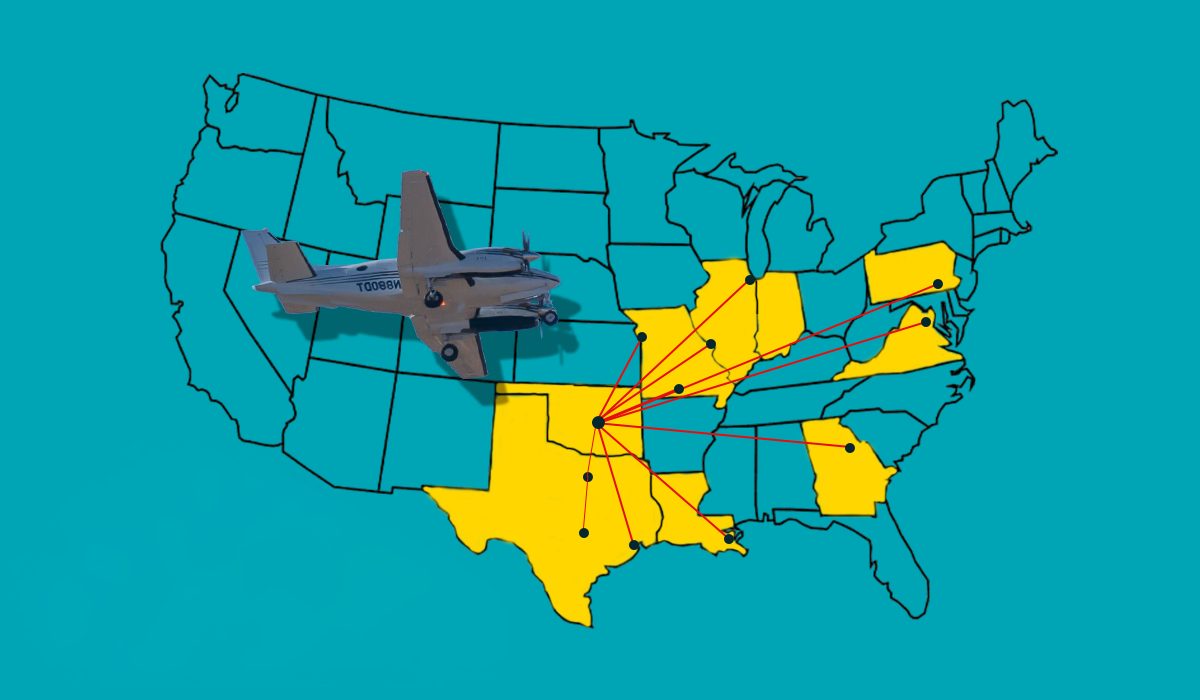

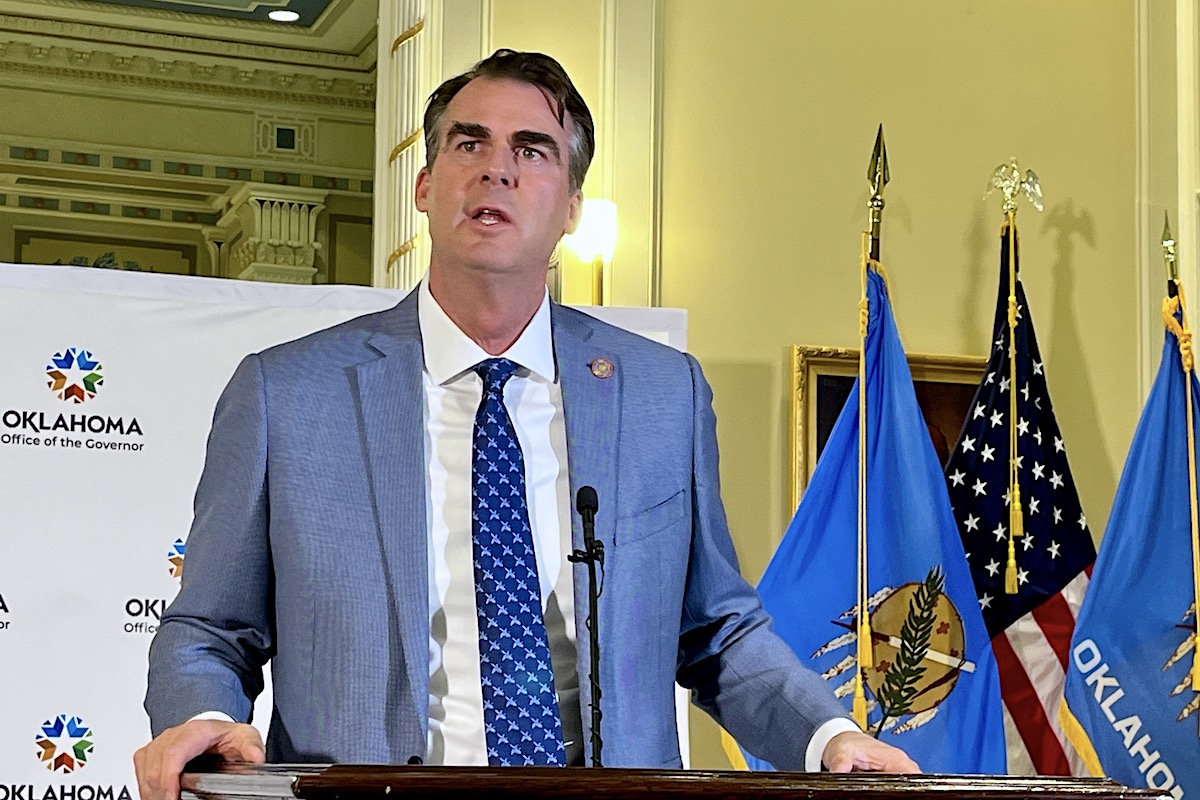
Eight years after he sold a state airplane in one of his first efficiency-focused executive orders, outgoing Gov. Kevin Stitt has asked the Oklahoma Legislature for $3 million to upgrade a Department of Transportation plane he and his family have used for official state business and personal and political travel.
Republican legislative leaders agreed to Stitt’s request ahead of last week’s budget deal announcement, and $3 million was etched into the House and Senate budget portals to “upgrade” the state plane for Oklahoma’s next gubernatorial administration. Still, amid a flurry of questions and looming votes on whatever bill will propose the aeronautical appropriation, the purchase has raised eyebrows as it prepares for takeoff.
“In 2019, Gov. Stitt sold the plane reserved for gubernatorial use and consolidated the state’s aviation fleet from 17 aircraft down to five, saving taxpayers millions of dollars,” said Tevis Hillis, press secretary for Stitt’s office. “In this year’s budget, the governor proposes using one-time funds to replace a 35-year-old state plane with a safer, more efficient model for supporting future state officials for the next decade or more.”
In July 2024, NonDoc requested flight logs and passenger manifests for all trips taken on an ODOT-registered 1992 Beechcraft King Air from Jan. 1 to July 1 of that year. In May 2025, ODOT provided 104 pages of records detailing 17 flights taken by the governor or his family. Of those 17 trips, 16 involved out-of-state destinations with unclear purposes not listed on the flight documents.
Now, the pending FY 2027 budget line item awaits legislative action as a plane-related open records lawsuit looms against ODOT. Brought by Oklahoma Voice, the suit seeks the release of redacted passenger names and trips aboard the current plane for flights that lack a listed purpose as required by state statute.
Meanwhile, travel without a recorded purpose taken by Stitt — alongside similarly unspecified trips taken by First Lady Sarah Stitt without the governor — has again raised questions about how tax money is spent on state travel, for which the governor holds exceptional status under state laws dictating political use of aircraft.
Lawsuit: ‘No legal basis’ for passenger name redactions in flight records

Questions about gubernatorial air travel in Oklahoma are nothing new, as Gov. Mary Fallin and Gov. Frank Keating also made headlines for their travels aboard state aircraft.
For the past two years, Stitt’s use of the state plane has been scrutinized by reporting from Oklahoma Voice, which filed its lawsuit in January alleging that the state is disregarding laws requiring flights aboard the airplane to have a publicly logged purpose and passenger manifest.
“There is no legal basis that can justify [ODOT]’s redaction of passenger names from the ODOT travel logs,” the suit’s initial petition reads. “Disclosure of the unredacted requested records is intended to, and reasonably likely to, enable plaintiff’s journalists to evaluate whether those entrusted with the affairs of the government are honestly, faithfully, and competently performing their duties as public servants. Accordingly, the public interest in the unredacted requested records outweighs any reason for denial.”
A footnote in the lawsuit notes that Oklahoma Voice also received travel logs for the aircraft dating from 2019 to 2023, that “contain similar redacted information; namely, the identities of passengers using the ODOT aircraft when the requesting party was the Governor’s Office.”
In the records provided to NonDoc by ODOT, redaction of passengers’ names occurred only on trips where Kevin Stitt or Sarah Stitt are also present, and they potentially reflect travel involving their children. In the provided records for flights requested by other state employees between Jan. 1, 2024, and July 1, 2024, all names appear unredacted.
ODOT filed a motion to dismiss the Oklahoma Voice lawsuit Feb. 9, in which the agency points the finger for record redactions at Stitt’s office and the Department of Public Safety.
“Plaintiff’s claims improperly attempt to impose liability on ODOT for actions taken by DPS and the Governor’s Office,” states the motion to dismiss. “ODOT lacks statutory authority to override another agency’s lawful redactions or to create or supplement information it did not receive. Because the petition does not allege facts showing that ODOT withheld non-exempt records or failed to comply with the [Open Records Act], dismissal is required.”
A hearing on the motion to dismiss is set for July 21 in front of Oklahoma County District Court Judge Natalie Mai.
Stitt ’emphatic’ on new plane for future governors

Oklahoma’s pending plane procurement represents a full-circle moment for the outgoing governor and licensed pilot, who initiated his first term in 2019 by issuing an executive order to sell a DPS-registered 1990 Beechcraft King Air 300 used by his predecessors. At the time, Stitt said there were other, more cost-effective ways to travel, including flying commercial.
Since then, though, Stitt and his family appear to have used the ODOT aircraft routinely, and it seems his experience with the 1992 King Air convinced him an upgrade would be practical for future administrations. When House and Senate leaders brought their proposed budget agreement to Stitt and his broader team last week, acquiring a newer plane was front of mind.
“That was a main negotiation point from the governor,” House Appropriations and Budget Committee Chairman Trey Caldwell told NonDoc after the April 1 press conference announcing the agreement. “He had a logical argument on it.”
Caldwell (R-Lawton) said Stitt was “emphatic about” the new plane and was “leading the charge” on it during budget negotiations. He said selling the current twin-engine propellor aircraft was also discussed.
The next day, as word spread about the governor’s aeronautic ask, legislative leaders faced questions on the proposal.
House Speaker Kyle Hilbert said he expects ODOT to pursue its new plane purchase through a competitive bidding process as required by Oklahoma law. In 1997, controversy swirled regarding the noncompetitive “sole source” purchase of a $2.9 million Beechcraft plane during Keating’s administration.
“I know they have processes on how they go about state purchases,” said Hilbert (R-Bristow). “I would assume all things would comply with the [Oklahoma Central Purchasing Act] and the requirements therein.”
Senate President Pro Tempore Lonnie Paxton (R-Tuttle) framed the new plane partially as a safety and efficiency purchase.
“We asked the governor about it a little bit. He said the plane that they use now, they have to stop and get fuel on the way to D.C. [The purchase] is a way to just improve what we have as a state,” Paxton said. “We ought to be able to get the governor around the country as fast as they reasonably can, and also, of course, as safely as they can. We’d hate to think that we’re trying to save money and we have a horrible accident because we didn’t have an upgraded plane.”
Sarah Stitt regularly traveled without purpose listed

Of the 17 flights on which the governor or his family were passengers between Jan. 1 and July 1, 2024, none had its purpose listed as required under Title 74, Section 500.6A. The law, created by HB 3226 in 1998, further requires the purpose of “each landing” to be specified on multi-leg flights, which was not done in the records provided from 2024.
Other requirements outlined under the statute were also lacking, including “the name of the group sponsoring the speech, presentation, meeting, event, or gathering, or receiving the service.”
The provided records indicate that, in the six-month period to start 2024, flights taken by Stitt or his family totaled about $65,000, accounting for pilot pay, fuel costs and “miscellaneous costs” like airport fees and security listed on flight manifests.
In 2024, the first lady traveled aboard the state aircraft without the governor seven times during that six-month span, all of which were out-of-state trips with unspecified purposes:
- A weekend-long trip to St. Louis from Friday, Feb. 16, to Monday, Feb. 19, with two other passengers whose names were redacted;
- A one-day trip Thursday, March 7, to Romeoville, Illinois, a town near Chicago that is home to Lewis University. Sarah Stitt departed Oklahoma City with one redacted passenger and departed back to Oklahoma alone around 6 p.m. the same day;
- Multiple flights between Oklahoma City and Dallas on Tuesday, March 12, and Wednesday, March 13. Sarah Stitt traveled to Dallas on March 12 with two redacted passengers and returned the same afternoon. She again traveled to and from Dallas with only one redacted passenger March 13;
- A multi-day trip beginning Sunday, March 31, in which the state plane departed Oklahoma City, picked up Sarah Stitt from Tulsa and flew her to the Lewis University airport in Romeoville, Illinois. The state aircraft then returned to OKC and flew back to retrieve Sarah Stitt on Wednesday, April 3;
- A weekend trip to Kansas City on which Sarah Stitt departed OKC with one unknown passenger on Friday, April 5, and returned Monday, April 8;
- Another trip to Romeoville, Illinois, on Monday, April 22. Sarah Stitt departed OKC alone but returned with an additional passenger whose name was redacted; and
- A brief trip to Branson, Missouri, on Friday, June 14. Sarah Stitt left OKC alone at 6:05 a.m. but departed Branson at 1:35 p.m. with two passengers whose names were redacted.
While such travel by gubernatorial family members is legal under state statute so long as its reasons are documented, the lack of explanation for the trips and redacted passenger logs sparked the Oklahoma Voice lawsuit and other questions about how exactly public resources have been expended.
Governor flew to Pennsylvania for political event
One trip made by Gov. Kevin Stitt in May 2024 highlighted a long-debated topic about elected officials’ use of state aircraft — a tricky subject that HB 3226’s author in 1998 once thought would be solved by his legislation.
On May 14, 2024, Stitt appeared on stage in Lancaster County, Pennsylvania, with U.S. Sen. Dave McCormick (R-PA). At the time, McCormick was running against then-incumbent U.S. Sen. Bob Casey (D-PA), whom he ultimately defeated by 0.22 percent of the vote.
According to a report of the event from LNP, Lancaster County’s local newspaper, Stitt joined McCormick and a conservative radio host for an on-stage Q&A session May 14, during which Stitt endorsed McCormick’s candidacy. NonDoc received records of a corresponding state aircraft flight to Pennsylvania on May 13 with the governor aboard.
“What happens in your Senate race affects Oklahoma (…), it affects everything,” Stitt said in an audio recording of the event obtained by NonDoc. “And that’s why it’s so important for us to rally together to make sure he’s the next U.S. senator.”
Oklahoma officials must file state documents before traveling on the ODOT plane. The first question on a required form asks, “Is this event(s) in support of, in opposition to, a political party, political action committee or political candidate?”
If that question — and a list of others — is answered affirmatively, the aircraft’s use is “therefore, not authorized,” according to the document.
The purpose of Stitt’s Pennsylvania flight was left unspecified. Records show the plane made a further 10-minute stop in Evansville, Indiana, before returning to Oklahoma City.
Oklahoma governors, however, are not bound by the parameters on the ODOT form prohibiting political travel. Under a 1997 attorney general opinion authored by former AG Drew Edmondson, the governor and his or her family possess broader allowances for air travel.
According to that opinion (emphasis added):
The responsibility of the commissioner of public safety, under 47 O.S. 1991, § 2-101, to provide the governor and his immediate family with transportation, is to transport the governor and his immediate family from place to place. In meeting this responsibility, neither the state-owned airplane nor vehicles may be used for other non-state purposes, such as for transporting persons other than the governor and his immediate family for non-state-business purposes, such as to a political rally, private business meetings, and the like. Nor, may the state airplane or vehicles be used to display campaign bumper stickers, signs, corporate logos, or for other non-state-business purposes.
In 1998, the Oklahoma Supreme Court’s decision in Ethics Commission v. Keating further reinforced that both the governor and their family have broad authority to use state transportation for myriad purposes.
In an October interview, Stitt noted the legal leeway he and his family have to travel on the state plane as Oklahoma’s first family.
“I can’t remember if there was another reason to go up there (to Pennsylvania), but it’s been very, very clear since Keating — me, my family, can ride on that state aircraft for any and all purposes, for security reasons,” Stitt said. “It’s been very clear — AG opinion after AG opinion. We put that to bed.”
Asked whether NonDoc’s interpretation of previous case law allowing such travel was accurate, Attorney General Gentner Drummond’s press secretary, Leslie Berger, said that interpretation appeared to be “correct,” but that the office could not comment on that specific flight.
“We are unable to speak to the governor’s trip. Not having knowledge of it, it would be inappropriate for us to speculate,” Berger said.
Keating, who drew the ire of a then-Democratic-dominated Legislature for his use of the state aircraft to travel to Republican political events, said that, when he used a state plane, he tried to ensure he was also working to advance Oklahoma’s interests with the same travel.
“Let’s say that I traveled to Michigan to campaign for (former Michigan Gov.) John Engler, I would want to do state business while I was there so that there would be no question,” Keating told NonDoc on March 26. “I would want to be careful and make sure there couldn’t be a belief that this was a little over the top. I would do what I could to meet with CEOs from Oklahoma, or that have company presence in Oklahoma.”
In anticipation of the 1998 Oklahoma Supreme Court ruling in the Keating case, former state Rep. Russ Roach (D-Tulsa) authored his HB 3226, which Keating signed. At the time, Roach told The Oklahoman the Supreme Court’s ruling was essentially “moot” thanks to his legislation, which said “no person shall travel on any aircraft owned, leased, chartered, or operated by the state to or from any place where such person attends an event sponsored by, or an event in support of or in opposition to, a political party, a political action committee, or a political candidate.”
“That’s really why we went ahead with the bill. We didn’t think we could depend on the Supreme Court to protect the taxpayers,” Roach said in 1998. “(The ruling is) almost moot because the law completely changes the governor’s practices and also will change the practice of any future governors.”
But Stitt said in October that he had received legal advice authorizing trips such as his flight to Pennsylvania for political purposes.
“When I first came in, my general counsel, Mark Burget, did a lot of research on that. There is nothing that we need to worry about about flying on the state aircraft,” Stitt said. “Anything the governor travels to is permissible (…) And I can’t remember if I did anything else up in Pennsylvania or not, but I absolutely went and spoke with McCormick.”
Saying “nobody’s more fiscally conservative than me,” Stitt also recalled his decision to reduce the state’s fleet of aircraft when he took office in 2019, saying he reviewed how the Fallin administration handled air travel and found that “we were training five pilots” for “six or seven flights” per year.
“Totally didn’t need it. So I sold that plane,” Stitt said. “I sold another plane. I sold a couple of 182s. And I found out that ODOT had a plane (…) and I said, ‘Let’s just all share that.’ So that’s what we do. We have a private guy that is on contract. So he’s not on salary, not on state benefits, and he manages that plane for ODOT. And then the governor uses it. The lieutenant governor uses it. The treasurer uses it. Highway Patrol uses it. Corporation Commission uses it. ODOT uses it, and so that’s how we use it. So it’s 150 times more efficient than it ever was before.”
(Update: This article was updated at 11:40 a.m. Tuesday, April 7, to clarify and add comment from Leslie Berger.)