

Oklahoma’s two-decade fight with poultry producers over pollution in the Illinois River Watershed still has no end in sight after a federal judge on Wednesday rejected proposed settlements between the state and poultry companies following a 2025 judgement that affirmed the involved companies were responsible for waste runoff.
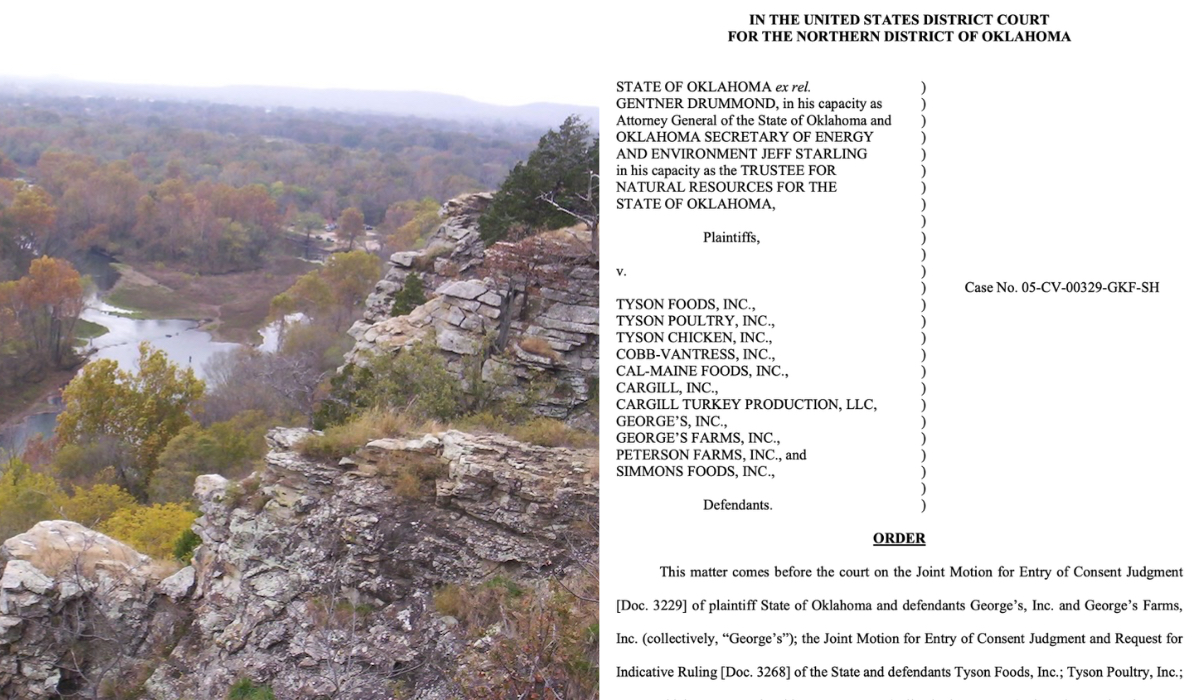
U.S. District Court for the Northern District of Oklahoma Judge Gregory Frizzell cited several reasons for denying the settlement between Attorney General Gentner Drummond and the companies, which include Tyson Foods, Cobb-Vantress, Cargill, George’s and Peterson Farms. Cal-Maine Foods and Simmons Foods are also defendants, although they had not reached proposed settlements with the state.
In his April 8 ruling, Frizzell said the settlements with the other companies lacked sufficient funding to provide remediation for phosphorous pollution caused by chicken waste runoff into the watershed. Frizzell also said the proposed settlements did not hold those responsible for phosphorus pollution accountable through civil penalties, nor would the proposed settlements do enough to mitigate ongoing pollution from chicken farming operations. Noting that remediation could take at least 30 years, Frizzell also said the proposed duration of the arrangements would not be long enough to address existing issues.
The state has been litigating with the poultry companies since 2005. In a 2023 ruling, Frizzell agreed with the state that the companies had engaged in pollution of the watershed through their poultry-producing operations and litter-disposal practices in northeastern Oklahoma.
“The court directed the parties ‘to meet and attempt to reach an agreement with regard to remedies to be imposed in this action,'” Frizzell wrote in his April 8 order, which quoted his 2023 ruling. “The court advised that ‘the agreed remedies, if any, must be approved by the court,’ and ‘in the event the parties were unable to reach an accord, the court shall enter judgment.'”
The companies began to engage in mediation with the state following the 2023 ruling but did not reach any settlements until after Frizzell’s December 2025 judgement, which outlined remediation plans and civil penalties.
“The parties conferred for months but were unable to independently reach a resolution. The parties next requested mediation before (now-retired) Judge (Deanell) Tacha, which the court so directed. Again, the parties were unable to reach a resolution. As late as Nov. 5, 2025, the state indicated that the parties were engaged in ‘ongoing settlement negotiations.’ Yet, no resolution was reached as to any party until after entry of the judgment,” Frizzell wrote. “Had the parties truly wished to reach a negotiated resolution of this matter without regard to outcome, such agreement could have been reached at any time in the nearly three years between the court’s findings of fact and conclusions of law and the judgment. The parties’ failure to do so suggests they ‘rolled the dice’ and now seek to erase the result of that gamble through vacatur.”
On Tuesday, Drummond had publicly asked Frizzell to approve the settlements, warning a further delay “risks unraveling agreements that took months of good-faith negotiations to reach.
“Cargill, George’s, Peterson Farms and Tyson did the right thing,” Drummond said in a press release Tuesday. “They came to the table and worked hard to reach agreements that will deliver real remediation to the Illinois River Watershed. The court owes it to the people of Oklahoma to approve these agreements without delay. The door to a fair and reasonable settlement remains open to the hold-out defendants, Simmons and Cal-Maine, as well. Their co-defendants found a path forward. They should too.”
Frizzell, however, disagreed Wednesday, concluding his 20-page order with additional reasons for his rejection of the settlements.
“The proposed consent judgments would fail to adequately fund the duties of the special master contemplated by those agreements. Nor would the special master be adequately equipped to ensure the settling defendants’ compliance with the litter removal commitments, as the proposed consent judgments include no staffing or administrative provisions,” Frizzell wrote. “The settling defendants would pay a total of only $1.325 million to fund seven to 10 years of the special master’s responsibilities to monitor compliance with litter removal requirements over the million-acre watershed. Once those monies are depleted, it appears likely that Oklahoma taxpayers would be paying the special master’s fees and expenses.”
Settlement rejection spurs calls to drop case

Wednesday’s decision by Frizzell drew reactions from politicians who have criticized the ongoing poultry lawsuit, which was filed by former Attorney General Drew Edmondson two decades ago.
“My heart goes out to the poultry growers in eastern Oklahoma,” Gov. Kevin Stitt said in a tweet. “The uncertainty they face is unimaginable, and it was preventable if Attorney General Drummond had simply withdrawn from this 20-year-old Democrat lawsuit.”
Rep. David Hardin (R-Stilwell) said the settlement rejections are cause for the state to drop its lawsuit against the poultry producers.
“With the court declining to move those agreements forward, the uncertainty surrounding this case continues, and it’s being felt most by the families who rely on poultry production to make a living. In eastern Oklahoma, poultry growers are family operations that have made significant investments and taken on real financial risk. Without long-term certainty, many of them are now facing difficult decisions about whether they can continue operating,” Hardin said in a press release. “At this point, I believe it is appropriate to reevaluate the direction of this case. I am urging the attorney general to consider withdrawing the lawsuit so we can prevent further economic strain on rural communities and avoid pushing more families to the brink.”
While farmers face economic strain, the watershed faces an ecological one. The court previously found there were about 363,531 tons of chicken scratch produced within the watershed in 2023, with “the majority” reapplied back to the land. Runoff causes elevated phosphorous, arsenic, copper and zinc levels, which in turn kill wildlife and pollute one of eastern Oklahoma’s drinking water sources. From an aesthetic standpoint, the pollution has had visible effects on Tenkiller Ferry Lake, a popular summertime tourism destination once advertised as Oklahoma’s clearest body of water.
Sen. Tom Woods (R-Westville) called the rejection of the settlements “incredibly disheartening.”
“I have heard directly from poultry producers across our region about the challenges, stress, financial strain and uncertainty they have faced while navigating this prolonged lawsuit. The proposed settlements would have offered security and stability to these farmers after more than 20 years,” Woods said in a press release. “Without resolution, many poultry growers will again be forced to make difficult decisions about the future of their farms, which will ultimately result in ceased operations in the state and detriment to our local economies.”
Drummond had been touting the settlements earlier this year. In a press release Feb. 12, Drummond announced he had reached the agreement with Tyson and Cargill.
“For over two decades, Oklahoma has fought to protect the Illinois River Watershed and the natural resources that sustain our communities,” Drummond said. “The decision to settle by Tyson and Cargill makes one thing unmistakably clear: Corporate accountability is not optional, and protecting Oklahoma’s water can, and must, go hand in hand with a strong poultry and agricultural industry. These settlements provide a path to move forward together, giving certainty for growers, protecting jobs and safeguarding Oklahoma’s waters for future generations.”
On Jan. 14, Drummond announced a settlement with producer George’s Foods.
“This settlement demonstrates that fair, good-faith negotiations can produce outcomes that serve everyone’s interests — protecting Oklahoma’s water resources while respecting the economic realities facing our agricultural partners,” Drummond said. “George’s willingness to come to the table and work toward meaningful remediation, rather than prolonged litigation, reflects the kind of responsible corporate citizenship I hope to see from all parties in this case. I remain committed to working with all parties to achieve comprehensive solutions for the Illinois River Watershed while preserving the economic vitality of Oklahoma’s poultry producers.”
A spokesperson for Drummond’s said he was disappointed by Frizzell’s decision, which she said will be appealed.
“These agreements followed months of good-faith negotiations and would have delivered more than $31 million to address poultry litter pollution in the Illinois River Watershed,” said Leslie Berger, Drummond’s press secretary. “Our focus remains on securing fair and reasonable agreements, a focus shared by all four of the settling defendants in this case. Cargill, George’s, Peterson Farms and Tyson have already filed appeals of the court’s decision. They expressed their commitment to finalizing the settlements regardless of the outcome, including by private settlement if necessary.”