

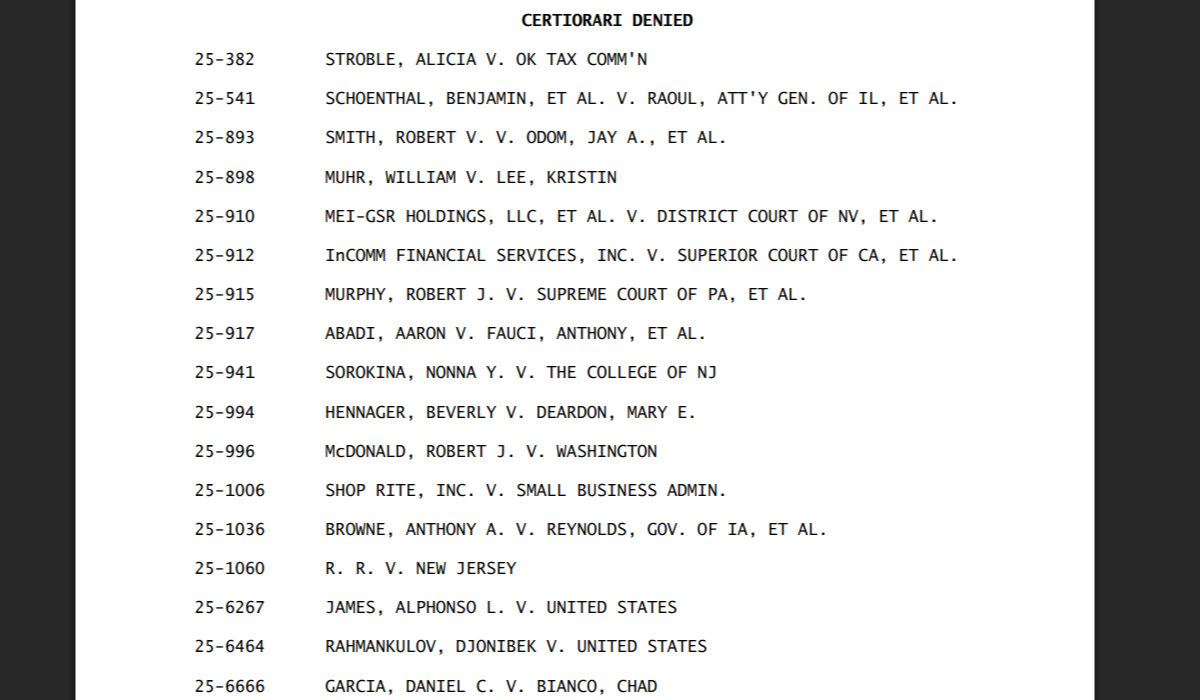

The U.S. Supreme Court today declined to hear Stroble v. Oklahoma Tax Commission, leaving the Oklahoma Supreme Court’s controversial ruling on income tax jurisdiction intact.
On the first day of Oklahoma’s Fiscal Year 2026, the state’s highest court ruled Alicia Stroble — a Muscogee citizen who resides within the Muscogee Reservation and works for the Muscogee Nation — is subject to state income taxation. Oklahoma’s justices ruled against Stroble despite the U.S. Supreme Court’s precedent in McClanahan v. Arizona State Tax Commission, which historically exempted similarly situated tribal citizens in Indian Country from state income taxation.
At its core, the Oklahoma high court’s decision reinforced the unusual dynamic created by the 2020 SCOTUS decision in McGirt v. Oklahoma: Eastern Oklahoma is a series of Indian Country reservations for purposes of criminal jurisdiction but not — mostly — for civil jurisdiction.
“The issue presented is whether the state has jurisdiction to impose income taxes on a tribal member who resides and works for the tribe within the boundaries of the tribe’s reservation as recognized in McGirt,” the Oklahoma Supreme Court’s per curiam opinion read. “McGirt declared the reservation status of the land at issue. The United States Supreme Court determined that because the land was reservation land, it constituted ‘Indian Country’ for purposes of the Major Crimes Act. Therefore, the state was without jurisdiction to prosecute certain crimes committed by an Indian on the reservation. Stroble is asking this court to extend McGirt to civil and regulatory law — to find the state is without jurisdiction to tax the income of a tribal member living and working on the tribe’s reservation. This we cannot do.”
Stroble had requested the U.S. Supreme Court to review the state court ruling. The Five Tribes — the Cherokee, Choctaw, Chickasaw, Muscogee and Seminole nations — filed briefs in support, while the Oklahoma Tax Commission asked the court to revisit McGirt itself if it considered the situation at all.
In the legal world, the SCOTUS’ denial of certiorari does not constitute precedent that would overturn McClanahan, but it does leave many questions as to how the U.S. Supreme Court views the status of its tax jurisprudence. Prior to the denial of certiorari, McClanahan was generally understood to support the rule that “a state has no jurisdiction to impose a tax on income of Indians residing on their tribe’s reservations whose income is wholly derived from reservation sources.”
Monday’s denial could signal the current court is willing to read McClanahan more narrowly, perhaps as only applying to the reservation at issue in that case, the Navajo Reservation. If so, other states could follow Oklahoma’s lead and attempt to impose income tax on tribally employed Indigenous Americans living within reservations that were previously considered exempt. Such a move would almost certainly draw legal challenges from the affected tribes. Alternatively, Monday’s decision not to hear the Stroble case could signal the court may believe there is an exception to normal civil jurisdiction rules only in Oklahoma.
Whatever the reasoning, scholars and Oklahoma tribal attorneys will have to adapt to a shifting legal landscape in the field of Indian law after Supreme Court justices failed to reach the four votes needed to take up Stroble’s case, thereby leaving the Oklahoma Supreme Court’s ruling as the law of the land.
Gov. Kevin Stitt praised Monday’s denial of certiorari and recent court rulings upholding state jurisdiction, while arguing the alternative would constitute race-based policies.
“This is about fairness for all 4 million Oklahomans,” Stitt said. “Time and time again, the courts have limited the McGirt decision, rightfully upholding state jurisdiction. This decision made it clear that someone’s tax bill will not be based on their race.”
Stitt’s framing of the question as one about “race” has continued to irritate some tribal citizens. The U.S. Supreme Court’s 1974 decision in Morton v. Mancari held preferences based on tribal status in the Bureau of Indian Affairs’ hiring practices were not “racial preferences,” instead describing the relationship as “political rather than racial in nature.” The case is often cited to support the premise tribal citizenship is a political category, instead of a racial classification.
To that end, the local dynamics of Stroble’s case posed a complicated question well beyond race: Would tribal citizens living in and working for their tribes in eastern Oklahoma be exempt from state income tax while tribal citizens living in and working for their tribes in western Oklahoma be required to pay state income tax?
While the Supreme Court denied Stroble’s petition, Muscogee Nation Principal Chief David Hill said the tribe is exploring additional options to challenge the state’s newfound income taxation authority. He also denounced Stitt’s framing of the tribal citizenship as a “racial preference” question:
We had hoped the U.S. Supreme Court would step in to address an egregiously wrong Oklahoma Supreme Court decision that disregards decades of settled federal law. While the court declined review, the matter is far from resolved.
Federal law governing state taxation of Indians is clear and has been reaffirmed repeatedly over time. When a state court ignores that law, it undermines legal certainty and invites confusion and conflict. That is not acceptable for tribal citizens, and it is not acceptable for the state of Oklahoma.
We are reviewing all available options, including seeking a remedy in federal court. The Muscogee (Creek) Nation will continue to stand up for its citizens and for the principle that law applies equally — regardless of political agendas. Recent attempts by Gov. Kevin Stitt to characterize these long-established legal protections as a “racial preference'” are simply false. The United States Supreme Court has made it abundantly clear that tribal citizenship is a political classification, not a racial one. Tribal nations are diverse, with citizens of many races and backgrounds. What unites our citizens is citizenship in a sovereign tribal nation, not race. The state of Oklahoma’s ongoing pattern of selectively complying with settled law poses a danger to all Oklahomans. The rule of law cannot be optional.