


ADA — As lawmakers weigh a sweeping “reset” aimed at funding education efforts, the Tobacco Settlement Endowment Trust’s director submitted her resignation Thursday, while the potential state question’s House author is asking Senate leaders to keep their word and send the idea to a vote of the people.
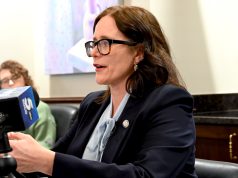
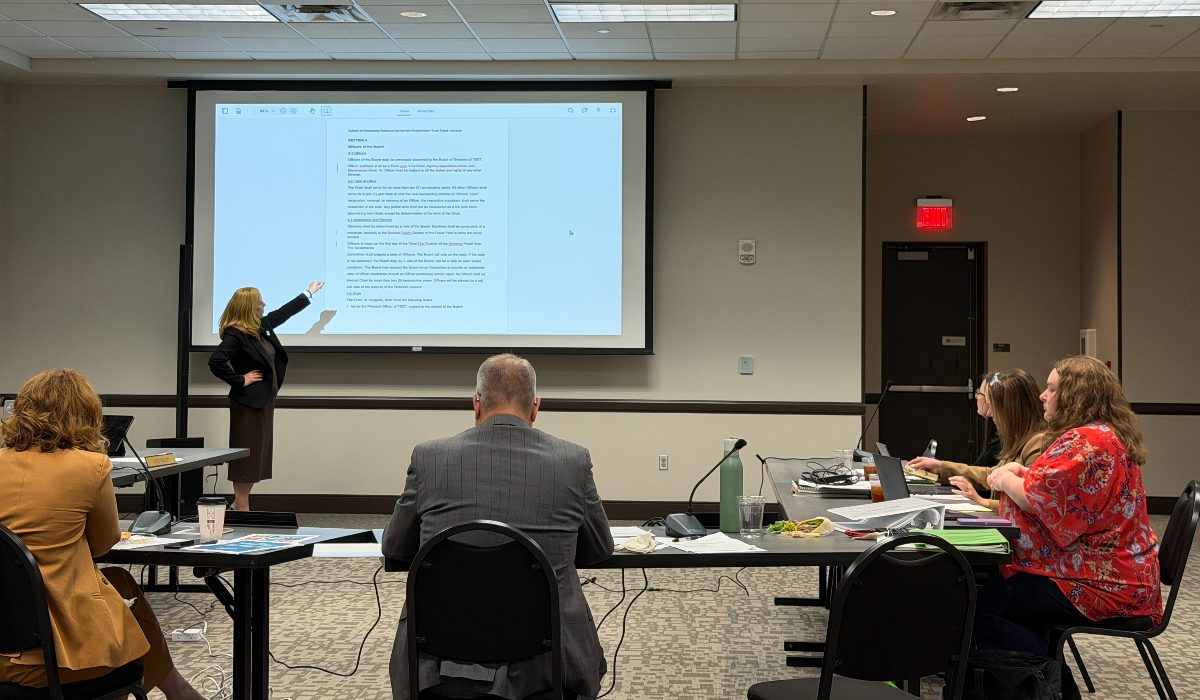
TSET executive director Julie Bisbee told board members during their meeting held on the campus of East Central University that her last day with the agency would be April 24. A former journalist, Bisbee joined TSET in 2012 and has served as executive director since 2019.
“I have been at the agency for 14 years, which is nearly half of the life of the agency, so I’m really proud of the things that we’ve done to move from what was a very small grantee budget and a very small staff to the next level,” Bisbee said.
With TSET’s grantmaking expanded and its portfolio diversified, Bisbee said her mental list of what she set out to accomplish as executive director is complete and that the board has met and exceeded goals that have been set.
“We have built a top-notch team and an agency that is ready to take on the challenge,” Bisbee said.
Following an executive session, the board voted to accept Bisbee’s resignation and appoint TSET chief of staff Lance Thomas to serve as interim director while a search for a permanent director is conducted. Thomas joined TSET in 2009 and has served as chief of staff since 2023.
“Lance has been a steady and trusted voice in this agency for years,” TSET Board Chairman Ken Rowe said in a press release. “He knows this work, he knows this team, and he knows what the board is trying to accomplish. The mission is in good hands.”
Caldwell: Senate leadership ‘should keep their word and deliver the budget’

As TSET’s public profile and $2.2 billion endowment have grown over the last 25 years, so have efforts to reform its constitutionally defined activities. Questions about whether TSET’s annual funding decisions and advertising campaigns produce an adequate return on investment have long lingered.
To that end, Bisbee and Thomas have defended the agency’s reputation for years, with Bisbee serving as director of communications when TSET’s board announced — and then abandoned — a controversial 2016 decision to create a CEO position. The board had offered to pay former Corporation Commissioner Patrice Douglas a $250,000 salary to lead the agency while state revenues sagged and other departments absorbed funding cuts.
In 2018, as legislators grasped at straws to avoid raising the taxes that ultimately plugged the budget hole, Bisbee pushed back against a critical press release from then-Rep. Kevin Calvey, noting no TSET funding was being spent — that fiscal year — on billboards and that a program encouraging bar owners to make their establishments smoke-free did not constitute “funding programs at strip clubs.”
In 2020, lawmakers created a ballot question to redirect 75 percent of tobacco companies’ roughly $70 million in annual settlement payments from TSET toward the costs of Medicaid expansion, but nearly 59 percent of Oklahoma voters rejected SQ 814.
Last year, when word spread that TSET had an additional $150 million of investment earnings at its disposal, House Speaker Kyle Hilbert (R-Bristow) told media the agency had indicated a willingness to help fund the University of Oklahoma’s new pediatric heart hospital. When Bisbee said no such offer had been made, Republican legislative leaders grew irritated with a perceived unwillingness to meet them halfway on a project directly tied to TSET’s mission and Oklahoma health outcomes.
RELATED
Caldwell seeks ‘TSET reset’ to expand OHLAP, but some concerned by Kevin Eagleson & Tres Savage

With TSET saying OU’s hospital project could apply for funding like everyone else, House Appropriations and Budget Committee Chairman Trey Caldwell ran a bill to make the agency’s board members serve at the pleasure of their seven separate appointing authorities. TSET sued to block Caldwell’s bill and won, with Oklahoma’s Supreme Court saying legislators should propose all changes for the constitutionally constructed trust fund to voters at large.
“(The) Supreme Court said we need to take it back to the voters, and that is what we are going to do,” Caldwell (R-Lawton) said last month while describing his House Joint Resolution 1077, which he said was brainstormed over lunch with Senate Appropriations and Budget Committee Chairman Chuck Hall after a groundbreaking for the Stephenson Cancer Center in Tulsa.
Under Caldwell’s “TSET reset” plan, HJR 1077 would eliminate the grantmaking agency, retain its protected endowment and redirect annual revenues to a doubling of tuition-free college access and vocational training for young Oklahomans. As the endowment reaches $3 billion within a decade, additional TSET revenues would eventually flow into the state’s 1017 Fund, which provides major money for common education.
“It’s time to review, in 25 years, OK, is this still the best way to use this massive asset the state of Oklahoma has? Are we using it the best way?” Caldwell explained last month. “I’m going to ask the Oklahoma voters, which is a better use of this money: commercials, billboards, sidewalks? Or, eventually, every single kid in Oklahoma not having to worry about having crippling debt for the rest of their life from higher ed?”
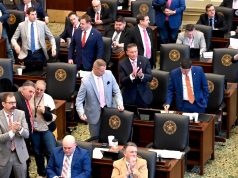
Caldwell has outlined the proposal in both HJR 1077 and HJR 1076, which would require supermajority support from legislators to achieve an Aug. 25 election date heavy on Republican runoff voters. Both versions passed the House late March 25, as did Caldwell’s HB 4003, which would create the “TSET Legacy Effort Revolving Fund” for the State Department of Health to receive millions for continuing some health initiatives currently funded by TSET.
When Republican legislators announced their proposed Fiscal Year 2027 budget deal Wednesday, Caldwell said sending the “TSET reset” proposal to state voters was part of the grand agreement among House leaders, Senate leaders and Gov. Kevin Stitt.
Hilbert, the House speaker, also said the “TSET reset” is part of the budget agreement negotiated by the three parties.
“Yes, that was part of the agreement, and part of what we discussed is that state question,” Hilbert told media Thursday. “”I know they’re discussing that (in the Senate), and it’s over in their possession now. We have state questions on our side too that they’ve sent us, and our members are currently vetting those.”
In his own media availability Thursday, Senate Pro Tempore Lonnie Paxton (R-Tuttle) said he supports Caldwell’s proposal, but he said the Senate will treat HJR 1077 and HJR 1076 like any other legislation that comes from the House and that “there is no guarantee that 25 senators agree to push that on to a vote of the people.”
“We will hear it in the Senate. We will work very hard to do it,” Paxton said. “I totally support the bill, and we’re pushing to get that done. There’s parts to it (where) a lot of senators are wanting to have discussions about, ‘Should the money be going to [the Oklahoma Higher Learning Access Program]? Should that be one of the things?’ There’s lots of discussions in there about where the money should go.”
Paxton said the biggest priority he has heard from his caucus is for the $2.2 billion TSET corpus to remain protected “and that is in no way accessible by a future Legislature.”
“The next thing we’re talking about is what to do with that revenue. So, the House’s idea — of course they’ve passed it — would put a big chunk of that into OHLAP,” Paxton said. “That’s a discussion we’re having right now. We have the bills, and we’re talking about them. We will probably amend parts of those and send them back to the House. It’s through a discussion with the House. It’s not like there’s a combative measure here. It’s just trying to find what’s best.”
Informed of Paxton’s comments, Caldwell emphasized Thursday that putting the “TSET reset” to a vote of the people was a part of the agreement announced the day prior.
“It is a part of the budget deal. That was part of the agreement that we agreed to. That was part of the budget,” Caldwell said. “And I had full faith in Chuck Hall and Lonnie Paxton to be able to keep their word and deliver the budget.”
To do that, however, Paxton and Hall will need at least 23 other votes in a divided Senate where the body’s most conservative members — like Sen. Randy Grellner — have clashed with their own party’s leadership on several fronts.
Grellner (R-Cushing) is a family physician who said Thursday that he doesn’t want the proposed state question to happen because TSET does too many good things and is “non-political.”
“We’ve got nursing programs, residency programs and family medicine that go back out and serve our rural patients,” Grellner said. “I think this is nothing more than, you know, a slush fund they want to get their hands into.”
Grellner said he believes Caldwell’s proposal is going to face a tough path in the Senate.
“I think there’s 25 people who will vote against this,” Grellner said. “The schedule came out for Monday — the agenda — and it’s not on there. So that tells you the whip count probably isn’t very good.”
Caldwell, who said his total proposal retains funding for health care outcomes and residencies, argued that the people of Oklahoma deserve a chance to decide where the TSET dollars go with oversight. He said his proposal asks Oklahomans to choose between expanding OHLAP and funding the Education Reform Revolving Fund, or to dedicate tens of millions of dollars toward sidewalks and advertisements telling people to drink more water.
“At the end of the day, I think the people of the state of Oklahoma should have the opportunity to have a say in how we handle one of the state’s largest assets,” Caldwell said. “I do agree that we need to protect it long term. That’s one of the first things we put in the piece legislation.”
Grellner, who said Oklahoma’s universities are “going to have to get their crap together” on a variety of fronts, said TSET representatives presented to the Rural Caucus on Tuesday and discussed how this year’s “reset” proposal stemmed from last year’s unfulfilled funding request.
“They told us in that meeting they met with one person out of the House — that’s all they met up with — and it was demands, demands, demands. And that’s not how it’s set up,” Grellner said. “Where are your smoking and chewing problems? Well, they’re all over in the state, but they really are probably worse in rural America, which is what they tell us. So they’re trying to follow their vision and their plan, and the Legislature handled it inappropriately or they probably would have gotten what they wanted.”
Caldwell said that if Grellner’s account of that conversation is accurate, it’s a problem.
“We’ve reached out a multitude of times to not only the administration at TSET but also to the board. Luckily, here recently, the board has been very facilitating in meeting with members of the Legislature,” Caldwell said. “We appreciate that. We have some really good board members that are on that board that are there for the right reasons. I don’t want to disparage them in any way, shape or form. I think they’re doing the best job they can with the information that they have. But it does not surprise me at all that they have chosen to go a different direction with their executive director and their administration.”
Caldwell’s “TSET reset” proposal recently drew the support of OU President Joe Harroz, who had initially expressed caution when asked about the idea Jan. 30. On March 24, Harroz noted that Texas has increased its state scholarship family income limit cap to $100,000. Caldwell has said the “TSET reset” could ultimately bump Oklahoma’s cap even higher than that.
“Health care is a huge priority. So is education,” Harroz said. “Obviously, we would love to have both, but I want to be clear: If we could move that (OHLAP eligibility cap) to $100,000 adjusted gross income, it would be a massive win on the education side.”
But Dr. Sumit Nanda, president of the Oklahoma State Medical Association, said policymakers should prioritize retaining TSET’s benefits.
“Voters have spoken on this issue twice, and each time they chose to protect TSET funds from legislative interference. For this reason, Oklahoma remains the only state in the nation to still have funds left from the 1998 Master Settlement Agreement with tobacco companies,” Nanda said in a statement. “Since its inception, TSET has worked to improve the health of Oklahomans — not only funding one of the most successful smoking cessation programs in the nation, but also supporting health programs throughout the state, vital scientific research and loan repayment for more than 150 rural physicians. At a time when health care is experiencing extraordinary funding cuts at the federal and state levels, Oklahoma needs TSET more than ever.”
Board approves projects, tables others
During Thursday’s board meeting, Bisbee provided an update on TSET-related bills in the Legislature, including those that did not advance before a recent deadline:
- HJR 1050 would have created a state question asking voters to amend the constitution and decrease the term period for board members and to authorize their appointing authorities to remove members at will.
- SJR 38 would have created a state question asking voters to require TSET to divest 5 percent of assets and proceeds into into the Health Care Enhancement Fund.
“So last week was very busy at the Capitol with the deadlines,” Bisbee said.
After hearing proposals from the University of Oklahoma’s Health Promotion Research Center and Oklahoma State University’s Project ECHO, the TSET board approved $973,369 worth of fitness projects in Tulsa and Rogers County.
The board then voted to table more than $5.5 million worth of statewide projects, including several walkways and trails and $300,000 proposed to “enhance the children’s playground by adding safety and accessibility amenities” for the Uncommon Ground Sculpture Park in Edmond.
The board approved school district project grants worth $523,201 and a $100,000 grant to the City of Edmond “for improvements at Hafer Park to increase accessible outdoor activity opportunities for the community.”
A total of eight previously approved projects saw their budgets reduced by a total of $503,464 for not using their total awards in Fiscal Year 2025.
Board members also approved a change to the TSET bylaws to allow officer elections to take place during the fourth quarter instead of the second quarter to allow terms to begin July 1. The change was intended “to allow transition and knowledge transfer.”
(Update: This article was updated at 9:12 a.m. Friday, April 3, to include comment from Dr. Sumit Nanda.)