

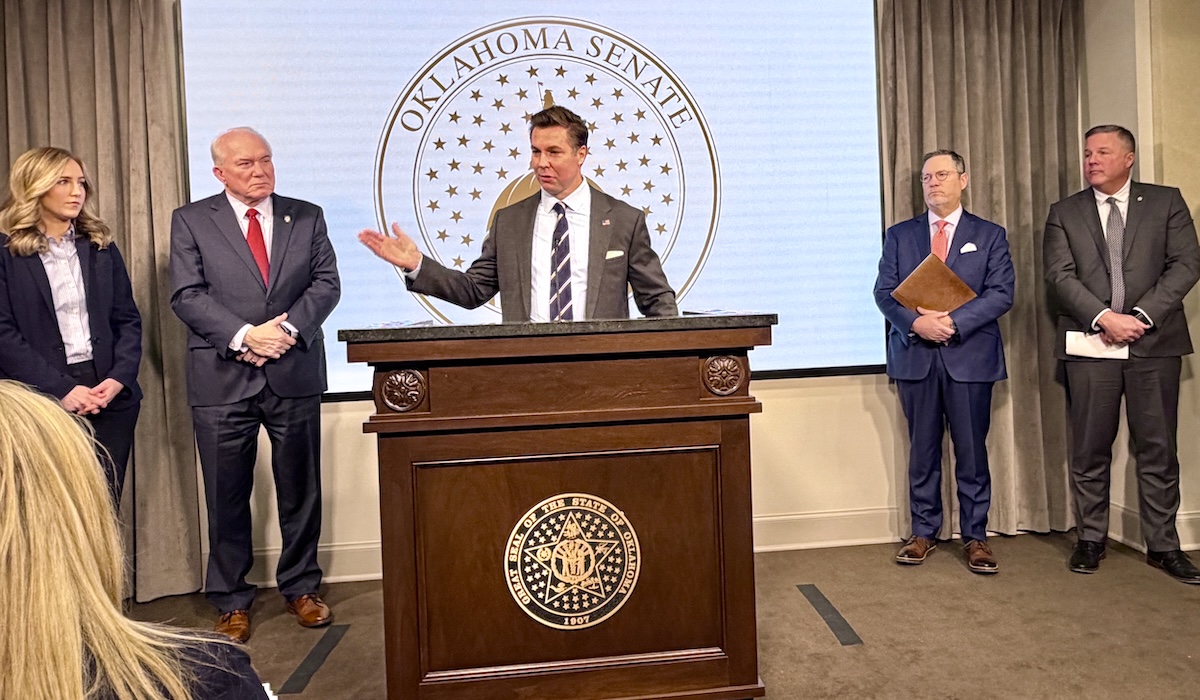

In an opening salvo between two chambers destined to debate public education issues during the year’s legislative session, Senate Republican Caucus leaders unveiled a proposal to cap Teachers’ Retirement System deposits and redirect $254 million toward a $2,500 across-the-board teacher pay raise, math and reading resources and an expansion of the Parental Choice Tax Credit.
Acknowledging the tight pecuniary picture facing lawmakers for Fiscal Year 2027, Senate Education Chairman Adam Pugh (R-Edmond) praised his caucus’ proposal for how it would “maintain revenue neutrality” yet still “allow for another significant investment.”
“We didn’t just file bills and hope that we could find some dollars in the couch cushions,” Pugh said at a press conference Tuesday.
Under the Senate proposal, more than half of Oklahoma’s off-the-top sales tax and income tax revenue apportionments dedicated to shoring up the Teachers Retirement System would be rededicated into the state’s funding equalization formula, expansion of the Parental Choice Tax Credit and a buffet of targeted instructional investments.
“If we want to increase educational outcomes across Oklahoma, not only do we need a plan, but we need to invest in the people that implement that plan,” Pugh said.
As always, however, the devil lives in legislative details, and House leaders hinted Tuesday afternoon that certain components of the Senate proposal would seem to pose problems.
For instance, Pugh said the Senate’s plan would not provide additional funding to off-formula school districts, a sore spot between the chambers over the last two years. Depending upon how legislative language is written, some of those districts can face mandates to raise their teacher pay without additional funding provided by the state, a position the House has opposed in the past.
Asked if he had already presented the proposal to his House counterpart after being spotted roaming House hallways Monday, Senate Appropriations and Budget Committee Chairman Chuck Hall kept his cards close to the vest.
“He thanked me for giving him a heads up and received the report,” said Hall (R-Perry).
Hall’s counterpart, House Appropriations and Budget Committee Chairman Trey Caldwell was quick to the point Tuesday, saying the House was trying to “fully digest this omnibus Adam Pugh plan.”
“We are just now seeing the full extent of how they want to rob Peter to pay Paul,” said Caldwell (R-Lawton). “So we will definitely review it and look at it and take it into consideration. It is a great starting point of negotiations.”
Hall said he asked his team for creative funding solutions that could support education while not growing government, and he said an evaluation of the Teachers’ Retirement System apportionment completed by his vice chairman, Sen. John Haste (R-Broken Arrow), became the cornerstone of the plan.
“The proposal will not decrease the more than $25 billion currently held in assets at [the Teachers’ Retirement System] or affect the money paid out to our retirees each year,” Hall said. “That is roughly $1.7 billion in the most immediate last year that was paid out in benefits, and it still helps to prop up the system financially to the tune of $200 million each year. So we will continue to provide extra dollars and grow the fund. The plan caps extra TRS deposits to $200 million, which frees up $254 million.”
The TRS serves approximately 70,000 retirees, according to Hall, who said the system is and should be strong after being “one of the most poorly funded state pensions” decades ago. He said the TRS investment portfolio has an “annualized five-year return of over 10 percent” and that benefits would not be cut.
Offering an initial reaction to the proposal, House Common Education Committee Chairman Dick Lowe, a retired teacher, expressed skepticism about the Senate’s proposal to reduce annual TRS funding.
“We are finally at the (funded ratio) 80 percent mark. We have been working for years to get there,” said Lowe (R-Amber). “I think the retired teachers in Oklahoma may not enjoy that.”
Lowe said the Senate’s proposal would mark the first time — that he is aware of — that an investment in a pension fund would be redirected. But Hall claimed the TRS would remain above 80 percent in terms of its funding ratio, the improvement of which is one of the most notable accomplishments of legislative Republicans after they took control of the chambers in the last 20-plus years.
COLA, off-formula funding questions loom
Tension between the two chambers could increase as House members digest a plan to raise annual teacher pay “across the board” by $2,500. Pugh and Hall said doing so would cost about $117 million, a figure that does not include additional flex benefit obligations or separate money to help off-formula schools avoid an unfunded mandate.
“I represent several schools that are off formula,” Lowe said, referencing a pain point in the Legislature’s recent school funding increases. “My school has been eating (it). I do not know how much more they can continue to eat, being forced to spend their money in that way. We always hear they are rich schools. Some are not. Some are just barely off formula.”
Asked about school districts with high enough local property tax funding that they do not qualify for state equalization formula dollars, Pugh argued the “vast majority, especially those off-the-formula schools, are already paying above the minimum salary schedule.”
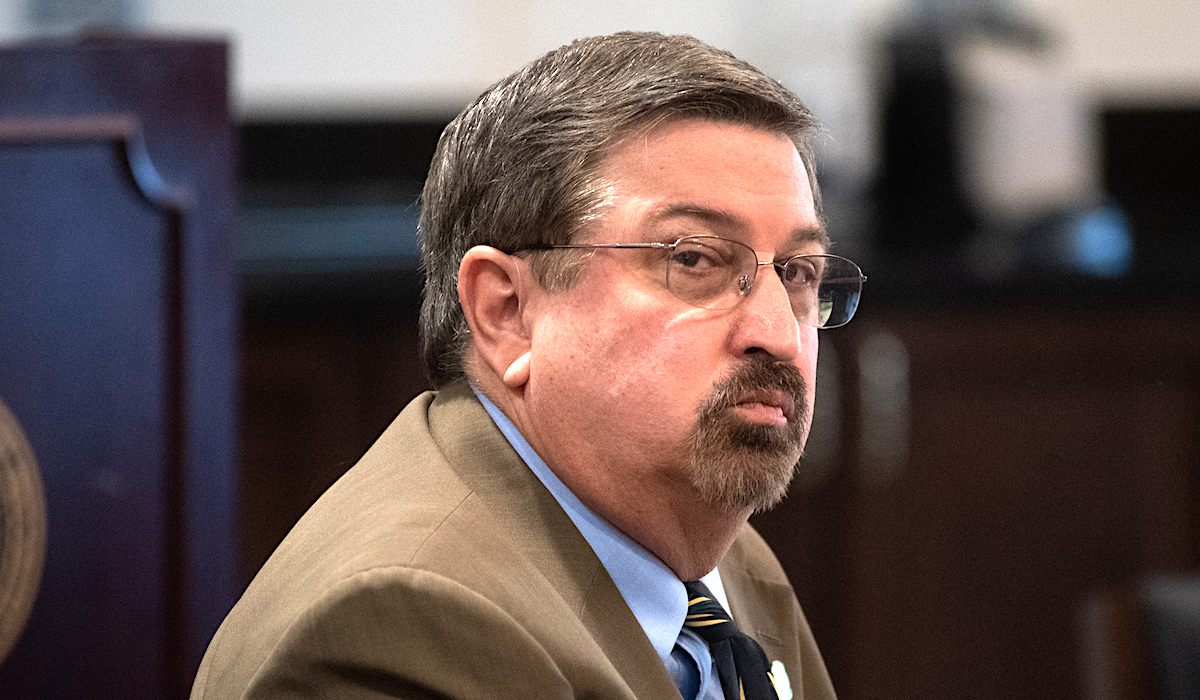
In a statement reacting to his Republican colleagues’ proposal, Sen. Mark Mann (D-OKC) shared concern about taking money from the TRS and how it would impact retirees’ benefits.
“We are confident this will put a [cost of living adjustment] for retired educators at risk,” Mann said.
Asked to raise their hands if they support a cost of living adjustment — or COLA — for retired teachers this session, Pugh was the only senator of the six in attendance who fully committed, and Haste slightly raised his hand. But when Senate President Pro Tempore Lonnie Paxton made his way to the podium, he said he anticipates further conversation on the topic for all state pension systems.
“There are multiple bills in every pension rolling through the system right now about COLAs and everything else that goes along with it,” Paxton (R-Tuttle) said. “That is all still being looked at. (…) All those bills are still alive, they are still working their way through the system. But we are not backing off (the) state’s extra contribution to keep that system strong. We, in fact, are continuing that, just lowering the level a little bit.”
Some lawmakers were surprised to learn that retired educators had not received a COLA since 2020. The 2020 COLA was tiered at 0 percent for those who had been retired for two years or less, 2 percent for those retired for two to five years and 4 percent for those who had been retired for more than five years. A COLA was also passed in 2008.
Proposals for cost of living adjustments typically take a two-year process. Requests for an actuarial analysis are commonly sent during odd-numbered years, with legislation moving in even-numbered years. HB 1904, which seeks a 50 percent increase in monthly benefits for retirees whose original benefit was capped at $25,000, is working its way through the Capitol, having received two committee substitute proposals in recent weeks.
The legislation was sent to an actuary in May, but the committee substitute filed Feb. 16 adds a nonfiscal retirement bill amendment, which could allow it to bypass actuarial analysis requirements.
House Appropriations and Budget Vice Chairman John Kane (R-Collinsville) said he does not believe anything currently floating around the Capitol would take away from the possibility of passing a COLA.
Senate plan seeks reading resources
An early sticking point in negotiations around education has been the divergence in reading retention preferences between Pugh and House Speaker Kyle Hilbert (R-Bristow). Both are running comprehensive reforms to the Strong Readers Act.
While Hilbert’s and Pugh’s legislation align on the number of literacy screeners approved by the state and the need for an expansion of the literacy coaching network known as HEROES, the most significant divergence has been on how retention — arguably the most controversial component of reform efforts — should take place. Pugh favors transitional classes and intensive intervention for struggling readers in first and second grade, saving retention for third grade.
“While we have third-grade retention, we want to identify and intervene significantly earlier. By third grade, it is too late, and that is kind of the ‘break glass in case of emergency’ option,” Pugh said about his SB 1778, which advanced through the Senate Education Committee with a committee substitute after Tuesday’s press conference.
Pugh noted in Tuesday’s press conference that the new version of his bill included stronger retention requirements than prior versions.
Hilbert’s legislation, HB 4420, includes a stronger retention mechanism that enables retention in first and second grade if a reading proficiency team deems it appropriate, with mandatory retention of struggling readers in third grade that do not qualify for a good cause exemption.
The Senate proposal includes $67.7 million in funding for reading resources, such as an additional $50 million toward the Strong Readers Act formulary.
“The impact to schools is that the amount of money that they get through the Strong Readers Act formularly would triple,” Pugh said.
Pugh said another difference is that his legislation would address teacher preparation programs. He said not all teacher preparation programs are readying future educators for science of reading instruction.
Kane said literacy education remains a priority, and he seemed somewhat open to considering a change to the TRS’ apportionment funding to support education initiatives.
“We are trying to pull every lever we can to make sure we can fund that, and this looks like a possibility since we put that money in every year,” Kane said. “On the same token, I mean, I am a pension protector. I know where we used to be in pensions, and I do not want to see it go the other way. I think there is an opportunity here (that) everybody wins.”
The proposal also seeks $10 million for math coaches and curriculum. Senate Education Vice Chairwoman Ally Seifried (R-Claremore) has been championing math reform alongside Pugh’s literacy reforms. Her legislation, SB 1360, would establish a three-year pilot program for math instructional coaches similar to the HEROES program.
“We have to be able to bifurcate these policy areas, because we know that reading is the foundation of educational attainment. These students are going to enter a very high-tech, fast-paced workforce and inherit an economy that is going to require some nature of STEM skills, and that has to start with numeracy skills as early as possible,” Pugh said.
The Senate’s education plan additionally proposes a $29.8 million infusion to the school funding formula beyond the teacher pay raise component.
The plan also calls for an increase to the Parental Choice Tax Credit funding cap and an infusion of $25 million. Pugh said doing so could allow up to 7,000 new students to enter the program, which has been criticized for primarily supporting higher-income families.
While Paxton emphasized that his team’s proposal totals a 10-to-one ratio of public school funding versus the tax credit, Sen. Carri Hicks (D-OKC) said taxpayer dollars belong in public schools with transparency and legislative oversight.
“This package raises the amount of public dollars going to the private school voucher scheme to $275 million dollars, and we know the vast majority of that is going to wealthy people that already had their kids in private school,” Hicks said.