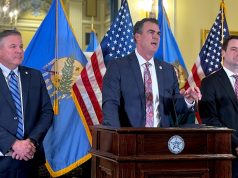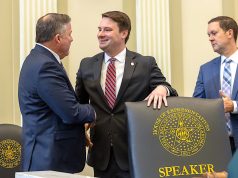


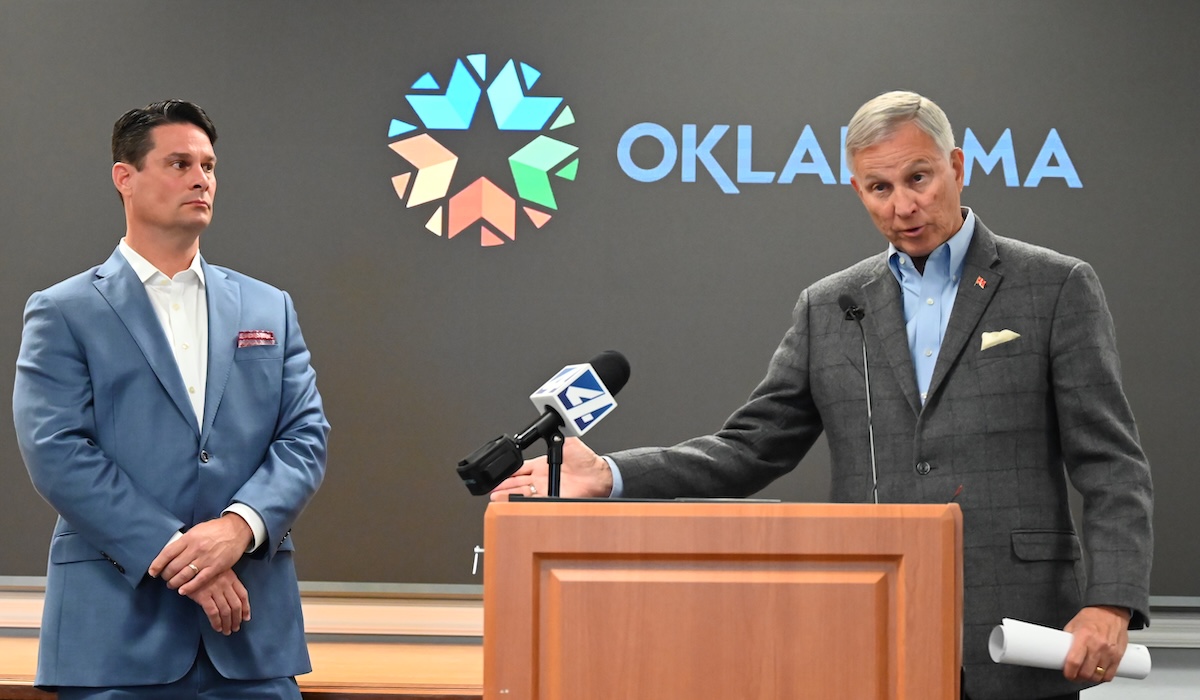

At a press conference announced and held Tuesday morning — the second day of a legislative deadline week — a trio of Gov. Kevin Stitt’s agency leaders made a public request that lawmakers write a bill allowing the State Department of Health to absorb the Department of Mental Health and Substance Abuse Services by the end of the calendar year.
Secretary of Health Clay Bullard acknowledged that the Oklahoma Health Care Authority, for which he serves as director, faces a cash flow crisis and has requested $494 million of additional appropriations for next fiscal year. That crisis, he said, has been exacerbated because ODMHSAS sits for the second year in a row unable to pay back the authority what it owes in Title XIX Medicaid dollars owing to its own budget crisis.
When he began examining ways to prevent the recurring issues OHCA faces in working with ODMHSAS, Bullard said he came up with what he originally called the “Reaffiliation of DMH Plan,” a “three-headed plan” to absorb almost all of the department’s operations into the State Department of Health.
“This is something I presented to the Legislature back in November with, actually, to my surprise, great acceptance and with more comments than not of, ‘We’ve been talking about this for years, maybe this plan will work.’ And so in direct conversations — and a good conversation with the speaker, in particular — it was, ‘I think we can probably do this. The timing may not be right, but we’ve got to figure this out. This is something we talked about doing last year when we had a budget crisis and years prior to that,'” Bullard said. “So I appreciate his candor on that and his willingness to do that.”
House Speaker Kyle Hilbert’s “willingness to do that,” however, remains to be seen. Bullard said he has hoped the plan would be implemented by the end of 2026, but legislative leaders have been barreling toward an early budget agreement with existing concerns that the $494 million supposed shortfall Bullard has asked them to fill for Fiscal Year 2027 isn’t even an accurate number.
Concern that lawmakers may only offer OHCA half of that figure reportedly spurred a meeting with hospital leaders and other medical providers Monday, according to several people with knowledge of the situation. It’s possible that culminating conversations about a final FY 2027 budget agreement led to Tuesday’s sudden press conference calling for agency consolidation.
Asked if any legislator has expressed interest in carrying a bill to divide ODMHSAS up and place many of its responsibilities under the OHCA and OSDH, Bullard said he had not found one.
“No, I’ve not heard of a legislator who has drafted that or has said that they will offer that or carry that,” Bullard said. “So that’s our ask right now, is that somebody will do that, and that we’ll have that process.”
Hilbert himself seemed caught off guard by Tuesday’s presser. Asked if Hilbert (R-Bristow) had any reaction to the proposal or whether he intended to carry legislation to fulfill it, press secretary Caroline Estes signaled his support for a portion of the plan but surprise about the press conference’s timing.
“As Speaker Hilbert noted in a public press conference last spring, he believes and supports that Title 19 funds should be managed by the Oklahoma Health Care Authority,” Estes said. “However, he has not had a recent conversation with Secretary Bullard and first learned of the press conference just this morning.”
Several other leading legislators also expressed surprise about Tuesday’s abrupt press conference, for which many people scrambled to find a livestream in hopes of learning exactly what Stitt’s agency heads were saying.
House Majority Leader Mark Lawson, who co-chairs a special committee dedicated to reviewing ODMHSAS’ finances, seemed amenable to the idea of consolidating operations under OSDH, although he stressed that all power to make such changes rests with the Legislature.
“I think the Legislature is still very much interested. The House is certainly interested in a healthy Department of Mental Health and providing quality service to people who need it,” said Lawson (R-Sapulpa). “I would just remind everybody that we make law in the legislative branch of government, and we certainly are willing to work with the executive branch in carrying out that law. But yes, we retain our right to make policy decisions and funding decisions, as the Constitution prescribes to us.”
Lawson said he was “reluctant to discuss” the proposal at much depth, as he had not received its specific details — a point of frustration among his colleagues.
“It’s premature to say anything is a done deal,” Lawson said. “In no way is the Legislature willing to relinquish its constitutional authority of creating public policy. And if policy changes need to be made and funding decisions need to be made, we are going to be a part of that.”
Lawson also said he did not know the governor’s agency heads would be touting some sort of plan before they did so publicly Tuesday.
“I am unaware of any agreement between the House and the Senate, let alone the legislative and executive branches of government, as to what changes need to be made in the mental health space. So again, I’m not saying that I support what’s been proposed. I’m not saying I don’t support it. I haven’t heard it yet,” Lawson said. “I have not been privy to any conversations to fundamentally change how we administer mental health services in the state of Oklahoma.”
Bullard suggests ‘three-headed’ approach to absorbing ODMHSAS

After he was appointed to his position in October, Bullard said he began speaking with ODMHSAS interim Commissioner Gregory Slavonic and formulating the “reaffiliation plan” in his first four to six weeks. However, in early February, Bullard’s team declined to discuss the idea when asked about it.
Six weeks later, Bullard outlined how the plan has three major components.
One is to “silo away” ODMHSAS’ forensic services division, which is dedicated to helping the department come into compliance with a consent decree to improve wait times for criminal defendants ordered to receive mental health competency restoration services. Another is to move “grants, administration and all non-facility personnel groupings” under OSDH’s purview.
“And so both the consent decree — the forensic services division — and the bulk of the services, if I can call it that, for the Department of Mental Health, [would] move over to the Department of Health,” Bullard said.
While the forensic services division dedicated to coming into compliance with the consent decree would be run by OSDH, competency services themselves would still be rendered by a stand-alone portion of ODMHSAS, Bullard said.
The third component would spell out the eventual transition of ODMHSAS’ state-run facilities to other operators. It was not immediately clear whether Bullard was suggesting those facilities would be operated in the private sector or under university health systems, but ODMHSAS is already reviewing responses to its request for proposals to privatize four state-run certified community behavioral health clinics. Unless all state-run facilities were privatized, the department would continue to exist with the sole purpose of running them, Bullard said.
“In the remainder of the calendar year ’26, yes, all [ODMHSAS] would be doing is overseeing the facilities, the actual physical facilities, and then the plan would be in the next legislative session to deal with that, however we can, whether that’s to maintain it — all they do is the facility management — or that we privatize those via an RFP or something like we did with the CCBHCs,” Bullard said. “It’s just — we continue to see the government is not great at managing facilities and large numbers of staff. Private companies can do that much better and can deliver services.”
Bullard also wants OSDH Commissioner of Health Keith Reed to serve in a dual role as ODMHSAS commissioner after the legislative session ends. Slavonic, a retired rear admiral in the U.S. Navy, took his post on an interim basis and has already stayed longer than he originally intended — a concession Slavonic made because Bullard “twisted his arm,” Bullard said. Slavonic now intends to end his tenure at the end of the legislative session.
“Once the gavel drops will be the admiral’s last day, and so therefore we will have no commissioner backfilling him. It’s not an easy job to recruit to whenever you sit there and you look at the fact that you have a new governor coming in in five or seven months, you have no back staff behind you, you have budget crisis problems, and you can imagine how the interview process goes whenever you start those conversations like that,” Bullard said. “So what we’ve asked is, inside of this mechanism bill, that we have a waiver for Commissioner Reed to be able to hold a dual role, dual agency role, just through the calendar year ’26 so that he can go over and start to stabilize that with his team, which is a very serious, long continuity.”
Reed said the dual role would enable him to understand ODMHSAS processes and programs better as the agency was absorbed by OSDH.
“Technically speaking, the way it stands now, you can’t hold dual office,” Reed said. “So this is just to request a temporary exception to that requirement to enable us to be in a position to get this transition more smoothly.”
Some OSDH officials have already begun offering their services to ODMHSAS. The Department of Health’s chief financial officer has been working with ODMHSAS “on loan,” and the department’s general counsel has been appointed head consultant on the team dedicated to consent decree compliance.
‘Deja vu’: ODMHSAS expands funding request
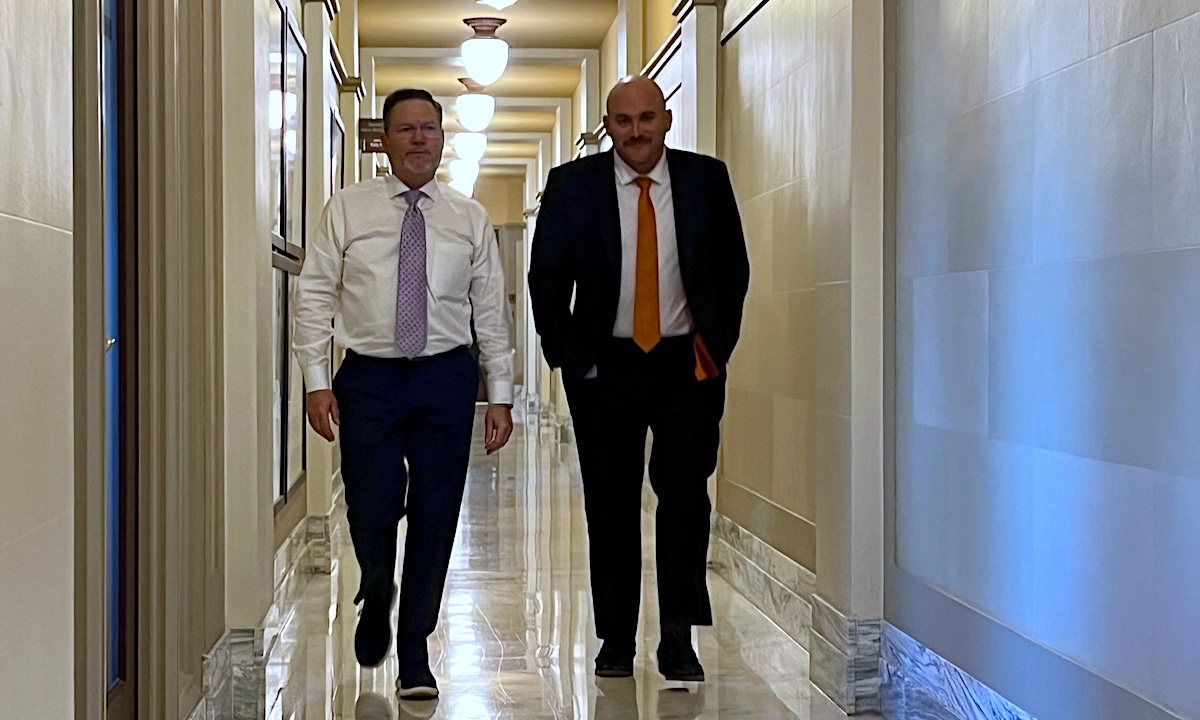
Before Bullard announced his plans to absorb ODMHSAS, Slavonic provided an update on the department’s budget. The admiral took over an agency that has been in troubled waters since its previous commissioner, Allie Friesen, alerted legislators to a budget gap last spring.
For Fiscal Year 2027, Slavonic initially requested $461.5 million in state appropriations, a $58.2 million increase over the current FY 2026 budget, which lawmakers knew for months would be short owing to last session’s chaotic confusion over the agency’s finances. Of that requested increase, Slavonic asked for $20 million to cover the agency’s lingering Title XIX Medicaid bills for the current fiscal year, an additional $17 million for consent decree compliance and $22.5 million in technology upgrades. (Beyond those asks, the Legislature has already appropriated $19.7 million to ODMHSAS this session to cover the agency’s delinquent Medicaid reimbursement obligations for FY 25, which ended nearly nine months ago.)
At Tuesday’s press conference, however, Slavonic announced what he had told legislative budget leaders a few days prior: ODMHSAS’ funding need had risen again. The new figures include a requested $49 million for Title XIX Medicaid payments and $30 million for the consent decree, with the request for technology upgrades holding at $22.5 million.
Through Title XIX, the federal statute guiding Medicaid funding, ODMHSAS must match federal dollars at a fluctuating rate to provide services for program beneficiaries. Slavonic said the federal match has posed a “challenge” for the agency.
“We went in to ask for $20 million back in October, and as we’ve entered into conversations with Secretary Bullard’s office, it’s become apparent that this federal match is something that we underestimated, and while we requested $20 million (for) that federal match Title XIX money, we need another $19 million (for the current fiscal year). And so, that’s a big number.”
Slavonic said all additional Title XIX money supplemented to ODMHSAS would be a “pass-through” given “to pay our part to OHCA.”
ODMHSAS had several roving funding request estimates last spring, and the Legislature’s budget leaders expressed frustration Tuesday that the pattern has continued.
“In the words of Yogi Berra, it’s deja vu all over again,” said House Appropriations and Budget Committee Chairman Trey Caldwell. “At end of the day, there are huge concerns that we have with Oklahoma Health Care Authority, but also with the Department of Mental Health.”
Caldwell (R-Lawton) said the new $30 million sought for the consent decree would be in addition to $9 million the Legislature awarded for the same purpose already in FY 26. Combined with the technology update request, the consent decree funding and a fully annualized ask for the higher Title XIX funding Caldwell said, the agency’s total ask is now $179.5 million more than it received last year.
“And they’re telling us that, you know, in the 11th hour of the budgeting process, which is a little bit frustrating,” Caldwell said. “The Health Care Authority’s saying that they need a half a billion dollars or they’re going to create a new tax on hospitals. I mean, all of that is very concerning.”
Senate Appropriations and Budget Committee Chairman Chuck Hall (R-Perry) said that when he learned of the three agency leaders’ planned press conference late Monday night, he sent his staff running around the Capitol early Tuesday to try and find a way to watch it. However, the event was held at OHCA’s headquarters a couple of miles north, so Hall said his staff ended up watching pieces of the presser via Zoom.
“I certainly had kind of a general idea, because the current interim Health Care Authority director has been talking about making some of these moves (…) in just generalized discussion. Kind of, ‘This is a theoretical discussion.'” Hall said, referring to Bullard. “But when the press conference was announced, none of us knew — I say none of us — I certainly didn’t have any idea of the specifics of what would be said (or) what was going to be presented.”
Hall said characterized the sudden announcement as “a little bit disappointing.”
“I would think we’ve always had pretty good communication. Director Bullard has been very good thus far to communicate with myself and my team. And so this was a little bit uncharacteristic,” Hall said. “I would have much preferred to have been able to sit down, have the Health Care Authority lay it out in front of myself. If they wanted to include my counterpart over in the House, I think we’d have both been willing to sit down and give that kind of a little bit of heads up.
“What they decide to do in a press conference and what they decide to announce in an announcement is certainly their business. But I think that if we’re going to be successful as a state, if we’re going to be successful as a Legislature, and if [ODMHSAS] and the Health Care Authority are going to be successful, then we’ve got to have better communication.”
Asked about the oddity of publicly proposing a major policy change during a session deadline week without alerting legislative leaders, Caldwell drily replied, “That’d be a keen observation.”
Like Caldwell, Hall also emphasized that the Health Care Authority has its own major issues to address this session.
“The Health Care Authority director, you know, wants a half a billion dollars. The governor, in his own budget, has cut that in half. I don’t know where we’re at, and so I’m spending an enormous amount of time trying to evaluate exactly what the real numbers are,” Hall said. “The goal post keeps moving, and you know, until we get some answers, until we can get some real comfort in what the real numbers are, what the real need is for the state, it’s going to be difficult to fund any request at this point.”
(Editor’s note: Tres Savage contributed to this story.)