


Despite concerns from several industry stakeholders, the Oklahoma Housing Finance Agency has suspended its administration of a federal grant program’s applications owing to a pending bill in the Legislature that would reduce guidelines and codify them in state law.
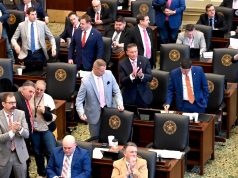
HB 1823 by Rep. Carl Newton (R-Cherokee) and Sen. Darcy Jech (R-Kingfisher) passed the Oklahoma House on March 12 by an 83-5 vote. Carrying an emergency clause that would make it effective upon the governor’s signature, the bill awaits Senate consideration in the coming weeks.
If passed and signed, HB 1823 would codify OHFA’s administration of the U.S. Department of Housing and Urban Development’s HOME investment partnership program in state statute and prohibit it from having stricter parameters than the federal guidelines.
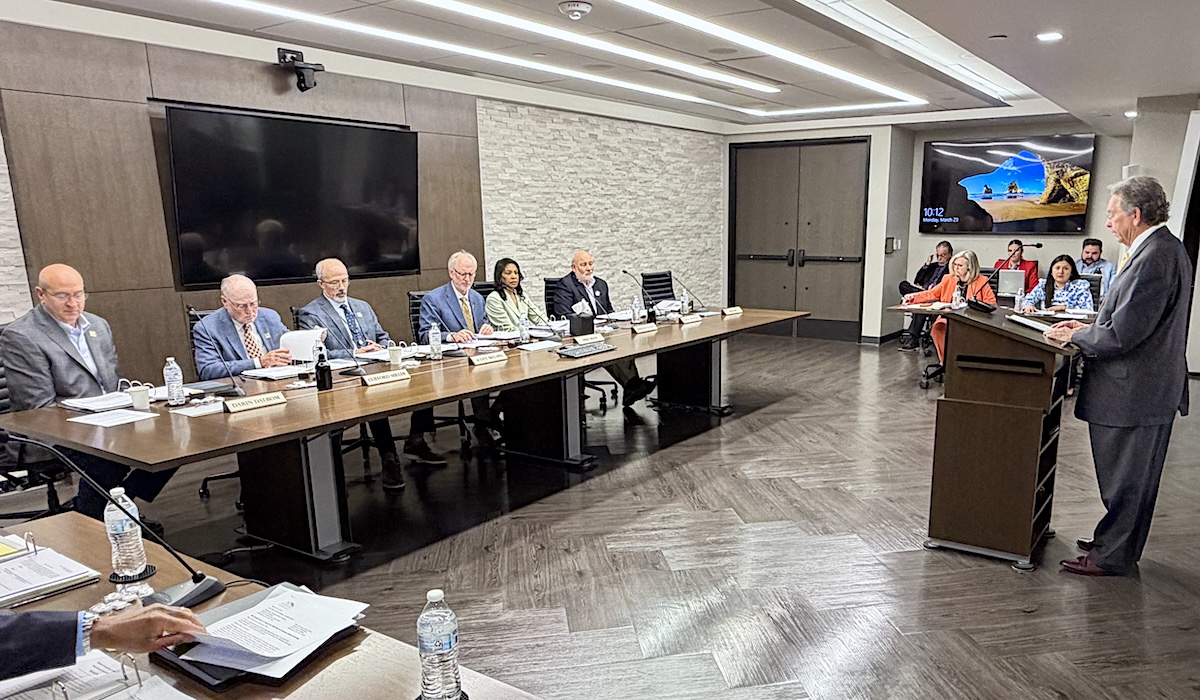
Stemming from a multi-year fight over how the program can be used for housing acquisition and redevelopment, the legislation caught OHFA leadership by surprise last week — which the Legislature largely took off for spring break — and spurred a special board meeting Monday.
By a 4-1 vote, the OHFA Board of Trustees approved a resolution suspending OHFA‘s “administration of the 2025 and 2026 HOME Investment Partnerships Programs, with the future possibility of termination (…) pending the outcome of” HB 1823.
“They only are seeing one side of this,” board Chairman Michael Buhl said. “They never reached out to OHFA for consultation, so if they move it forward, they’re doing so not really understanding both sides of it.”
Board member Doyle Province voted against the resolution, suggesting instead that “somebody get out there and do some footwork with the senators and see what the real deal is.”
“What bothers me is it looks like we’re taking a stand here,” Province said. “And I wonder if we really should be reaching out. If we take a stand, it can create some bad will, especially in the future.”
With legislative leaders recently reaffirming support for OHFA’s nascent $215 million Housing Stability Program, Province’s sentiment was echoed by multiple industry stakeholders. Gary Jones, who works with Neighborhood Housing Services of Oklahoma, insisted that trustees need not panic and suspend the HOME program based on a bill advancing halfway through the legislative process.
“Our concern is that reacting to this legislation at this date and time with the resolution that is proposed is, again, premature,” Jones said. “There are other opportunities that are available before you have to take that type of action. The question is, why disrupt or cause harm if it appears the legislation could be modified in a way that could be manageable or set aside or tabled until the next legislative session?”
With OHFA executive director Deborah Jenkins saying she and her team “haven’t been given that opportunity” to meet with Newton and Jech so far, Buhl responded to calls for the board to table its resolution by saying legislators should slow their own roll.
“I think the Legislature should get with all parties and sit down and understand both sides of this situation,” Buhl said. “So I think if there’s a pause, it should be on the House bill and not on us.”
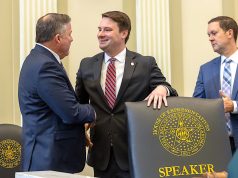
With lawmakers only returning to session Monday afternoon — three hours after OHFA’s board meeting — the HOME program’s suspension surprised Newton, especially because he said House staff checked his phone logs and confirmed no one from OHFA had reached out after he posted the current version of his bill March 2.
“My concern was, you paused the program before you even talked to me or came to us and talked to us about the legislation,” Newton said. “I mean, a lot of times we propose legislation, and we expect to have amendments and stuff added to that.”
‘I would love to sit down and have a conversation’

Confusion over how Newton handled his bill appears to have affected OHFA trustees’ decision to suspend the HOME program.
During Monday’s board meeting, Jenkins said Newton’s bill caught her team off guard. Responding to Jones’ assertion that the Senate would take at least three weeks to consider and pass HB 1823, she erroneously claimed the bill’s language was revealed only three days prior to its House floor vote.
“The language in HB 1823 was inserted on March 9. It passed the House floor on March 12. OHFA did not become aware of the bill until it was on the House floor being prepared to be voted on,” Jenkins said. “When you speak to, ‘Three weeks is the earliest this bill could pass,’ that hasn’t been our experience in the House.'”
The timeline Jenkins told OHFA Board members, however, was incorrect. While the “Versions” tab on the Legislature’s page for HB 1823 dates the committee substitute as March 9, the “Amendments” tab shows the true date it was filed for public review: March 2.
On March 5, the final day for House bills to receive initial committee approval, Newton presented HB 1823 in the Rules Committee, where it advanced 10-0.
“We’re just trying to make sure that the Oklahoma Housing [Finance Agency] stays within their lane and (we are) making sure they’re being transparent with the things that are happening there,” Newton said while presenting the bill, which received no questions or debate.
One week later, March 12, Newton presented HB 1823 on the House floor.
“This works with the HOME part of the Oklahoma House Finance Agency. We’re just trying to make sure they stay in compliance with the guidelines they’re given from the federal government,” Newton said. “These are federal grants that are given back to Oklahoma, and we’re just making sure that they’re not going broader or more stricter than the federal guidelines that they’re given from the federal government.”
The bill again received no questions or debate.
Responding to Jenkins’ claim that the bill was only posted three days before the House floor vote — instead of three days before its committee vote and 10 days before its floor vote — OHFA’s board chairman said Newton was attempting to hide his legislation by initially filing it as a shell bill in Title 60 with “social work reform” in its name.
“You make it sound like we can sit down with the Legislature and we can communicate the intent,” Buhl told Jones. “The intent to me was that they wanted to introduce a bill that was under a different name and they didn’t want OHFA knowing about it until it was passed. The intent to me is not a good one right now. The intent doesn’t seem like they want to work with OHFA to come up with solutions. The intent seems to me like they were trying to do it without transparency.”
Newton scoffed at Buhl’s notion.
“I would love to sit down and have a conversation,” Newton said. “It’s still my bill. Me and Sen. Jech work together very well, and I’m sure he would be happy to sit down. I run bills to try to make a difference — to help. I don’t try to have bills run over people or run around them or hide things. I try to make sure we’re doing the right thing.”
‘It is to be a partnership program’

Exactly what constitutes the “right thing” for Oklahoma’s implementation of the HOME investment partnership program has been a matter of great debate. For the past two years, the agency’s HOME program application has gone through extensive drafts, public feedback and reviews.
At OHFA’s Jan. 21 board meeting, where the 2026 HOME program application was finally approved, trustees’ board packets contained more than 300 pages of stakeholder comments and staff responses.
“Without our partners, we would not have a program. We need them as much as they need us, and it’s a true partnership,” said Darrell Beavers, OHFA’s housing development programs director. “However, not all feedback can be incorporated. (…) There are no decisions or changes you can make that will please everybody. There are only trade offs. I imagine there are some who would never feel that they have received a meaningful opportunity to be heard until such time as OHFA would capitulate to what they would want OHFA to do.”
Jenkins noted that a representative from Gov. Kevin Stitt’s administration had called and asked the board to consider tabling the 2026 HOME program application until March.
“The governor’s office made it clear that, while they were asking OHFA to consider tabling it, it was strictly OHFA’s decision — that this was not a mandate by the governor’s office,” Jenkins told trustees Jan. 21. “They felt like this was between OHFA and stakeholders, and so if OHFA chose to move forward, that is OHFA’s decision. It was not a mandate, and the governor’s office said they would really like to remain out of the middle on this issue.”
Andrea Frymire, the CEO of Housing for Communities, told the board that developers around the state were frustrated by a new requirement prohibiting certain guarantor relationships on projects and by a new rule “to prohibit even the general public from direct or indirect communication regarding program policies or procedures” with trustees.
Ultimately, however, the OHFA Board adopted the 2026 HOME program application days before the year’s legislative session began.
“I’ll say it again: I think that the parties are just not going to agree on certain things,” Buhl said before the Jan. 21 vote. “It’s not even really an issue of we agree to disagree. They’re just not going to agree.”
On Monday, the contentious discussion surrounding the HOME program revealed additional bureaucratic battle lines.
According to OHFA staff, rules were changed on HOME program rehabilitation projects in 2024 to prevent developers from spending a modicum of money — on “blinds or gutters” — to receive 15 percent fees for doing the bare minimum in a property flip.
“There were a couple of instances where there were some acquisition-rehab properties or acquires where not a substantial amount of rehab in our eyes was being done, but a 15 percent developer fee was being taken,” Corey Bornemann, OHFA’s housing development program manager, said Monday.
Bornemann said several projects for which developer fees were paid saw less than $5,000 of rehabilitation work. In response to an Open Records Act request, OHFA provided NonDoc with a list of 20 projects under that threshold between January 2020 and March 2025.
“That’s why we made a lot of changes to the program. We instituted the $20,000 minimum rehab per unit, which the (federal) regulations allow us to do — for a [participating jurisdiction] to be more strict than that [federal rule],” Bornemann said. “HUD (only) requires a minimum $1,000 investment into rehabilitation. What [HB 1823] allows is, if it’s a $300,000 home purchase, then they could get the 15 percent developer fee on that, which would be $45,000.”
Buhl suggested that whether HB 1823 ultimately becomes law or not, OHFA might consider simply withdrawing as a “participating jurisdiction” for the federal HOME program. Other entities in Norman, OKC, Lawton, Tulsa and Tulsa County also operate HOME program partnerships.
“How did we get to this point when, in 2025, we had 27 units?” Buhl asked. “For me, it comes down to a money issue. It’s excessive profits and developer fees at the root of this. And again, the disconnect is the communication in that. I think that one side is taking the position under the guise that OHFA is hurting the program when it’s really trying to protect fees and profits that they’re used to taking. And OHFA, in my opinion, has determined that there’s some level of abuse within taking those fees and profits.
“And in all fairness, one side would say it’s not abusive if that’s what the program provides. Fair enough. But in my opinion, just because a program provides something doesn’t mean that it’s right.”
Buhl’s argument struck a nerve with Kay Decker, the executive director of Freedom West Community Development Corporation in Alva.
“None of us are making bank, and I don’t know who seems to think that,” Decker said of her fellow community housing development corporations. “That’s craziness.”
As Newton’s constituent, Decker’s growing beef with OHFA’s management of the HOME program directly led to Newton filing HB 1823 in an effort to limit OHFA’s home program guidelines to those required by HUD. Decker said OHFA has been “increasing regulatory barriers unnecessarily.”
“It is hard enough to build affordable housing in the state of Oklahoma and keep things rolling administratively with basically zero administrative funding that the agency provides us,” Decker said. “I don’t know how long that mindset has been going on, but I’m going to guess that what we have here is a failure of leadership with the top two staff at OHFA, and we have board members appointed by the governor who do not understand what a partnership is supposed to be.”
To that end, Monday’s OHFA Board vote blocked — at least temporarily — an application from Neighborhood Housing Services of Oklahoma to receive $200,000 for down payment assistance on 10 housing units.
“It is not a new or speculative application, but one that had already been vetted and positioned for award. Therefore, treating this application as under review or subject to suspension under the (prior) agenda item is a mischaracterization, as it mischaracterizes its status,” argued Katrina Washington, NHSO’s executive director. “This creates uncertainty and undermines the predictability required for the HOME program delivery, particularly for nonprofit housing providers serving low and moderate-income households.”
With the program suspended, Washington’s plea for consideration was to no avail. Frymire said the situation underscored concerns developers have about uncertainty when working with OHFA.
“After 11 drafts of the 2025 HOME application and five drafts of the 2026 HOME application, stakeholders are simply looking for consistency in program administration,” Frymire said Friday. “After OHFA’s board action, our organization has around $1.6 million in previously awarded applications across Logan and Canadian counties that are now frozen.”
Decker, who has been working with OHFA since 2003 to build housing in northwest Oklahoma, said developers’ concerns are not being heeded.
“The federal government designed the program to be broad in scope and in interpretation so as to allow the partners in each state working the HOME program to make the best and most appropriate decisions for their particular state and the needs of their state,” Decker said. “A partnership situation implies — and in fact the HOME program requires it — that there be a conversation, engagement, discourse, whatever your want to call it, between the participating jurisdiction and the users of the program, meaning the development community. And through [that] we, under the broader guidelines of the federal government, determine what is the best use of this funding, how can we maximize this funding, how can we comply with federal requirements, but do the best dadgum job for the people of Oklahoma. That’s the nature of this program.
“Two years ago, that changed with the staff at OHFA.”
Despite the 300 pages of communication provided to trustees for review in January, Decker claimed her experience is that current OHFA staff “won’t listen” and “won’t engage in discourse” over the HOME program’s administration.
“The feedback loop is gone. The nonprofit community has made recommendation after recommendation after recommendation to no avail. Nothing happens,” she said. “I guess where I’m most disappointed with OHFA as a state agency is the fact there are staff that refuse to engage in quality, solution-seeking conversation to come up with strategies that meet their increased requirements. We don’t understand this — they will not tell us at OHFA — they won’t tell us why their requirements are more stringent than the federal government. They don’t need to be. It’s hard enough to create affordable workforce housing without additional requirements.”
At Monday’s meeting, however, OHFA staff and Buhl outlined their concerns about program “abuse” and how many of the federal guidelines are 35 years old.
“There are a lot of rules in this program that have not been updated since it was created (in the early 1990s),” Bornemann said. “There were a few (program applicants) that were doing only acquisition and getting that 15 precent developer fee. Some would buy a brand new house or a relatively new house and they would put gutters or lights in it and call it access and rehab [and either sell it] or turn around and rent it out.”
Buhl characterized that type of application — which is no longer allowed under OHFA’s more stringent rules — as seeking “free money.”
“Unfortunately, as Corey said, it’s a few. And I get that there’s probably quite a few members that would rather us not be doing all of this,” Buhl said. “But unfortunately, the many are paying the price of the few that we determined were abusing the system.”
Jech, HB 1823’s Senate author, said Tuesday that he would begin reviewing House bills after Thursday’s deadline for measures to advance from their chamber of origin — a saga in the Senate that slogged along thanks to a riff in the GOP Caucus.
“Our focus in the Senate is the consideration of advancing Senate bills to the other chamber,” Jech said Tuesday. “As with all House bills that I’ve agreed to sign on to as the Senate author, I do look forward to discussions with the House author on HB 1823 as we work through the process.”
Both Jech and Newton emphasized that it sounded like all stakeholders needed to get in a room, discuss HB 1823 and figure out compromise for OHFA’s administration of the HUD HOME program.
“At any point, I would be happy to sit down with them,” Newton said.