


The Small Business Administration’s Section 8(a) contracting program is drawing scrutiny in Washington from those who accuse it of being a diversity, equity and inclusion initiative. But cuts to the program could have economic consequences thousands of miles away — including in Oklahoma, where tribal governments bring federal dollars to the state’s economy through the 8(a) program.
Across the state, tribally-affiliated companies participate in federal contracting tied to aerospace, defense and logistics work, sectors that help anchor Oklahoma’s $44 billion aerospace and defense industry. Tribal leaders and state lawmakers say changes to the program could ripple through that economic ecosystem.
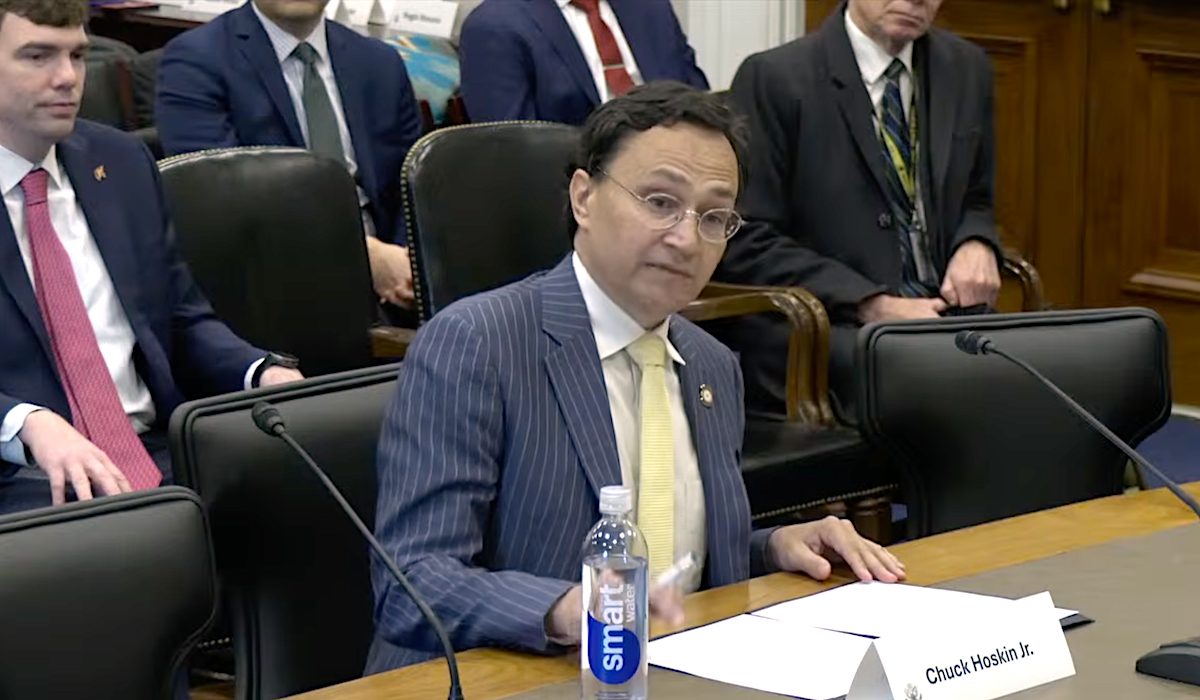
Cherokee Nation Principal Chief Chuck Hoskin Jr. said in testimony March 17 before the U.S. House Subcommittee on Interior, Environment, and Related Agencies that the 8(a) program is a key driver of “tribal self-sufficiency,” tying it directly to the federal government’s trust responsibility to tribal nations.
“Funding matters, and the relationships matter,” Hoskin said, emphasizing that federal support and tribal capacity must work together to sustain economic development.
The subcommittee is part of the House Appropriations Committee, chaired by Rep. Tom Cole (R-OK4).
The 1953 Small Business Act authorized the Section 8(a) Business Development Program with the intent to help small and disadvantaged businesses compete for federal contracts. The program provides participating firms with business training, mentorship and access to certain government contracts that might otherwise be difficult for smaller companies to obtain.
In recent months, the program has become the focus of renewed attention from federal officials who say oversight is necessary to ensure the system operates fairly and complies with constitutional standards. Secretary of Defense Pete Hegseth lambasted the Small Business Act in January, calling it “the oldest DEI program in the federal government.”
Hegseth said he would conduct a line-by-line review. The U.S. Treasury announced a similar review in November, and the Small Business Administration itself announced in December it was requiring contracted businesses to provide financial records in hopes of rooting out waste, fraud and abuse.
Hoskin, who also testified in February before the Senate Indian Affairs Committee, said Cherokee Nation businesses serve more than 60 federal agencies and employ more than 4,400 workers worldwide. Under tribal law, those businesses return at least 37 percent of their net income to the Cherokee Nation’s General Fund, supporting services ranging from health care to housing and language preservation.
Over the past decade, tribal businesses affiliated with the Cherokee Nation have contributed roughly $364 million to those services, Hoskin said.
Oklahoma lawmakers say the economic effects extend beyond tribal governments.
“These are contractors that have been in place for a number of years,” said Rep. Meloyde Blancett (D-Tulsa), a former executive director of the Oklahoma Department of Commerce. “They would not be allowed to be contractors were they not providing a quality product and a quality service.”
Federal contracting requirements in sectors such as aerospace and defense are difficult, she said.
“You cannot play in that realm without doing a good job,” Blancett said. “It’s very tough and very demanding, so they’ve got to be doing a good job, and they’ve got to be providing good value.”
Blancett said tribally-affiliated enterprises often bring federal dollars into the state economy.
“In essence, they are a headquarters organization here, pulling revenue from out of state into our state,” Blancett said.
Rep. Tammy Townley (R-Ardmore) also questioned whether tribal participation in the program should be framed primarily through a diversity lens.
“I don’t believe that a tribal member should be included in the DEI,” Townley said. “Here in Oklahoma, being native is just part of our way of life.”
Federal review raises questions about 8(a) program
Nonetheless, the federal program that supports tribal businesses in Oklahoma and beyond has seen increased scrutiny.
The SBA issued new guidance earlier this year emphasizing that race-based discrimination is not permitted in the program and outlining new compliance expectations for contractors.
“Providing these small businesses with opportunities is a laudable goal,” Hegseth said in a video message. “But over the decades, as it happens, the 8(a) program has morphed into swamp code words for DEI race-based contracting.”
At the same time, lawmakers and tribal leaders have pushed back against claims that the Native 8(a) program operates as a diversity initiative.
During a recent Senate Committee on Indian Affairs hearing, Chairwoman Lisa Murkowski (R-AK) rejected allegations that the program is illegitimate or based on diversity, equity and inclusion policies.
“This program is a success story. It’s not a fraud, as some have alleged,” Murkowski said. “Quite honestly, that’s terminology that I would just categorically reject.”
Murkowski said the Native 8(a) program is rooted in Congress’ constitutional authority over Indian affairs and the federal government’s trust responsibility toward tribal nations.
The distinction is significant in federal law. Courts have repeatedly ruled that policies affecting tribal governments are based on political status rather than racial classification because of the government-to-government relationship between tribes and the United States.
Tribal leaders defend economic development tool

Tribal leaders say the 8(a) program has become more than a contracting tool — it functions as a primary economic engine for Indigenous communities.
“This is our way of hunting and gathering now,” said Jon Panamaroff, co-chair of the Native American Contractors Association, in testimony March 18 before the House Appropriations Subcommittee on Interior, Environment, and Related Agencies.
Hoskin told the Senate Indian Affairs Committee the program allows tribal governments to generate revenue that supports essential services without relying solely on congressional appropriations.
Cherokee Nation businesses employ thousands of workers and serve dozens of federal agencies through federal contracting, but he warned that growing criticism of the program has already begun to create uncertainty for contractors.
“Our teams are increasingly faced with questions from contracting officers about whether our operations are under investigation,” Hoskin testified.
Other tribal leaders told the committee the program has helped Indigenous communities create economic opportunities that extend across generations.
“The missing piece from this structure was the economic engine, and the 8(a) program filled this gap,” testified Katherine Carlton, president of Chugach Alaska Corporation and policy chairwoman of the Native American Contractors Association.
Follow @NonDocMedia on:
Facebook | X | Text or Email
Oklahoma contractors tied to federal economy

In Oklahoma, tribally-affiliated enterprises participate in federal contracting across several industries tied to national defense and aerospace supply chains.
The state’s aerospace and defense industry generates roughly $44 billion in economic activity and includes more than 1,100 companies, according to the Oklahoma Department of Commerce.
Major employers include Boeing, Northrop Grumman, Pratt & Whitney, Raytheon and Rolls-Royce, along with a network of suppliers and contractors that support both commercial aviation and defense programs.
Some tribally-affiliated companies have built business lines around those contracts.
Choctaw Global, a tribally-owned enterprise headquartered in Oklahoma, operates several subsidiaries involved in federal contracting. One of those subsidiaries, Choctaw Defense Manufacturing in McAlester, produces defense-related components and employs workers in southeastern Oklahoma.
Janie Dillard, CEO of Choctaw Global, said the company “has played an important role in creating meaningful economic opportunities that directly support tribal programs, essential services, and employment for the Choctaw Nation.”
“A reduction or elimination of the 8(a) program would impact Choctaw Global, including Choctaw Defense Manufacturing, as well as all southeastern Oklahoma,” Dillard said.
Dillard said Choctaw officials have been in contact with U.S. Sen. James Lankford and other congressional leaders about the value of the 8(a) program.
“Scaling back the 8(a) program would have economic consequences for all southeastern Oklahoma,” she said.
Debate reflects broader policy tensions
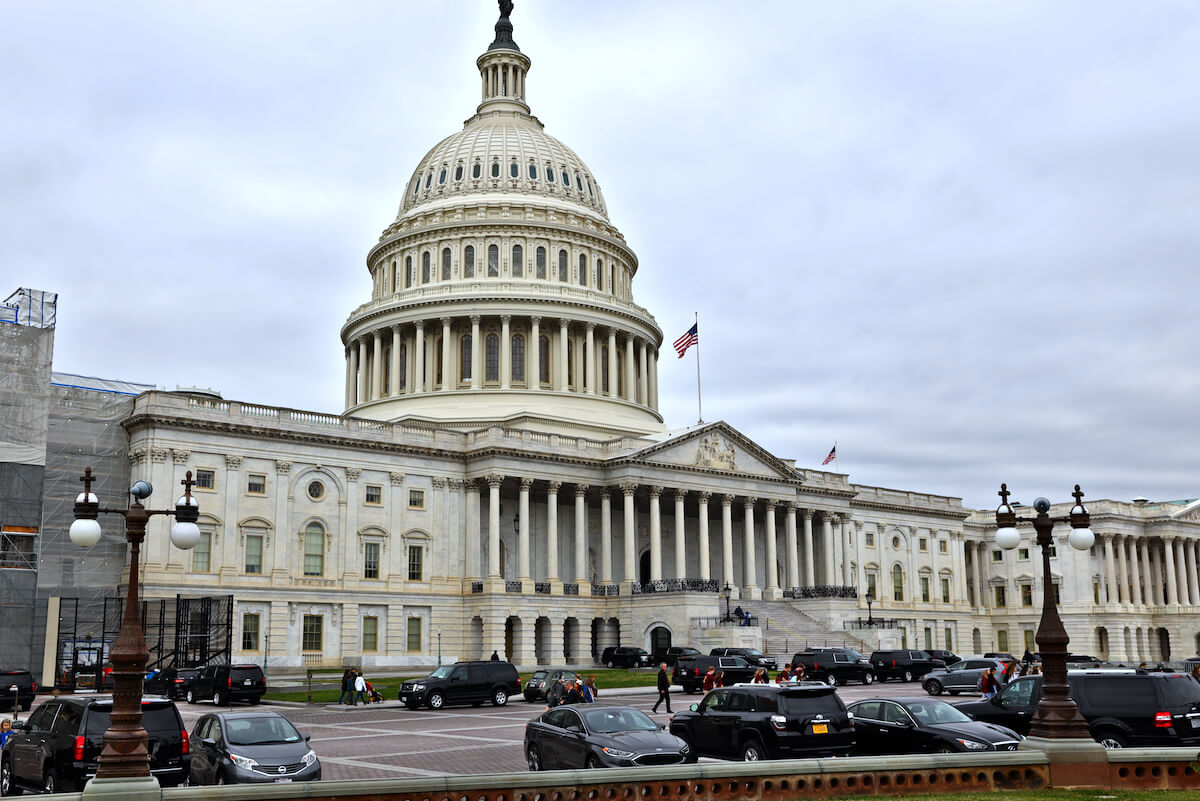
The debate surrounding the program highlights a larger policy question: how federal contracting rules should balance oversight with economic development goals.
Critics argue the program should face stronger scrutiny to ensure federal contracts are awarded fairly and efficiently.
Supporters counter that the program has a long record of delivering value to federal agencies while supporting tribal economic development.
Adrian Dotson, a Navajo entrepreneur who works with Native federal contractors, wrote in a recent commentary on LinkedIn that tribal participation in the program reflects treaty obligations and the federal government’s trust responsibility to tribes.
“Tribal 8(a) preferences aren’t favors. They’re treaty obligations,” Dotson wrote.
For many tribal leaders, the issue ultimately comes down to economic self-determination.
“The 8(a) program has been transformative,” Hoskin said.