

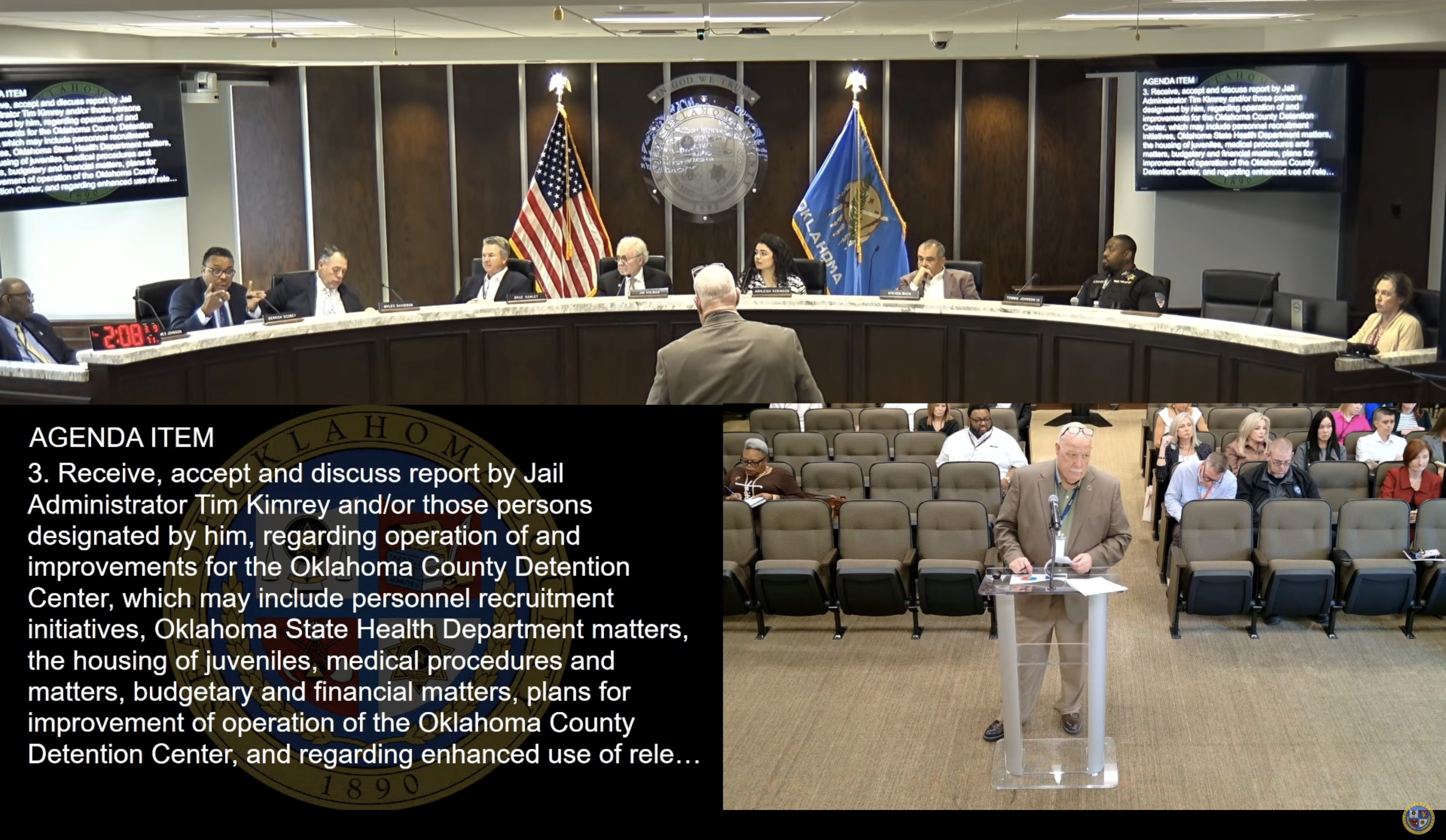

A typically routine monthly report from Oklahoma County Jail administrator Tim Kimrey turned contentious Monday when jail trust member Derrick Scobey questioned him and Chairman Jim Holman over raises the board voted to delay earlier this year but that were given to jail staff anyway.
“Lord have mercy,” Scobey, a reverend, said with exasperation during Monday’s tense exchange. “This is the world we live in.”
On Jan. 12, the trust voted to postpone indefinitely a pay raise for jail staff that would have bumped average employee pay from $41,000 to about $47,000 annually. The increase carried a roughly $3.4 million fiscal impact. But according to at least one member of the county’s budget team, those raises started appearing on employee paychecks last month, despite the earlier vote by the trust.
The jail already faces a projected $5.8 million shortfall this fiscal year, which ends June 30, and county officials have been considering staffing cuts among ways to reduce costs. Most recently, District 1 Commissioner Jason Lowe requested an investigative audit of the jail trust from the state auditor’s office, but his fellow commissioners declined to support the initiative because they said the county’s financial problem must be solved sooner than later.
‘What occurred here is not a policy disagreement’
In light of Oklahoma County’s budget woes, Monday’s revelation that pay raises for jail staff had been executed despite the board’s January vote landed poorly with Scobey, who challenged Holman and Kimrey to explain how and why the raises came to be.
“Several months ago, this board voted to indefinitely pause staff raises,” Scobey said to fellow trustees. “It was properly motioned, properly seconded, and it passed with only one dissenting vote. And today we are sitting in this very room looking at a projection of a $5 million shortfall, but it could be less. But yet, those raises, they went forward anyway. Chair, you cast the one ‘No’ vote. And then you went outside this chamber and authorized the very thing this board voted against. And then, administrator, you executed it. Maybe both of you together.”
Holman told Scobey that was incorrect. That led to further back and forth between the trust chairman and Scobey.
“Both of you need to understand this clearly,” Scobey said. “The administrator of this jail serves under the authority of this board, not under the authority of one member of the board, not even the chair. The board’s vote is not a suggestion or a recommendation. It is a governing decision, and it was ignored. What occurred here —”
Holman interjected, cutting Scobey off and repeating, “That is incorrect”
“You keep making statements,” Holman said. “If you’re going to make statements that aren’t correct, we should address that.”
Scobey then asked Holman if raises were given. Holman said raises were given before the Jan. 12 vote, but not afterward.
Oklahoma County Sheriff Tommie Johnson said he had received a letter that indicated raises were part of the budget. Scobey then requested Joe Blough, a member of the county’s budget evaluation team — typically referred to as the BET — to come forward. Blough is also Lowe’s first deputy for District 1.
Blough told the trust he had sought clarity about the Jan. 12 vote owing to confusion over the result in the minutes of that meeting. Blough’s version of events appeared to contradict those of Holman and Kimrey.
“There was a line of questioning in BET regarding raises that were given on the February payroll,” Blough told the trust. “The pay cycle begins 1/21, OK? The answer that was given was a couple. Upon further examination of the February payroll change sheet submitted by the jail, there were approximately 100 raises. Some promotions. Others were just straight raises. My understanding of the decision this body made was that you voted [Jan. 12] not to give raises. The raises appeared subsequent to the vote of this board, if I am reading the information I was provided from your own staff correctly. So it appears that raises were given subsequent to the vote to postpone.”
Scobey then accused Holman of disregarding the established practice that key decisions on issues like staff pay are decided by members of the jail trust, which was created in 2020 to take over operation of the detention center from the Oklahoma County Sheriff’s Office.
“What occurred here is not a policy disagreement, it is not an administrative grey area. It is a unilateral override of a democratically constituted board vote by the very person who lost that vote,” Scobey said. “I’m not going to just sit here in the seat and act like it did not happen. It is unacceptable. I have questions. I need answers — but it’s not just me — and I need them on the record. Question one, under what specific legal authority did you override the vote of this board?”
Holman responded defiantly.
“I did not override the board, so therefore I have no answer to that question,” he said.
Scobey asked Holman to repeat his statement that he never authorized pay increases for jail staff.
“I’ve made it enough,” Holman said. “It’s in the record. You’ve heard it. What has not been discussed is that, when the raises that began in the February pay were announced, it was previous to that meeting, which makes this whole discussion a waste of time.”
Undeterred, Scobey asked Kimrey who had authorized the pay raises.
“This was done privately, between you and the board chair, Jim Holman?” Scobey asked.
Kimrey repolied: “No, that’s not correct.”
Scobey asked Kimrey to “tell me what is correct.”
“What transpired?” Scobey asked.
Kimrey repeated himself: “I said, ‘No.’ The answer to your question is no.”
Scobey once again asked Kimrey if he had authorized the raises. Kimrey again said he did not.
“So they just kind of fell out of the sky — fell out of the sky with a pen — to authorize raises?” Scobey asked. “And you didn’t authorize it? Board chair, did you authorize it?”
Holman again denied that he authorized the raises, which prompted Scobey to ask the lord for mercy.
“This stuff has become permissible from all the way at the top of this country down. You can just play all these kinds of games,” Scobey said. “So you didn’t authorize them, and you didn’t — so then these raises are null and void because the raises weren’t authorized by anybody.”
Johnson then interjected, saying he understood Kimrey’s desire to provide more salary for his staff, but he also accused him of “insubordination.”
“It’s not that we don’t want the raises given or that they are not certainly owed and earned,” Johnson told Kimrey, “But we can’t offer them because of the information provided to us [about] the shortfalls and where we were landing financially. I’m a big believer in this. There is not one person bigger than the organization. So one person can’t make the decision and go against an entire organization, which was exactly what happened with that vote. I believe it was insubordination, to be quite frank.”
Letter shows Holman’s support for Kimrey’s action
A document read aloud by Lowe’s District 1 chief deputy, John Pettis Jr., appeared to provide more clarity Monday. The letter, dated Feb. 5, came from Holman to the county budget board. In it, Holman said that, while he believed Kimrey had the authority to authorize the raises on his own, he concurred with and approved of the raises being awarded to staff.
Scobey then told both Kimrey and Holman that he was disappointed in their actions, which elicited a strong reaction from Kimrey, who has clashed with Scobey in previous jail trust meetings.
“I am disappointed that this hasn’t been properly funded,” Kimrey shot back. “When was you told this would be $5.8 million short? Of course, it doesn’t matter. But you was actually told in June of last year that the jail would be $5.8 million short. It’s going to be less than $5.8 million because we have made cuts, and we are going to drop it by probably $1.5 million. We have saved uncountless lives. We have made progress like you can’t believe.”
Kimrey then accused Scobey of not caring about detainees at the jail.
“Don’t go there,” Scobey replied.
Holman said the letter reflects that he acted in a way he has been accustomed to in private business over the years, allowing a subordinate to make decisions independently without intense scrutiny over every one of them.
“There is a propensity to micromanage everything, and if that is the direction we are going to go, I will comply with that, but prior to that, the indenture says that we are to hold the administrator accountable,” Holman said. “And that, to me, is no different than companies I ran in the past. You report to a board of directors that gives you leeway to make audibles down the road, and if you save money here and apply it there to enhance safety — all these things.”
Holman said, in the end, one of the trust’s jobs is to make sure the jail is run properly, which will also reduce the county’s exposure to potential lawsuits, which create costs that are usually passed on to taxpayers.
“Anytime we put inmates at risk, we create opportunities for lawsuits,” Holman told the trust. “Those get on the books if we lose or settle. The jail gets blamed for every lawsuit that happens, and we’re just now litigating things that happened in 2020 or 2021. You want to pick on whether raises are approved or authorized, or what henceforth we have changed that dynamic. But prior to that, the jail administrator had the authority to operate the jail, and we hold him accountable. But if we are going to make every call that gets made, then it’s a different environment and not the one I signed up for.”
No further action was taken Monday, and the meeting ultimately moved on to other subjects. The jail trust’s next scheduled meeting is slated for April 13.