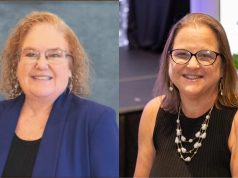




Two Generation Z candidates have set up the first contested race for the Oklahoma City Public Schools Board of Education District 7 seat since 2014.
Incumbent Meg McElhaney announced on Facebook that she was not running for reelection in November, which spurred Natalie Roman, 22, and Galilea Martinez, 28, to file for the seat. Martinez and Roman share a few similarities beyond their relative youth. Both said they grew up and went to school in the area, have deep affinities for the community and graduated during COVID-19 — Martinez from the University of Oklahoma and Roman from Southeast High School.
“I really do think having that lived experience and knowing how the classrooms feel — especially after COVID and after technology has become a forefront to our learning, even with AI and all of these things — I think being a recent student and having that perspective when making decisions, it is good to know how that is going to show up in classes and how that is going to affect our students,” Roman said in an interview.
While they share similarities, Martinez pointed to life experience as a differentiator for voters.
“I was the only documented person in my family. (…) I always had it in the back of my mind that, at any point, my family could be taken away from me. (…) I do think it has prepared me for roles such as this one because of the climate that we are in,” Martinez said in an interview. “Being on the board, you oversee budgets, and you hold people accountable. And having the confidence to ask hard questions, knowing that you are doing it for your district, (…) I think that lived experience is helpful as someone who has paid property taxes and understands the nuances of that lived, adult experience.”
Roman said she was raised by a single father alongside her sister. She graduated from the University of Oklahoma in December with a degree in computer science. Last year at OU, Roman served as executive chairwoman of Latinos Unidos, a student organization that “seeks to transform America by recognizing Latinos’ innate leadership.” Meanwhile, Martinez has spent her career in politics and campaigns and currently works in communications for the Partnership for Large Election Jurisdictions. She also runs with District 7 students through Course for Change, she said.
A timely opinion Roman and Martinez shared was their belief that OKCPS’ Cesar Chavez Elementary School in District 7 should be renamed in lieu of reporting by the New York Times that Cesar Chavez allegedly sexually assaulted several members of his labor and civil rights movement, including Dolores Huerta and two women who were children at the time.
On Friday, March 20, an OKCPS spokesperson said the district recognizes the concerns being raised and is committed to handling the process with care as they undergo the renaming process with the intention to bring a “thoughtful” recommendation “as soon as possible.”
District 7 lies mostly south of the Oklahoma River and is anchored by the historic Capitol Hill neighborhood. Its boundaries run along Interstate 40 to the north, roughly a mile south of Interstate 240 to the south, South Western Avenue to the west and between South Bryant Avenue and South Sunnylane Road on the east.
Residents within OKCPS District 7 are eligible to vote at their normal polling place from 7 a.m. to 7 p.m. Tuesday, April 7. Early voting is set for Thursday, April 2, and Friday, April 3.
BCOC representation, pathways programs remain considerations
In recent months, questions originating from District 5 about the composition of the OKCPS Bond Citizens Oversight Committee — which is tasked with overseeing projects under the nearly $1 billion bond package district voters passed in 2022 — prompted possible changes to district policy to require BCOC members to live in the district. Both Roman and Martinez said they are happy the policies are being reviewed.
Specific to District 7, McElhaney questioned the programs planned for a new college and career center at Capitol Hill High School. McElhaney raised concerns about the inclusion of a culinary arts and hospitality program, noting the number of available programs around the metro and state, as well as game design and e-sports, computer science, construction and agriculture programs destined for the high school.
“You do not have a lot of time left to hear me beat this drum, but when we started talking about the pathways, I was very disappointed when, in a predominantly Hispanic community, in Capitol Hill High School, we put both agriculture and hospitality and culinary arts,” McElhaney said at the board’s meeting on Feb. 9. “I would love to see data on the average starting salary and long-term job outlook for all of these paths. I think construction has probably great prospects. Computer science and game design, I am very suspect in the age of AI that we have a curriculum that will keep up with that and make sure it is modernized.”
Roman said she believed those programs should be reevaluated with more inclusion from community members. She said it seemed that early surveys of community members fell short.
“There were not enough surveys being filled out. Were these surveys even in Spanish? So did they even touch on a majority of the District 7 population? I do think they should be re-administered,” Roman said. “Also (for) our workforce partners, it was heavily skewed toward the construction workforce, so does it even accurately reflect our workforce needs? (…) AI, with all of this tech, it moves so fast and making sure we are not putting our money into a program that is outdated is definitely something to be aware of.”
Martinez, on the other hand, said she does not believe the programs themselves should be reevaluated, but that attention should be paid to the granular details as the process moves forward.
“I want to believe that everyone is coming from a good standpoint. (…) My question would not be directed toward demographics, but rather directed toward, what kind of pairing are we doing with these programs to ensure that our students are not only learning the skillsets, but learning to take ownership of them so that they can then begin to start a small business through this, or learn the operational side of it as well to pair it with that skillset?” Martinez said.
Roman wants to ‘be a soundboard’ for teachers to Legislature
In recent years, OKCPS resurrected its Government Affairs Committee, according to OKC Free Press. McElhaney sought to be the newly revived committee’s chairwoman and has been at the forefront of efforts to build relationships with legislators — including the State of OKCPS Legislative Breakfast — during her tenure. That history and the idea of being a liaison is not lost on Roman or Martinez as the Oklahoma Legislature works toward improving literacy, exploring the role of AI in education and considering reforms to meet evolving workforce needs.
Highlighting her ability to connect with state policymakers, Martinez said she used to work with the Future Caucus, a national organization that connects young policymakers across the country. In her role, she was tasked with building bipartisan coalitions around the country, including in Oklahoma.
“I was able to build a lot of those relationships when it comes to the Legislature here and also understand the nuances that both parties are coming in with and how we can get them to work together,” Martinez said. “At the end of the day, this is about the success of children and our community here on the southside.”
Roman said getting with legislators to advocate for the community is important.
“A lot of the issues fall to lack of staff and lack of support, so that is a top priority — to get with our legislators and be a soundboard of what we are hearing back from the community,” Roman said. “Making sure we are advocating for our teachers at that level is really important.”
Both said they believe the community would benefit from more communication, and each said she was committed to fostering increased engagement and transparency.
Martinez: Addressing immigration crackdowns is ‘a very holistic issue’
As state lawmakers debate bills about what residents with certain immigration statuses are eligible to receive, such as resident tuition or proposed tuition waivers for victims of trafficking, the recent detention of an Enid High School student following a traffic stop for speeding has renewed conversations among education leaders about safety.
Martinez and Roman both said they have been thinking about how they would navigate personal interest and act as a board member if immigration policies threatened to impact their community after their election.
Martinez said she would hope to spark conversations to shore up internal district and board policies on what to do in the event of immigration enforcement activity and how they can keep families and students safe. She also said she would take proactive steps to disseminate information to community members about options such as standby guardianship, which designates a guardian for dependents in certain situations.
“This really is a very holistic issue when it comes down to it,” Martinez said. “Asking if there are set policies and procedures and asking how we are thinking of keeping our families safe — having those sort of conversations and keeping it top of mind, I think, is really important. I think the other angle is ensuring that we are communicating with our families how they themselves can be safe and giving real-life, tangible ways to do so, and not just creating noise in the media for no reason.”
She said concerns about immigration enforcement extend beyond families and students to teachers and staff as well.
Roman had similar thoughts and noted that there are a “lot more limitations” than might be expected when it comes to assisting community members and keeping them safe, especially for board members — but advocacy would remain top of mind.
“There is a role for a school board member, and not to overstep that is super important. But as far as advocating for the community, that is always going to be the top priority,” Roman said. “With these new challenges that we are seeing in our community, making sure we are getting ahead of it as a district to protect our students is something that will have to happen.”