

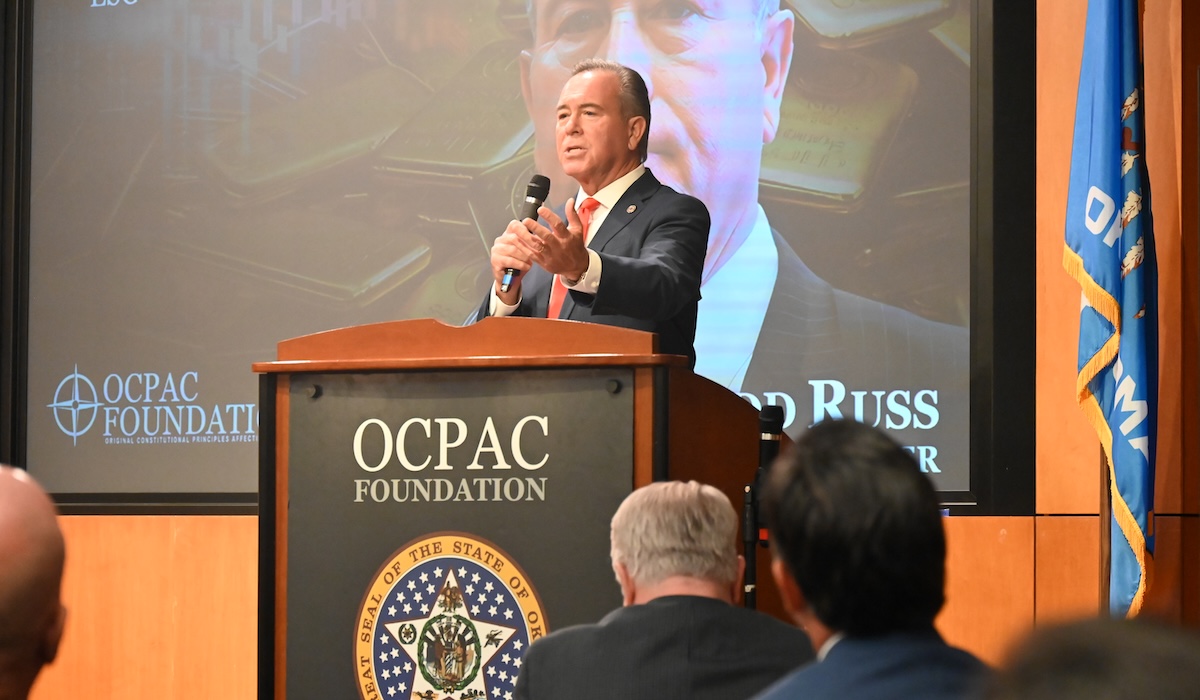

A narrow majority of the Oklahoma Supreme Court found today that the Energy Discrimination Elimination Act of 2022 is unconstitutional as applied to the Oklahoma Public Employees Retirement System. The act mandated the state treasurer, currently Republican Todd Russ, create a list of “financial companies that boycott energy companies” and required state government entities to divest from companies appearing on the list.
The majority opinion, written by Justice James Edmondson, found the act’s “dual purposes” of preventing discrimination by financial companies and increasing the effectiveness of the retirement system violated the Oklahoma Constitution’s Article 23, Section 12 requirement the state’s public retirement system be administered “for the exclusive purpose” of providing for the system’s benefit.
“We conclude that application of 74 O.S. §12003 to OPERS violates Oklahoma Constitution Article 23, Section 12 by creating a ‘dual purpose’ for investment decisions made by OPERS when administering a public retirement system as opposed to the ‘exclusive purpose’ OPERS must follow due to the express language of Oklahoma Constitution Article 23, Section 12,” Edmondson wrote. “We conclude (the) Energy Discrimination Elimination Act of 2022 (…) is unconstitutional in its entirety when applied to OPERS.”
Edmondson was joined by Justices James Winchester, Douglas Combs, Noma Gurich, and Richard Darby in the 5-3 majority opinion. Justice Travis Jett recused from the decision.
Don Keenan, a former president of the Oklahoma Public Employees Association and disabled veterans employee representative for the Oklahoma Employment Security Commission, had challenged the EDEA and the trial court issued a permanent injunction preventing enforcement of the act. However, Keenan died on April 7, 2025, while the case was on appeal. Edmondson’s opinion ultimately found the court could still rule in the case despite the death of a party, a decision which prompted the dissents from Vice Chief Justice Dana Kuehn and Justice M. John Kane IV.
“Through no fault of the tragically departed appellee, the majority proceeds forward with a case that either needs a new party substituted, or else necessarily stands as abated. Since the court has elected to proceed forward without a real party in interest to stand in the shoes of the late Appellee, I believe the action is abated,” Kane wrote. “I take no position on the merits of the litigation, as this action is no longer procedurally viable. If an action is abated, the court loses jurisdiction, and the underlying judgment in this matter should be vacated.”
Kuehn wrote separately to argue that neither party in the case was the proper party, the plaintiff lacked standing to bring the case and the case was not properly before the court.
“I understand that original plaintiff, plus the persons or entities pressing the suit after his death, want to challenge the constitutionality of the act. But process matters. Parties matter. If citizens want to resolve this question in the courts, they must find the appropriate plaintiff and the appropriate defendant for that challenge,” Kuehn wrote. “Neither is present in this case. Because I find neither a justiciable controversy nor standing, I express no opinion on the substantive issues. I dissent.”
Chief Justice Dustin Rowe was the only dissenter in favor of finding the act constitutional.
“The Constitution commands that retirement funds ‘shall be held, invested, or disbursed as provided by law.’ This language expressly delegates to the Legislature — the body elected by the people — the authority to implement mechanisms by which retirement funds are administered,” Rowe wrote. “The Energy Discrimination Elimination Act of 2022 operates precisely within its constitutional directive. The act does not alter the exclusive purpose of the retirement trust, nor does it divert funds to unrelated ends. Instead, the act prescribes conditions as to how funds may be invested by identifying certain financial relationships as impermissible. That determination falls squarely within the Legislature’s delegated discretion conferred by ‘as provided by law’ in Section 12. Accordingly, I respectfully dissent from the majority opinion as I would find the act is constitutional.”
The parties have 20 days to file a petition for rehearing with the court to challenge the ruling.