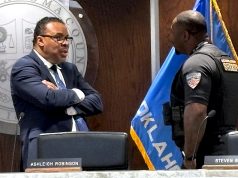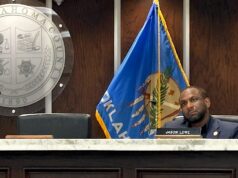


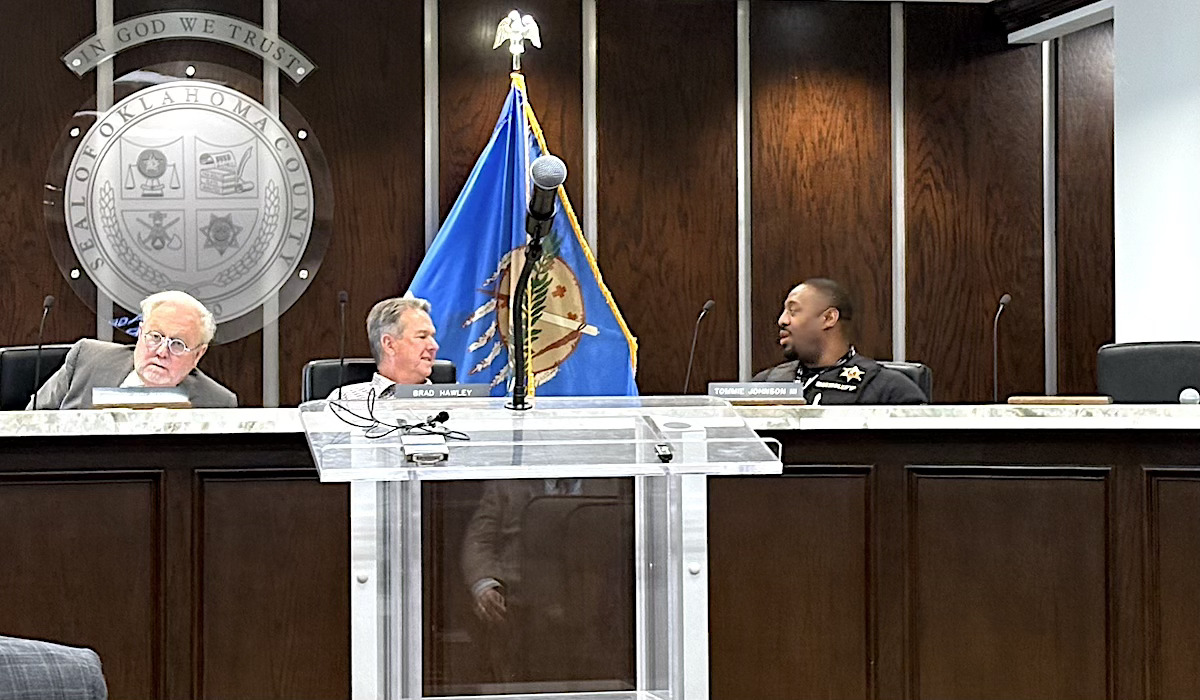

Led by District 1 Commissioner Jason Lowe, the Oklahoma County Budget Board took the initial step in dissolving the jail trust during a special meeting on Wednesday while also delaying $2.6 million in supplemental funding for the troubled facility.
The vote, which officially recommended the Oklahoma County commissioners begin the formal process of dissolving the trust, passed 6-1 with one abstention. District 2 Commissioner Brian Maughan voted against the proposal. Paul Foster, who is District 3 Commissioner Myles Davidson’s chief of staff, abstained.
The Oklahoma County Criminal Justice Authority, colloquially known as the jail trust, has handled the day-to-day operations of the jail since July 2020, but not without controversy. About 60 detainees in the jail’s custody have died in that time, and more recently, the facility has been plagued by budget problems that included a seemingly unauthorized pay raise given to jail employees after the trust voted to delay raises earlier this year. The money squabbles come in the wake of jail trust chairman Jim Holman warning over a $5.8 million funding gap at the facility, which he said could significantly impact its operations.
Lowe, who has repeatedly called for the jail trust to be disbanded and return operational responsibilities to the Oklahoma County Sheriff’s Office, said the time has come for the trust to end.
“Enough is enough. It’s time for the trust to dissolve,” he told fellow budget board members on Wednesday.
Lowe said following the meeting that the three-member board of county commissioners would next need to vote to ask the jail trust to dissolve itself. At that point, dissolution would be taken up by the jail trust. Lowe said the nine-member board would need to vote unanimously to disband itself.
Wednesday’s resolution to start the process of dissolving the jail has no operational effect on the jail, and Maughan said he has been told by Holman that he does not intend to vote to dissolve the trust.
“The only leverage they have is just the one that they exercised today, which is to take away funds,” Maughan said of the budget board deferral.
Since Lowe has indicated he will vote in favor of dissolving the trust, while Maughan today voted against it, the next step in the dissolution process will likely come down to District 3 Commissioner Myles Davidson. Davidson was not present at Wednesday’s meeting.
Lowe said he is confident commissioners would move the effort to disband the jail forward.
“I think reality has set in, and I think folks know that, finally, we need to move on from this,” Lowe said. “It’s been a failed experiment, and again, I think that reality has set in.”
Wednesday’s vote comes just over a week after the trust’s latest controversy. During a contentious meeting on March 9, Holman and trust member Pastor Derrick Scobey clashed over a pay raise for jail staff that the jail trust voted to table in January. Those raises were later approved by jail administrator Tim Kimrey with Holman’s support.
In that meeting, Scobey pressed Holman and Kimrey on raises for jail staff. Initially, the total cost was estimated to be more than $3 million annually, but a statement released by the jail trust on Friday said the amount would be far lower than that.
According to the jail trust’s press release, the raises amounted to a $7,000 pay bump for 40 officers at the jail, which would cost about $280,000 annually, or about $140,000 for the remainder of the fiscal year.
“During the March 10, 2026, meeting, Mr. Scobey combined the issues of budget shortfall and salary adjustments into a single topic, accusing Chairman Holman and Mr. Kimrey of disregarding the trust’s vote,” the statement said. “Chairman Holman responded by clarifying that no raises were given after the vote on the proposed $3.4 million salary increase, emphasizing that he did not override the Board’s decision. Mr. Kimrey confirmed that he did not authorize any raises that had not already been discussed prior to the January 12 meeting. The confusion stemmed from Mr. Scobey’s mistakenly treating these two separate issues as one, which could have avoided a great deal of the misunderstanding and tension that it caused. Both Mr. Holman and Mr. Kimrey have reviewed the situation and present this detailed account to accurately reflect the facts.”
Supplemental jail funds tabled for now, Maughan fears DOJ intervention

The issue of supplemental funding for the jail was on the budget board agenda on Wednesday. An agenda item that would have transferred about $2.6 million in funding to the jail, including about $300,000 from the Juul settlement fund, was tabled until the next meeting, which will not occur for at least 30 days. Lowe told fellow budget board members he is opposed to transferring the amount to the jail trust for its operations because of uncertainty about how the jail ended up with a significant deficit.
“I think everyone here wants to fully fund the jail, but I’m not just going to give you $2 million [if] you’re not going to tell me why you need $2 million and why you’re in this position,” Lowe said. “I think that’s irresponsible for us to vote for this as far as a board, not to have the answers we need. The taxpayers need to know why we are in this position. This is taxpayer money. These aren’t our personal funds. They need answers, and we can’t provide those answers. So we’re going to shell out $2 million and not know why? That’s insane.”
Holman told the budget board in February that if a more-than-$5 million funding deficit was not addressed with additional funding, the jail would be forced to furlough more than half of its staff.
Maughan said he voted against Lowe’s proposal to begin dissolution proceedings because funding problems existed before the raises were approved.
“I believe that there is a budget failure at the jail,” Maughan said. “I believe there was before the raises were given, and if they don’t have operational funds, they will be forced to issue furloughs. When the chairman of the jail trust appeared in front of the budget board in February, he said that if money wasn’t given that was needed — which at that time was about $5.3 million — they would need to lay off 55 percent of their employees. He then went to [the Oklahoma County Criminal Justice Advisory Council] that day and repeated it. So both of those were public meetings. That was public notice from the chairman of the board. I have discussed that with Mr. Kimrey as well.”
Many officials believe May 1 is the current deadline to grant the supplemental funding before layoffs would be necessary, but Maughan said it may already be too late to avoid furloughing some jail employees, given the funding constraints.
“They’re putting all the emphasis on May 1, but there’s no time for the jail trust to recover by the end (of the current fiscal year) if they don’t receive adequate funding, whatever that number happens to be on May 1,” Maughan said. “I was hopeful that if they could just wait until we got to today’s budget board, they would receive some supplemental funding and avoid furloughs to the majority, if not altogether. So if we wait until May 1, when they are completely out of money, and the budget board should fail to act or act with a sufficient amount, they don’t have enough time in the fiscal year to make up for it.”
Maughan said he sees the funding issue as far more pressing at the moment than the dissolution of the jail trust.
“Absolutely,” he said when asked if that was the case. “You’ve got the possibility of having the National Guard or the Department of Corrections coming in and taking over, which will probably prompt the Department of Justice to take some kind of action.”
(Clarification: This article’s headline was updated at 5:55 p.m. Wednesday, March 18, about 30 minutes after its publication.)