

Jobs at the Oklahoma County Jail are safe, at least for now, after about $4.6 million in supplemental funding was approved Tuesday amid a series of back-to-back meetings that included clashing jail trust members and admonishments from elected officials about how the facility’s governing body needs to do a better job managing its finances.
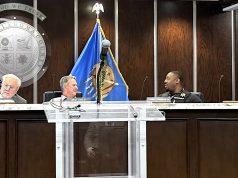
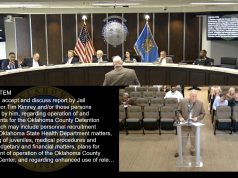
Proceedings got off to a rocky start owing to procedural issues. Both the Oklahoma County Criminal Justice Authority — or jail trust — and Oklahoma County Budget Board, which controls spending, met Tuesday morning in what would eventually become a sort of do-si-do between the two bodies. First up, the jail trust discussed requesting additional funding from the county and recessed. Next, the budget board planned to take up that request.
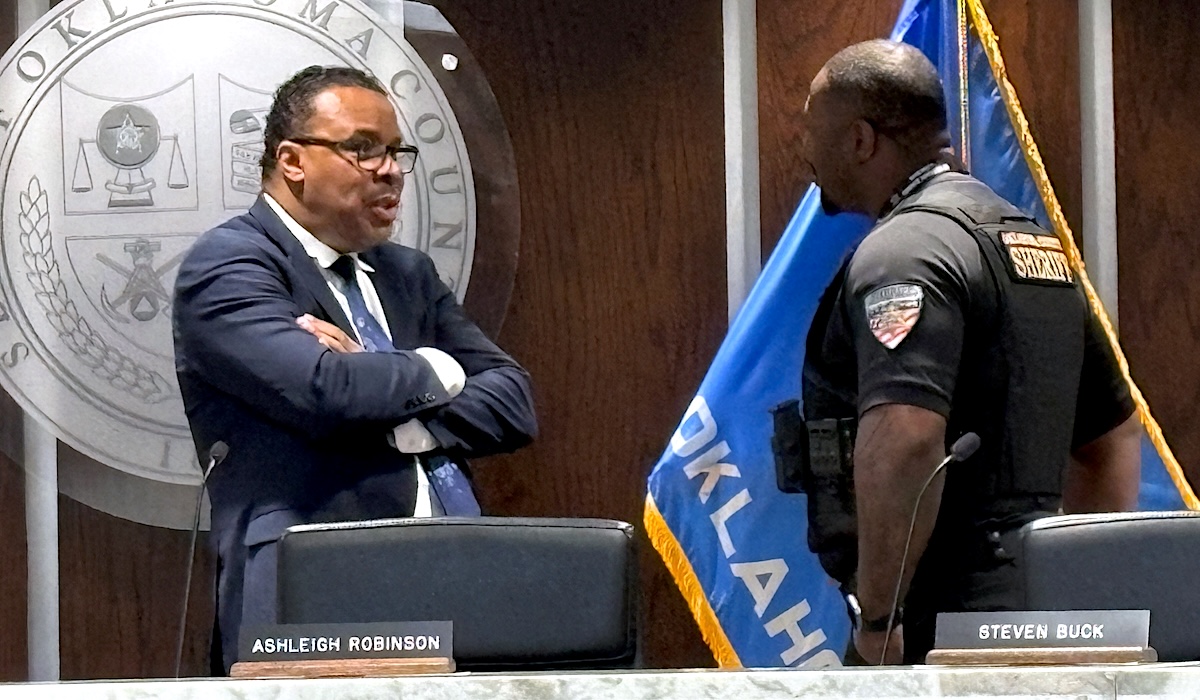
But the budget board got off to a false start when the jail trust did not formally approve a request to send to the budget board. As the budget board gaveled in, court clerk and budget board member Rick Warren reminded Chairman Brian Maughan that the jail trust had not formally approved the request for additional funds during their meeting moments before. With that, the budget board recessed briefly, allowing the jail trust to once again take over the horseshoe to formally request the funding from the budget board.
The need for additional funding was first brought up by former jail administrator Paul Timmons, who told members of the trust in July 2025 that the jail didn’t have enough money to get through the entire Fiscal Year 2026, which ends June 30. At the time, Timmons estimated the shortfall to be about $5.8 million.
Timmons later resigned, and Tim Kimrey took over as jail administrator in November. Since then, he has worked to reduce costs. Kimrey told trust members Tuesday he has reduced about $1 million in expenses so far this year through a series of cuts and renegotiated contracts, among other means.
But that still left the jail in the hole financially and facing the possibility of laying off about half of its 338 employees if it did not receive supplemental funding. Maughan told The Oklahoman last week that the Oklahoma National Guard could be called to supervise detainees at the jail in the event of mass layoffs.
But those layoffs have been paused, at least for now, with the supplemental funding. Kimrey said he was relieved with the outcome.
“It’s going to sustain us for the next couple of months to the end of the fiscal year,” Kimrey told reporters Tuesday. “So we’re very pleased. We know it’s been, like I said at the start of the meeting, it’s been a rough couple months. There’s been some disagreement. I understand that. But the jail has historically always been a problem. There have been some issues. Funding has always been an issue. Even under previous sheriffs, we know that. The jail deaths, if you can go all the way back to 2016, I think there were 19 jail deaths under the sheriff here. So that’s one thing that we had to fix, obviously, with the death rate that was going on inside the county jail. I’m very pleased with the staff. They’ve worked very hard.”
Holman, Scobey clash again
The resolution for supplemental funding came after the trust meeting, which included a tense back-and-forth between trust Chairman Jim Holman and trust member Derrick Scobey. At one point, Scobey said the trust’s meeting was pointless, given that the budget board controlled the funding for the jail. Holman said the meeting was taking place to provide a recommendation for the budget board from the jail trust. Scobey also said Kimrey and Holman had inadequately explained how the deficit grew in the first place.
“This body is not funding the jail, and we don’t know how we got here,” Scobey said.
Holman then accused Scobey of not attending regular informal briefings of the trust held most Tuesday mornings. These are separate from regular trust meetings, and no business is conducted.
“When you say you have no experience with these, you don’t show up when the briefings take place,” Holman told Scobey.
Scobey shot back, “I don’t know that you have invited me.”
Holman responded, “You’re throwing a dart in the dark.”
Scobey said, “No, you’re throwing a dart in the dark, because we don’t have that number.”
Oklahoma County Sheriff Tommie Johnson attempted to break up the exchange by saying he had not attended the informal briefings either but had watched how the county’s budget evaluation team had addressed the jail shortfall in its meetings. Johnson said he remains uncertain as to how the budget crisis developed.
“I certainly watch [budget evaluation team meetings], and in BET, there are a lot of questions asked as to how we arrived here,” Johnson said. “There have been a number of attempts as to how we’ve arrived here, and that has never been explained in BET.”
The $4.6 million approved Tuesday by the budget board will be distributed in equal monthly installments of about $1.5 million each over the next three months. Johnson, who is also a member of the jail trust, was the only budget board member who voted against the additional funding. Johnson cited the need to work within constraints and the uncertainty of how the budget hole developed.
“I don’t want my ‘No’ vote to represent my unwillingness to help, because I do believe in teamwork, and I think that’s what we are all about here at the county,” Johnson told fellow trust members. “But I certainly want to signal the slippery slope that I do believe we’re on — the fact that you can’t see where the money or where the funds went astray for us from being able to adequately help and solve an issue. I just think that just to throw money at something that we know nothing about is kind of ill-advised. But I do respect the group and their decision.”
In remarks at the end of the budget board meeting, Warren criticized the trust for not speaking up sooner about their money problems. Warren specifically seemed to criticize Holman, who approved a series of pay increases for jail employees after the jail trust had voted to defer those pay raises to another time because of money constraints. That decision stirred controversy and led some to call for Holman to step down.
“For you to just jump out there and do it, that does not represent this board at all, so we need you to start following the budget, we need you to go out and seek other alternatives for support of this county jail, which is in your indenture and you have not done it all the years it’s been there, not one time have you gone out and tried to find other sources of income as your indenture points out to you,” Warren said. “I wish you would take a hard look at your indenture and actually read it.”
Kimrey: Jail needs more money in the long run

Oklahoma County’s entire budget is about $126 million per year as the only county in the state without a sales tax, something that may change in the near future. County commissioners are attempting to find a way to bridge a more-than-$400 million funding gap for the construction of a new county jail through a proposed sales tax. Some of that tax, should it be approved by voters, could also be used to operate the jail.
Kimrey told reporters, following the conclusion of both meetings, that the bottom line remains that the jail needs more money to operate. He said the facility’s budget has remained mostly flat at $33 million for the last four or five years, with little room in the county budget to adjust that figure.
“I have 338 employees, and I’ve got anywhere from 1,500 to 1,800 inmates that I have to worry about,” Kimrey said. “That takes a lot of money. There are some constitutional obligations that we’re required to maintain, and it’s hard to do. So we’re hoping that going forward, we get the proper funding for the jail. I think just a rough number, and I know I’m probably going to be held to this, so this is just an estimate on what I know so far, and looking at our budget going forward, it probably takes about $43 or $44 million to run the Oklahoma County Jail. So we’ve got to get off that $33 million. I know they don’t want to hear that, but if we’re going to run it effectively and efficiently and make all these improvements that we’ve made, we have to have the funding and the resources to be able to do that.”
District 1 Commissioner Jason Lowe said he believes it’s time to return the jail to the sheriff’s office, calling the trust a failure. However, Lowe and fellow commissioners Brian Maughan and Myles Davidson all voted for the supplemental funding.
During the March 18 meeting of the budget board, Lowe put forth a proposal for a non-binding recommendation for the dissolution of the jail trust, which passed. However, that is unlikely to happen anytime soon.
“I’ve been saying for weeks now, the Oklahoma County Criminal Justice Authority is a failed experiment,” Lowe told fellow budget board members Tuesday. “The lack of accountability and transparency from the trust since its inception cannot be ignored any longer. The talk of reforms and more involvement from the trust as a body is too little, too late. Since its inception, the trust has never formally adopted a budget. I repeat, never formally adopted a budget. As a body, they have failed to approve the transfer of funds within operating lines — operating line items for salary, benefits, operations, travel and capital expenditures. I will vote in favor of bailing out the trust today, not because I believe they will be able to get their financial house in order, but rather because the employees at the detention center should not be used as pawns to cover up for the failings of the body as a whole.”
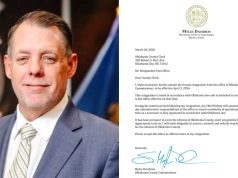
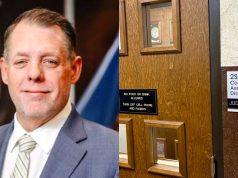
While the jail trust will likely continue running the jail’s operations, it’s unclear for how long. While Lowe is ready to dissolve the trust, Maughan has said he opposes its dissolution. District 3 Commissioner Myles Davidson’s last day on the job is April 3, after he announced his resignation earlier this month. Davidson has been a long-term supporter of the jail trust. His decision to step down followed a Cleveland County District Court Judge’s granting of a victim’s protective order against him. Davidson was up for reelection this year. His chief deputy, Paul Foster, will serve out the remainder of Davidson’s term. Foster recently told The Oklahoman he sees the trust as a failure.
“In many ways, it’s been a failed experiment,” Foster said.