


Muscogee Nation courts have a busy month ahead of them as the criminal case against Rep. Robyn Whitecloud continues in district court, while attorneys representing Muscogee Freedmen Jeff Kennedy and Rhonda Grayson filed two separate motions in the nation’s Supreme Court, including a request to delay the tribe’s May 30 special election.
In district court, Whitecloud is charged with four counts of preventing or attempting to prevent the performance of official acts for allegedly taking her colleagues’ mail from the offices of the Muscogee National Council. On March 2, she filed motions to disqualify the Attorney General’s Office and suppress a search warrant filed against her. The next court hearing is set for April 6.
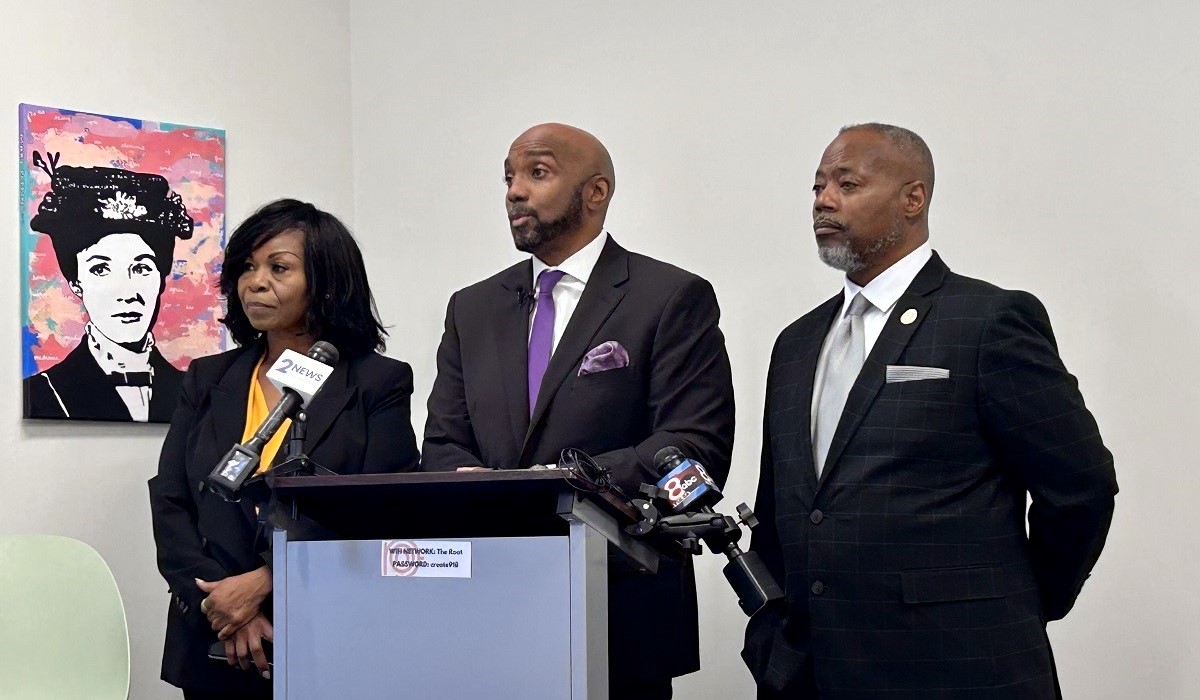
Meanwhile, attorney Damario Solomon-Simmons announced his office has filed two new motions in the Muscogee Freedmen citizenship case seeking to delay the Muscogee Nation’s May 30 election and hold Muscogee Nation Principal Chief David Hill in contempt of court for not issuing his clients citizenship cards.
“Because of Chief Hill’s obstruction, Creeks of African descent have not been able to enroll. And as of just today, there are an estimated 4,000 Creek Freedmen descendants who have submitted their applications — who are, in fact, eligible for citizenship. And yet, they have been denied citizenship, and they’ve been denied the right to vote,” Solomon-Simmons said during a March 10 press conference. “There are tens of thousands of Creeks of African descent who are eligible for citizenship. According to the federal government (in a Government Accountability Office report), they estimate 47,000 to 117,000 Black Creek Indians who are eligible for citizenship, and yet each one of those individual citizens of Creek African descent are still being discriminated against.”
While Solomon-Simmons filed for an injunction preventing the May 30 election, the Muscogee Nation is preparing to vote on four constitutional amendments this year, at least one of which appears directly inspired by the Tulsa-based attorney’s litigation against a special justice law struck down last year.
Term limits for tribal councilors, changing the official spelling of “Muscogee” to “Mvskoke,” and allowing more special election flexibility are also set to be voted on in May without the participation of Freedmen descendants.
Whitecloud files to disqualify AG, suppress search warrant

Through attorney Ryan Cannonie, Whitecloud filed a motion to disqualify the Muscogee Nation Attorney General’s Office, led by Geri Wisner, from prosecuting her case. While the motion does not cite any legal authority, it argues the Attorney General’s Office has a conflict of interest because it also represented the National Council and that the council’s formal rejection of Wisner’s attorney general nomination could create the perception of bias.
“This is even more pertinent given Rep. Whitecloud’s vote against the appointment of the current attorney general,” Cannonie wrote. “The possibility or appearance of bias, or retaliation, does serious and long term detriment to the status and legitimacy of this court.”
As a result, Whitecloud requested the court appoint a special prosecutor to handle her case if the Attorney General’s Office is disqualified.
She also filed a motion to quash a Feb. 2 search warrant, arguing the warrant was unconstitutionally broad and violated the Indian Civil Rights Act’s Fourth Amendment protections. While United States constitutional amendments are not binding on tribal governments, the Indian Civil Rights Act generally requires tribal governments to follow the Fourth Amendment.
“The warrant authorizes the search and seizure of ‘personal electronic communication devices such as cellular phones, which would be capable of communication with co-conspirators,’ without any limitation as to the specific device, model, or relevant time frame, nor any connection to the alleged offense. Such a broad and undefined description effectively grants law enforcement unfettered discretion to seize any and all electronic devices in the possession of the target, amounting to a general warrant,” Cannonie argued. “There are no facts presented to suggest that any communication relevant to the alleged offense occurred via cellular phone, nor that any such device contains evidence of wrongdoing.”
Whitecloud’s motion argues that any evidence seized from the alleged unlawful search should be suppressed.
Muscogee Nation special election set for 4 constitutional amendments
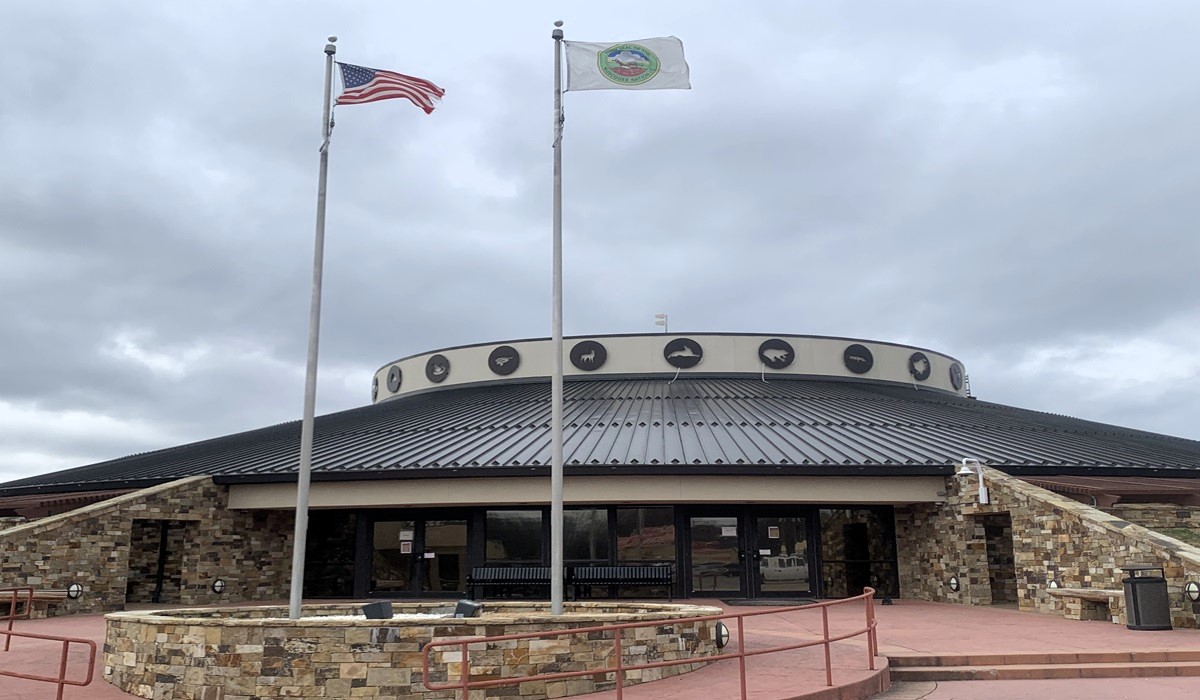
Citizens of the Muscogee Nation are currently set to vote on four constitutional amendments during a May 30 special election, according to Mvskoke Media. The amendments range from the symbolic removal of the word “Creek” from the nation’s constitution, to term limits for Muscogee National Council representatives and a change that would allow the principal chief to make special justice appointments for the Supreme Court.
NCA 26-030, the special justice amendment, proposes the most substantive change among the four ballot questions, and it appears to be a direct response to inter-branch tensions within the nation. Last April, the Muscogee Supreme Court struck down a “special justice” law passed by the Muscogee National Council before issuing a July ruling in favor of Muscogee Freedmen descendants having a right to citizenship within the nation.
After ruling the special justice law unconstitutional, the Muscogee Supreme Court created its own rules for appointing temporary justices when a justice recuses. As proposed to voters May 30, the special justice amendment would override the Muscogee Supreme Court’s temporary justice rules and replace them with a constitutional rule for the appointment of a special justice in the event of a recusal.
“If for any reason, one or more Supreme Court justices recuse from a case, special justices shall be appointed [by the principal chief, subject to majority approval by the Muscogee National Council], to ensure that seven justices hear each case,” the proposed amendment states. “The appointment of the special justices shall only be for a particular case and shall expire at the conclusion of the case.”
The amendment does not address potential conflicts of interest which may arise when the principal chief’s office is a party to litigation or could be adversely affected by the pending case at hand, nor does it address the potential appearance of impropriety — conduct that clearly imposes on a judge’s independence — that could arise from allowing a party to a case to appoint temporary justices only for that case.
Also on the May 30 ballot, the other major substantive amendment is NCA 26-038, which would limit council representatives to serving three full four-year terms on the council. The amendment would begin counting terms starting in 2028. The 12-year limit would largely mirror term limits that exist for the Oklahoma Legislature.
While impossible to litigate until after someone reaches the term limit in 2040, the amendment’s wording could potentially allow term-limited representatives to be eligible to run in future special elections.
NCA 26-031, the special election amendment, would change the special election timeframe requirement in the Muscogee Constitution to give slightly more flexibility in setting special elections. Currently, the principal chief must set a special election date within 30 days of the Muscogee National Council passing an amendment ordinance.
If passed, the amendment would allow the chief to set a special election on the same day as a general election if the amendment ordinance is passed 90 days before a general election.
Finally, NCA 25-109 is proposed to removed the word “Creek” from the nation’s constitution and laws, and to replace the English spelling of “Muscogee” with the traditional Muscogee language spelling of “Mvskoke.” Like many Indigenous languages, the Muscogee language is considered endangered, with a 2024 estimate putting the number of fluent speakers at around 500. Proponents of the measure argue the change will help preserve the tribe’s history and language. The Muscogee language is a member of the Muskogean language family, which also includes the Choctaw and Chickasaw languages.
Whether to remove the word “Creek” from the tribe’s identity has been a debate for years, with the Muscogee (Creek) Nation long designated as the formal name. In 2021, a rebranding effort that included a logo change initially removed “Creek” from tribal leaders’ statements and correspondence, but the colonial-era term designated by the British largely remained in use the despite that formal announcement.
Muscogee Freedmen file injunction to postpone May election, hold chief in contempt
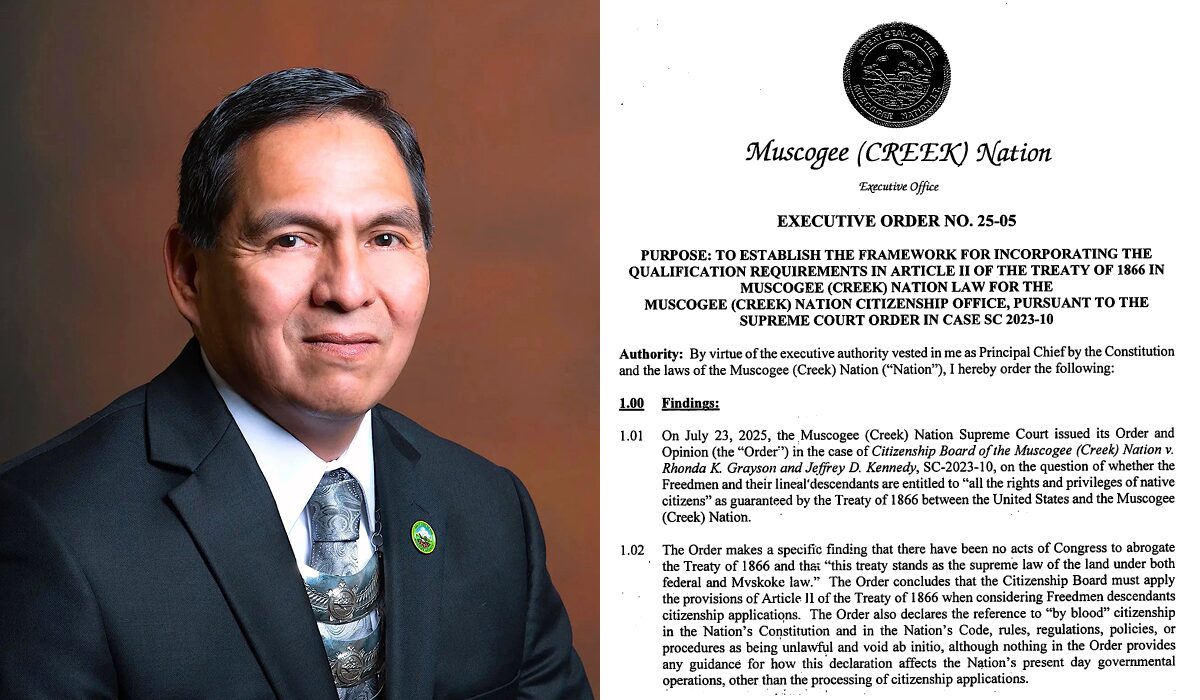
Whether Muscogee citizens will decide the four proposed constitutional amendments May 30 remains to be seen.
On March 10, Solomon-Simmons announced his office had filed two motions with the Muscogee Nation Supreme Court the day before, each involving his clients’ long fight seeking citizenship for the descendants of former Muscogee slaves. Last July, the tribe’s high court determined the Treaty of 1866 requires Freedmen citizenship.”
“First, we asked that the court hold the (Muscogee Nation) citizenship board and Chief Hill in contempt for willfully disobeying their court order,” Solomon-Simmons said during a press conference. “Secondly — and we really thought about this a long time before we filed this second motion — we have asked the Muscogee Nation Supreme Court to postpone all elections within the Creek Nation until they start enrolling Creeks of African descent. We did not want to do that. They have forced us to make this filing. They have forced us to go to the court and ask for this relief.”
At his press conference, Solomon-Simmons argued the Muscogee Nation’s sluggish response to its Supreme Court’s ruling last year has been “an assault on our dignity as Black people” and undermined the rule of law.
“As a lawyer, I’m concerned because the Creek Nation is showing itself to be not a nation of laws, but a nation of men. Because a nation of laws will follow the law. They’re disobeying their own court system,” Solomon-Simmons said. “That puts all tribal sovereignty in jeopardy, because we all, as Creek citizens and native people, want treaties to be followed. If our own nation won’t uphold and follow it, why would the United States do it? So this is even bigger than anti-Black discrimination, this is about the rule of law. This is about, ‘Will you listen to our Supreme Court?'”
He also vowed to continue fighting for the citizenship rights of Muscogee Freedmen descendants, arguing their ancestors’ contributions to the Muscogee Nation are a vital part of the tribe’s history.
“We know who our nation is. We know what the contribution of our people was. We know that our people spoke the language. We know that our people walked the Trail of Tears just like other Creeks,” Solomon-Simmons said. “We know that some of our people were enslaved and built up the Creek Nation and then rebuilt it after the Civil War. We know that, without Creeks of African descent, there might not even be a Creek Nation today. And that’s why we will not give up this fight.”
The contempt motion argues that both the nation’s citizenship board and Hill should be held in contempt by the court, and it also notes the only alternative to the Supreme Court taking action to force compliance would be filing in federal court.
“Regrettably, without action from this court, respondents are left with no other option for relief besides filing in federal court,” a footnote in the motion remarked.
The motion for the restraining order and temporary injunction asked the court to delay the May 30 election until “Muscogee Freedmen with pending applications are rightfully granted their citizenship cards,” or instead order the nation to allow Muscogee Freedmen to cast provisional ballots in the election.
Asked why his filings did not mention the Muscogee National Council — which Hill’s administration has argued is responsible for changing the nation’s laws to comply with the court’s order — Solomon-Simmons that argued including them would not have been appropriate.
“Our position is the citizenship board doesn’t have to do anything but follow the order of the Muscogee Supreme Court,” Solomon-Simmons said. “The court has spoken. The court said, ‘You need to do this.’ They are willfully and voluntarily listening to what Chief David Hill is telling them to do. So this is a constitutional issue within the Creek Nation. And that’s why we say, does the rule of law apply, or does the rule of David Hill apply?”
Asked about the filings, Muscogee Nation press secretary Jason Salsman said Hill’s administration is working to create “consistent standards before moving forward.”
“We understand that this is an emotional issue for many people. However, that cannot supersede the critical work of ensuring that the nation establishes fair, transparent and consistent standards before moving forward,” Salsman said. “We remain committed to carrying out this work thoughtfully and responsibly so that the process is grounded in the governing law of the Muscogee Nation.”