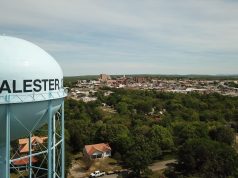


If voters in McAlester approve a one-cent sales tax increase April 7, the city would generate an estimated $4.5 million a year for street repairs over a decade — and become the largest city in Oklahoma with a municipal sales tax rate of at least five cents.
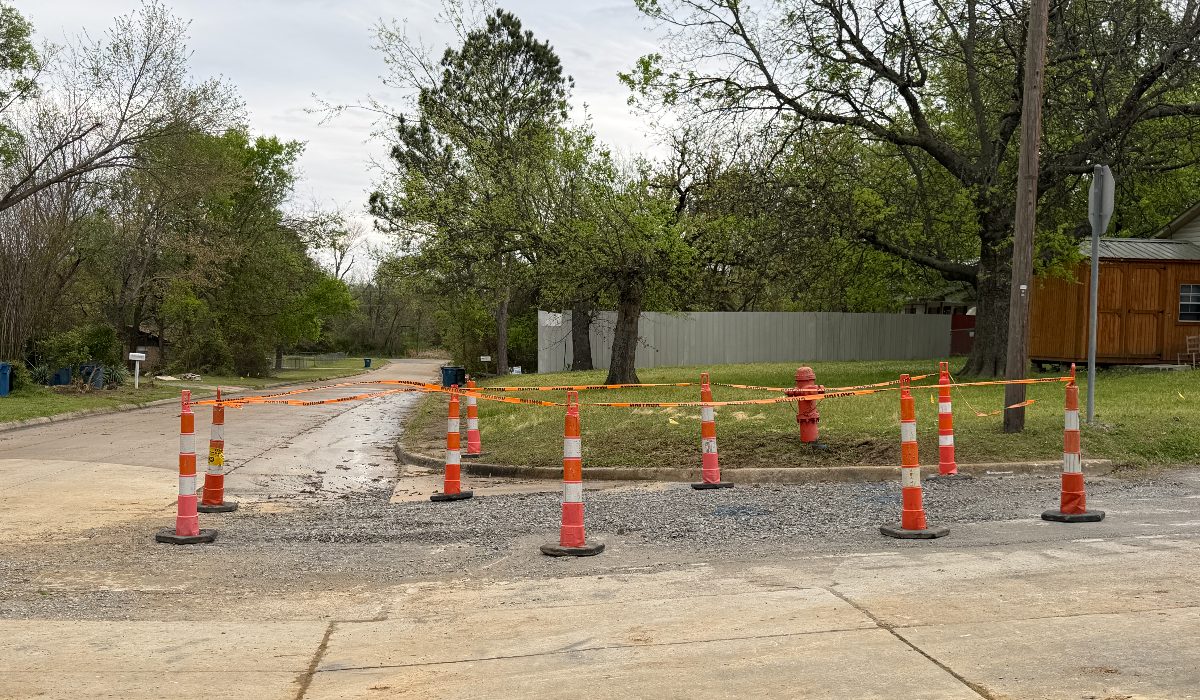
The April 7 election comes after city leaders looked at ways to fund street projects in southeast Oklahoma’s second-largest city, where a 2023 road assessment rated 37 percent of the city’s roads as poor or very poor.
McAlester Mayor Justin Few said city leaders decided to propose the additional sales tax to create a “dedicated, voter-approved funding source for streets and infrastructure without cutting services or adding new long-term debt.”
“The alternative is to continue falling behind or take on more long-term debt, and we’ve seen what that can mean over time,” Few said.
John Wolfe, with Municipal Finance Services Inc., told city councilors during an Oct. 14 special council meeting that the fortunate thing about McAlester is it’s a hub.
“If you were a community 10 miles out of McAlester, and they were looking at raising their sales tax, they probably have a greater concern that their constituents would come to McAlester and shop if they could save 1 percent off their sales tax or more,” Wolfe told councilors.
Sales tax rates
Currently, shoppers generally pay a combined 10% sales tax rate in McAlester. The state of Oklahoma collects a 4.5% sales tax on non-grocery items, Pittsburg County collects a 1.5% sales tax, and the City of McAlester collects a 4% sales tax.
The April 7 proposal for another 1% tax to fund city street repairs would increase the combined rate in McAlester to 11%.
Data from the Oklahoma Tax Commission show 27 cities in Oklahoma have a city sales tax of five cents, including neighboring Savanna and Kiowa. Only three cities have a tax rate higher than five cents: Choctaw and Okeene at 5.23 cents and Watonga at six cents.
The council also discussed the possibility of proposing higher property taxes but was advised to consider the city’s outstanding $26 million worth of bonds, for which residents still foot the bill on $450,000 monthly payments decades later.
After another discussion was held during a Nov. 12 special meeting, the council approved its resolution Jan. 13 to call for a vote on the sales tax increase. If approved, the tax would go into effect July 1 and end in 2036. All funding would be dedicated to streets and infrastructure by law and would be overseen by a citizen-led commission.
Proactive vs. reactive

The City of McAlester currently maintains 166 lane miles of streets with about a half-cent of the city’s current four-cent sales tax dedicated to street maintenance.
At current funding levels, the mayor said it would take about 110 years for all the roads in the city to be repaired.
“Our funding constraint is we only have half-a-cent that is dedicated to our streets, which is about $1.5 million a year,” Few said. “And that’s roughly the cost to fully construct a single city block.”
Philosophically, city leaders would like to be proactive rather than reactive in terms of utility line repairs.
“What we want to do is, when we put down the street, we don’t want to have a water break two weeks later, Few said. “We want to be able to fix the water lines and sewer lines, get the streets where they need to be, and not have this patchy street that is constantly just cut up.”
According to the city’s 2025-2026 fiscal year budget, McAlester allocated $1.25 million for streets, which includes $825,327 in compensation for 14 employees, leaving approximately $424,000 for day-to-day operations and routine maintenance like patching and minor repairs.
Adrian O’Hanlon, the city’s public information officer, said the current $1.5 million streets budget doesn’t include other allocations made by the council for road repairs. An additional $1.75 million has been approved for asphalt overlay projects, concrete panel replacement, crack sealing, sidewalks and repairs following utility work. He said the additional money is “what goes toward actual street reconstruction and improvements and can change from year to year depending on budget and priority projects.”
City addresses questions during town hall, online

City officials held a town hall regarding the upcoming vote March 19 at the S. Arch Thompson Auditorium in McAlester. About three dozen citizens attended the forum to hear from Few and McAlester interim city manager Ken Wimer. They were also introduced to members of the Citizens Street Improvement Commission.
Few spoke about how the city is fighting “malfeasance from decades-old infrastructure, neglect, and mismanagement.”
“I know sometimes it’s hard to get over a reputation,” Few said. “Any questions on any perception from the past or anything, we’d be happy to address.”
When it came to the outstanding property tax bonds — the oldest being from 1999 — Few said the city has had to refinance those loans over the years. However, Few announced at the meeting that a bond from 2012 had been paid off.
“Like many municipalities around Oklahoma, we have to borrow money,” Few said. “What has happened is, money has been borrowed, and it’s like, ‘Hey, we need a little more money. Let’s just refinance that debt. We need a little bit more money, let’s refinance that debt.’”
The mayor said that is the reason the city did not pursue a bond and instead wanted a shared collection of people coming into the city to help pay for the project through tax dollars.
Also announced during the meeting was the early conclusion of a $5.5 million tax increment finance district for the Shops at McAlester, a large retail outlet located off U.S. Highway 69 on the south side of town. The TIF payoff is expected to result in more than $1 million of additional annual tax revenue for the city in future years.
Few said that, despite the payoffs, there will only be some funding available to spend on city services.
“You can’t just say, ‘Hey, it’s paid off. We’re going to get this big bundle of money,’” Few said, explaining that the funds will mostly help pay down the city’s bond debt. “That’s not going to help our General Fund.”
From the audience, former McAlester Mayor John Browne brought up 2018 bonds that are on the books for McAlester Public Schools and for the cancer center at McAlester Regional Health Center. Both are set to end in 2033. The expiration of the school bonds could reduce residents’ property taxes if they are not renewed — voters recently rejected an MPS bond proposal to fund a $4.7 million STEM center — and the one-eighth sales tax for the cancer center could be allowed to expire as well.
“So when people look at this and say, ‘It’s going to be 11 percent, it’s going to be 11 percent forever,’ that’s not an accurate way to look at it,” Browne said.
Asked if the 10-year sales tax proposed on voters’ April 7 ballots would allow the city to hire more employees or whether the additional projects would be contracted out, Wimer said it would be a mix of the two options.
“I would probably have to hire 16 to 20 more people. So that’s a bump in salary,” Wimer said. “In the long run, it’s cheaper for us to contract.”
Few asked voters to give the additional one-cent tax a chance, as he said he believes new business growth is on the way.
“Give us 10 years,” Few said. “Roads are a big project. (It) takes a lot of time, takes a lot of money. So we want to put a sunset on this. If we’re not doing what we said we [would] at the end of this term, you know, you don’t have to rebuild it in. It gives it an ending point.”
Follow @NonDocMedia on:
Changes to city charter also on ballot
McAlester voters will also see a pair of other questions on their April 7 ballot concerning changes to the city’s charter.
Proposition 2 involves emergency spending by the council. The change would allow the council to respond more quickly to major infrastructure issues or emergencies by updating current voter-approval requirements for certain large expenditures.
Few cited a 2023 catastrophic pump failure at the city’s water treatment plant and highlighted how Section 5.11 of the charter currently states the city must take any creation of indebtedness above $1 million to a vote of the people.
“That major failure was $2.3 million,” Few said. “As currently written in our charter, if we did not have our emergency funds in place, that emergency repair would have to go to the vote of the people, and you’re looking at a minimum of 90 days. If the voters didn’t approve it, we would still be stuck without a water treatment plant.”
Proposition 3 would amend the qualifications for the city manager as found in Article 3 of the charter.
Few said the update is needed to modernize the requirements and allow broader, relevant professional experience for future managers.
“The way that our current qualifications are written, Jeff Bezos and Elon Musk are not qualified to run the City of McAlester,” Few said.
Polls are open from 7 a.m. to 7 p.m. Tuesday, April 7, with early voting set for Thursday, April 2, and Friday, April 3, at the Pittsburg County Election Board.