


The Choctaw Nation of Oklahoma Tribal Council voted unanimously Feb. 14 to broaden and clarify the tribe’s criminal code, approving amendments that assert the nation can hold any person — not just Indians — within its southeast Oklahoma reservation liable for crimes within its jurisdiction to the extent allowed under federal law.
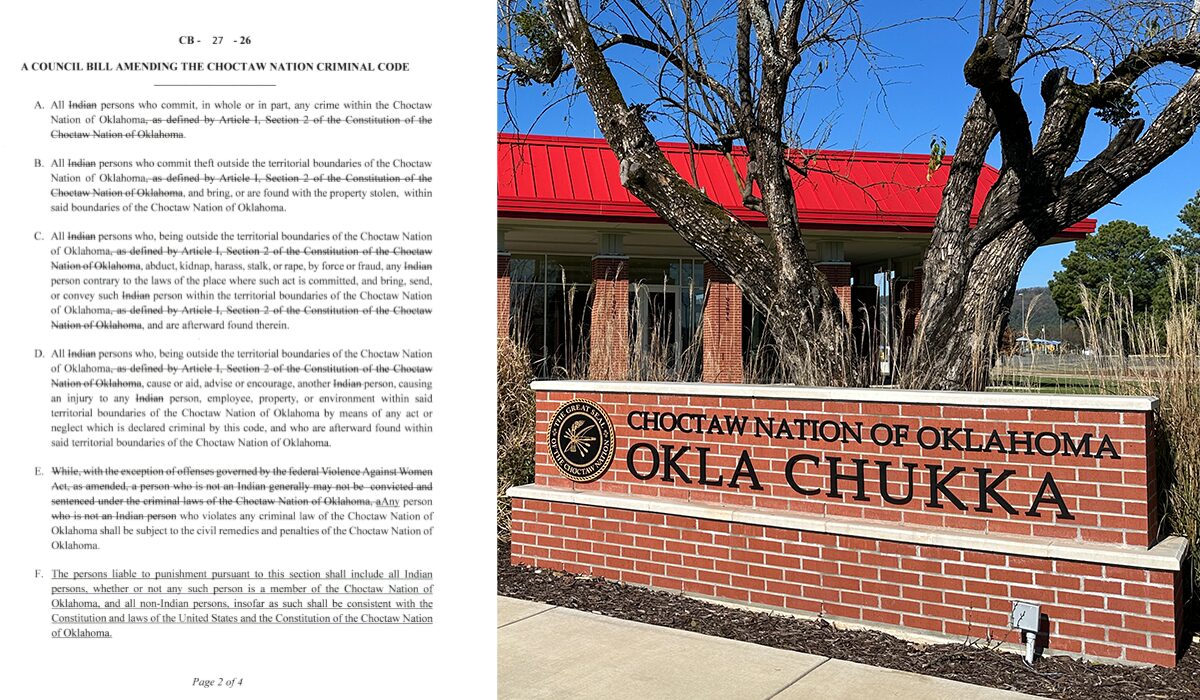
Chief Gary Batton signed Council Bill 27-26 into law Feb. 17, enacting changes to Section 151 of the tribe’s criminal code. The revisions more clearly define “persons liable to punishment within the Choctaw Nation of Oklahoma” and outline categories of individuals subject to tribal prosecution, including non-Indians who commit crimes wholly or partially within the nation’s territorial boundaries.
The move advances tribal sovereignty amid legal fights over criminal jurisdiction across the affirmed reservations that span eastern Oklahoma, including the pending prosecution of a county jail employee that has been challenged in federal court and could affect the application of tribal jurisdiction over non-Indians.
In the bill, Choctaw Tribal Council members stated their intent that tribal jurisdiction “be exercised as broadly as possible, consistent with the Constitution and laws of the United States and the Constitution of the Choctaw Nation of Oklahoma.”
Sean Bradley, the tribe’s executive director of legal operations, said in an emailed statement that the changes modernize and strengthen the Choctaw Nation’s criminal code.
“CB-27-26 is intended to modernize and strengthen Section 151 of the Choctaw Nation Criminal Code by clarifying who may be prosecuted and ensuring that the Nation’s jurisdiction is exercised to the fullest extent permitted under federal law,” Bradley said. “The removal of the term ‘Indian’ ensures the criminal code is consistent with federal statutes, including the Violence Against Women Act, that authorize tribes to exercise criminal jurisdiction over certain non-Indians in defined circumstances.”
Congress first enacted the Violence Against Women Act in 1993, creating a dedicated funding stream for American Indian and Alaska Native tribes to address violent crimes against women, including sexual assault and domestic violence. Lawmakers have reauthorized the act four times. In 2013, Congress authorized participating tribes to exercise “special domestic violence criminal jurisdiction” over non-Indian defendants who commit domestic violence crimes in Indian Country.
That 2013 reauthorization marked the first time since the U.S. Supreme Court’s 1978 decision in Oliphant v. Suquamish Indian Tribe — which said tribal courts lack inherent criminal jurisdiction over non-Indians absent congressional authorization — that tribes could again prosecute certain non-Indians.
Non-Indian tribal jurisdiction case lingers in Eastern District

In 2022, Congress expanded that special jurisdiction so that tribal prosecutors can file charges regarding the assault of tribal justice personnel, child violence, obstruction of justice, sexual violence, sex trafficking and stalking.
About two years later, the Muscogee Nation became the first tribe in the country to use that provision to prosecute a non-Indian for assaulting a tribal officer when it charged Okmulgee County jailer Matthew Douglas in tribal court for a December 2023 fight among law enforcement personnel in the jail’s booking area.
In February 2024, Oklahoma Attorney General Gentner Drummond’s office responded by filing a writ of habeas corpus in the U.S. District Court for the Eastern District of Oklahoma seeking to prevent the prosecution, and the Muscogee Nation filed a motion to dismiss Drummond’s case that April. By June, the preliminary motions were fully briefed to the court.
On Oct. 1, 2025 — after more than a year without a ruling — federal Magistrate Judge D. Edward Snow released his report and recommendation, which sided with Drummond’s office and recommended the Muscogee Nation’s motion to dismiss be denied by District Judge John Heil III. The report allowed the Muscogee Nation and Drummond’s office to submit another round of briefs on the same issue, and Snow’s report has been fully briefed before Heil since December.
Possibly contributing to the judicial delays, Heil — who also serves as a district judge for Oklahoma’s other two federal judicial districts — is currently the only sitting district judge in the Eastern District since Ronald White took senior status in January.
While Drummond’s position that the case against Douglas should be dismissed is based on an argument that the jail fracas did not involve an underlying crime required under the VAWA statute, the ultimate disposition of the Muscogee Nation’s prosecution of Douglas could establish precedent on tribal governments prosecuting non-Indians outside the context of domestic violence.
Follow @NonDocMedia on:
Facebook | X | Text or Email
Details on Choctaw code changes
The amended Choctaw code strikes prior language in Section 151, Subsection E that previously read, “While with the exception of offenses governed by the federal Violence Against Women Act, as amended, a person who is not an Indian generally may not be convicted and sentenced under the criminal laws of the Choctaw Nation of Oklahoma.”
Bradley said removing that sentence does not limit the nation’s authority under VAWA. Instead, the newly added Subsection F incorporates all applicable federal laws.
“The deletion in E has no impact on VAWA. Because VAWA is federal law, it is fully incorporated in the framework of the more inclusive language of the U.S. Constitution and federal law reference,” Bradley said. “The approach of the amendment to referencing federal law generally, rather than naming VAWA (or other laws) specifically, the code prevents any impression or argument that only specifically listed statutes are applicable.”
After the amendment, the new Subsection F now states:
The persons liable to punishment pursuant to this section shall include all Indian persons, whether or not any such person is a member of the Choctaw Nation of Oklahoma, and all non- Indian persons, insofar as such shall be consistent with the Constitution and laws of the United States and the Constitution of the Choctaw Nation of Oklahoma.
The bill also amended provisions governing crimes that cross territorial lines. The revised code now states that “all persons” accused of theft beyond the nation’s boundaries who bring stolen property into Choctaw territory may face prosecution — to the extent allowed by federal law. Likewise, any individual who abducts, kidnaps, harasses, stalks or rapes a person outside tribal territory and then brings that person within Choctaw boundaries may face punishment under tribal law as allowed by federal law.
Other amendments to the code also further extend criminal liability to any person outside the nation who causes or aids criminal injury to an Indian person, employee, property or environment within Choctaw territory and later enters its boundaries.
The bill also added specific territorial definitions to Section 151, including all territory described by Article I, Section 2 of the Choctaw Constitution; all Indian Country land owned, controlled or held in trust for the nation, whether inside or outside of those constitutional boundaries; and any other territory subject to Choctaw jurisdiction.
The code changes took effect Feb. 17 when Batton signed the bill into law.