
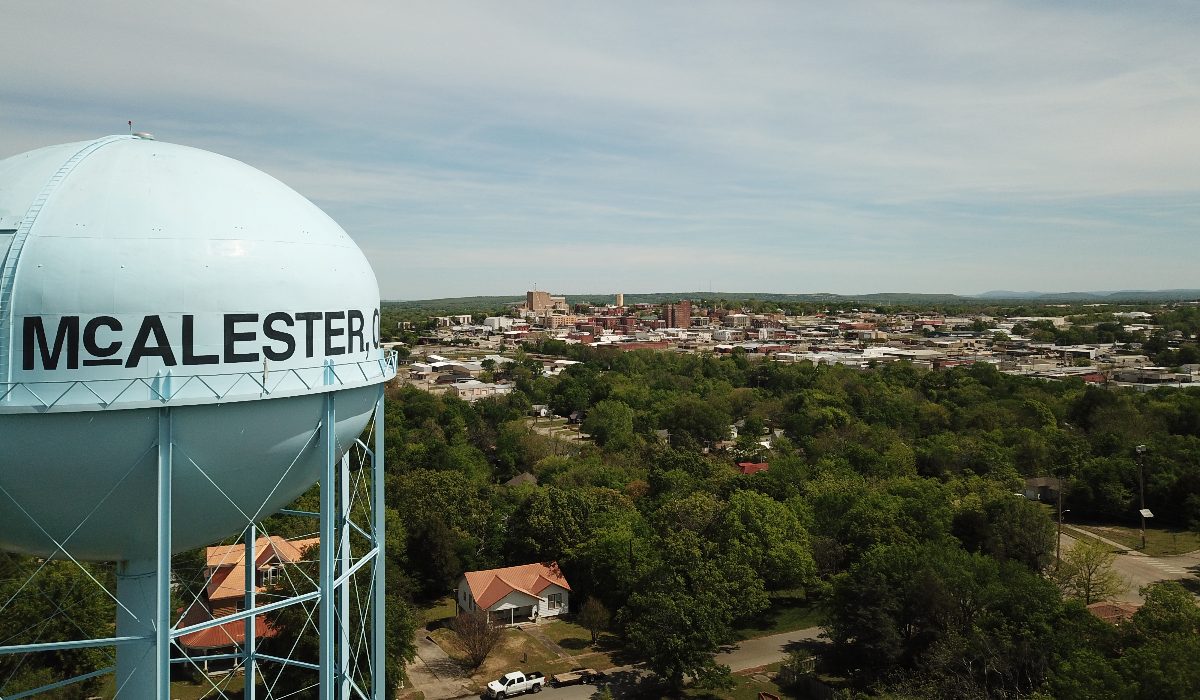
A one-cent sales tax increase proposed for McAlester street and infrastructure improvements has failed on a local Election Day that also saw voters in Yukon, Ardmore and Maysville reject tax questions.
A total of 1,248 voters in southeast Oklahoma’s second-largest city cast a ballot in Tuesday’s election, with 55.77 percent rejecting the McAlester infrastructure funding measure. All election results are unofficial until they are certified by the Oklahoma State Election Board.
The proposed the sales tax increase would have created a “dedicated, voter-approved funding source for streets and infrastructure without cutting services or adding new long-term debt.”
The tax would have generated an estimated $4.5 million a year for street repairs over a decade and made McAlester the largest city in the state with a municipal tax rate of five cents.
On Facebook, a post from the city’s official account said voters made their decision on the proposed street sales tax.
“We respect the outcome and thank everyone who engaged in the process. The condition of our streets remains a priority, and we will continue addressing needs within our current budget while exploring future solutions,” the post stated. “Community input will remain an important part of that conversation.”
Currently, shoppers generally pay a combined 10 percent sales tax rate in McAlester. The state of Oklahoma collects a 4.5 percent sales tax on non-grocery items, Pittsburg County collects a 1.5 percent sales tax, and the City of McAlester collects a 4 percent sales tax.
The April 7 proposal for another 1 percent tax to fund city street repairs would have increased the combined rate in McAlester to 11 percent.
Pair of McAlester charter changes pass
Despite the rejection on Proposition 1, McAlester voters passed two other propositions with more than 60 percent of the vote, asking for changes to the city’s charter.
Proposition 2 involved emergency spending by the council and passed with 62 percent of the vote. The change will allow the council to respond more quickly to major infrastructure issues or emergencies by updating current voter-approval requirements for certain large expenditures.
Proposition 3 amends the qualifications for the city manager as found in Article 3 of the charter. The proposition also passed with 62 percent of the vote.
Elsewhere: Yukon, Ardmore voters reject tax hikes
A majority of sales tax-related issues on the ballot in rural Oklahoma passed, with cities such as Yukon, Ardmore, and Maysville seeing their proposals failing.
A proposed hotel tax increase in Yukon was voted down during Tuesday’s election, with 53.9 percent of voters saying no.
The proposal would have raised the city’s hotel excise tax from 4 percent to 9 percent.
According to the city’s website, the tax brought in $379,192.55 in the previous fiscal year and supports the city’s parks, economic development initiatives, festivals, and tourism promotion.
Voters in Ardmore voted against a proposed one-cent tax increase on the ballot for streets and drainage repair in the south-central Oklahoma city. The proposition failed with 58.9 percent of voters saying no to the increase.
The ballot in the Garvin County town of Maysville included a proposition asking voters to change how portions of an existing one percent sales tax can be spent. The Garvin County News Star reported the current ordinance designates that three-eighths of the one percent sales tax passed by Maysville by voters in 1988 is to be used to support the public library, and the remaining five-eighths is to be used for street resurfacing and repair.
Town Trustees asked voters to amend how the portion designated for street repairs can be spent, allowing it to be used for General Fund expenditures, specifically to “satisfy the outstanding debts and liabilities of the town of Maysville.”
The proposition in Maysville failed, with 84.9 percent of voters saying no.
In LeFlore County, more than 69 percent of voters in Pocola supported the continuation of a 1 percent sales tax for street repairs and improvements. Voters in nearby Red Oak also passed with 76.7 percent of the vote a 0.75 percent sales tax for streets and related capital improvements, as well as a half-cent tax dedicated to Public Works Authority operations and capital improvements.
In far northeast Oklahoma, 70.3 percent of voters in West Siloam Springs passed a 1 percent sales tax increase. The increase will be used for street and road improvements and the associated infrastructure and personnel costs.
Near the Kansas border, South Coffeyville voters passed a 1.5 percent sales tax that will be used “exclusively for acquiring emergency services equipment, including the town fire department, emergency management, town police department, and maintaining and supporting necessary and required emergency services equipment, operational needs, and services to the Town of South Coffeyville,” according to the Nowata Star. The proposition passed with 72.3 percent of the vote.
In Seminole County, three propositions asked voters to extend percentages of a quarter-cent sales tax for county fire departments, ambulance services, and 911 services.
Proposition 1 asked to extend 40 percent of the tax for the county’s eight fire departments. Proposition 2 would extend 30 percent of the tax to the county’s three ambulance services, and Proposition 3 would extend the remaining 30 percent for 911 services. All three propositions passed with about 81 percent of the vote.
Voters in Coalgate passed by 10 votes — 99 to 89 — a 1 percent permanent tax to be used “for municipal purposes,” which include street repairs and public safety services. Allocation of the collected funds will be determined annually by the City Council.
Coalgate’s fire union, in a Facebook post, said that without proper funding, “response times, staffing, training opportunities, and equipment upgrades could be negatively impacted, ultimately affecting the level of service we are able to provide.”
With 71.1 percent support, Hughes County voters passed a bond of up to $745,000 for the county’s emergency medical services. Hughes County EMS said on Facebook the funds would be used to purchase new vehicles and equipment.
(Update: This article was updated at 10:10 p.m. Tuesday, April 7, to correct reference to the total number of votes cast in McAlester. It was updated again at 11:40 p.m. to include a rundown of additional elections around Oklahoma.)