


With his counterpart across the rotunda repeatedly advocating for increased school days in Oklahoma, House Speaker Kyle Hilbert revealed and sent the Senate a live-round proposal last week that would add seven days of classroom instruction for districts operating on the state’s hours-based calendar, starting in the 2027-2028 school year.
In Oklahoma, public school districts and public charter schools must meet one of two requirements for an academic year: 181 days of instruction or 1,086 hours of instruction. Most districts currently choose to follow the hourly calculation, which they must meet over a minimum of 166 days.
If Hilbert’s new version of HB 3151 becomes law, the hour-based calendar requirement would increase from a minimum of 166 days to a minimum of 173 days if the Legislature increases the State Department of Education budget by at least $175 million — two state fiscal years from now.
In theory, triggering that provision could seem achievable this year alone.
This session, Senate President Pro Tempore Lonnie Paxton and his leadership team have already proposed pumping more than $200 million into Oklahoma’s public school system — for Fiscal Year 2027 that starts July 1.
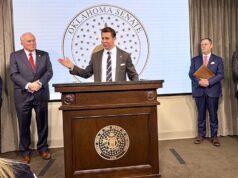
However, that plan has received criticism for how it would reduce state contributions to the Teachers Retirement System, and for how the Feb. 24 press conference held by Senate GOP leaders caught several fellow caucus members by surprise.
“That was actually a reverse of what we should have done,” Paxton said during his weekly press conference Thursday. “And I took the blame for that with my caucus. I said, ‘Hey we should have put that together.’ We were in the last week of bills being heard in committee and there were some bills that we needed to hear, that we needed to explain while we were hearing them. And so I kind of put a rush on that, and that was an error on my part.”
With Paxton’s presser pitching a broader $245 million package of funding decisions, Hilbert (R-Bristow) said the House’s move Wednesday “perhaps” foreshadows his caucus’ budget goals.
“We put a flag in the ground yesterday that said, we believe, despite this year being the highest funding level in the history of the state of Oklahoma for public education, we want the budget in the year after next to be even higher than it is this year,” Hilbert said. “That could be reading money, that could be math money, that could be formula money, it could be various things.”
In their press conference, Paxton, Senate Education Chairman Adam Pugh and other Senate leaders called for a $2,500 across-the-board teacher pay raise, literacy and math initiatives, an expansion of the Parental Choice Tax Credit and additional dollars for the school funding formula. Under Senate leaders’ proposal, portions of a trio of tax apportionments would be directed away from the Teachers Retirement System and primarily to OSDE.
“The funding sources for the Teachers’ Retirement System, their teachers’ contributions, we would never touch that. The schools’ contributions, we would never touch that. And the growth of the fund, we would never touch that, and also, we would never touch the corpus of the fund,” Paxton (R-Tuttle) explained Thursday. “This is the extra money — the 5 percent of everybody’s income taxes, sales taxes and use taxes. They have been going into that since 2003 to turn that thing from a 40 percent-funded fund to now in excess of 80 percent-funded fund.”
Authored by Rep. Rob Hall (R-Tulsa), HB 3151 passed 62 to 28 with an unusual mix of bipartisan support and opposition. While the bill would add seven days to the instructional calendar, it would not change the school year’s minimum number of instructional hours.
According to Hilbert’s office, Hall said OSDE provided him data indicating that only 32 of Oklahoma’s 500-plus school districts currently have more than 175 days on their instructional calendar.
“Time spent with students in the classroom is the highest and best use of the resources we invest in our schools,” Hall said in a press release. “Increasing the minimum number of instructional days is a much-needed step toward improving educational outcomes in our state. Spreading instructional time over more days will help keep students engaged throughout the day and make the time our educators spend with them more effective.”
Senators critique lack of communication

With a big education ball now in their court, some rank-and-file Republican senators are first reckoning with the fact they did not find out about their caucus leadership’s proposed education package until it was revealed to media.
“Their plan to gut the teachers’ retirement and use it to spend, that was not communicated to the entire caucus,” said Sen. Shane Jett (R-Shawnee). “It was communicated through his press conference to the media. And that is how the entire caucus, except those in [Paxton’s] close circle (learned of the plan).”
Jett, who chairs the Freedom Caucus and who has already clashed with Paxton over property tax reform this year, is not the only member of the Senate GOP Caucus to say he did not learn of the plan prior to its announcement. Minutes before the Feb. 24 press conference, Sen. David Bullard was grabbing coffee on the fourth floor of the Capitol and expressed surprise to learn what Paxton was about to announce.
Asked about the situation Wednesday, Bullard (R–Durant) confirmed that he also learned of the so-called “Senate plan” during the press conference. He said the Senate Republican Caucus did not meet about the plan, a lack of input that he called unusual.
“Typically, we talk over plans and agendas. We do not have an agenda walking into this year or last year that is a Senate agenda,” Bullard said. “Normally, we have an agenda, we talk about what that agenda is, the major plans that are coming out. That is usually run through the caucus first.”
Bullard called it an “error in judgment,” but also something that he and other senators must move forward from. As chairman of the Senate Retirement and Government Resources Committee, which handles legislation related to the Teachers Retirement System, Bullard said it would have been valuable for Senate leaders to get others’ perspectives before announcing the proposal.
“It is a bad idea to pull that money out of that subsidized money that we are putting into TRS,” Bullard said. “We need to get those pension funds to 100 percent.”
Paxton reportedly defeated Bullard by one vote in a November 2024 caucus election for president pro tempore. As political dominoes fall heading into election season, the pair and the caucus factions they represent within the Republican Party could be pitted against one another again.
With Paxton taking accountability for the “error,” however, Senate Republicans generally seem willing to move forward with education negotiations now that HB 3151 is in their possession.
Sen. Casey Murdock (R-Felt) said he was in the same boat as Bullard, Jett and others, but he said he was less concerned about the lack of communication about the Feb. 24 press conference owing to his focus on other topics early in session.
“It would not make any difference to me if I had known they were going to do the press release or press conference or if they did not,” Murdock said. “I think that was a whole to do about nothing, being upset that they did not let people know that they were going to do it.”
Murdock said it is still too early in the process for him to take a stand on the proposal outlined by Paxton and Pugh.
“A lot of people want to just throw their arms up and get mad on a piece of legislation,” Murdock said. “You have got to see how it goes through, what changes are made. Because right now, everything is just ideas.”
House legislation endorsed by advocacy organizations
Meanwhile, Hilbert believes HB 3151’s proposal to increase the school-day floor in Oklahoma has momentum because it would help close the state’s calendar gap compared to neighboring states and countries around the world.
“The bill is endorsed by [the Oklahoma State School Board Association], [the Cooperative Council for Oklahoma School Administration], [the Oklahoma Education Association], the Rural Schools Association and the Suburban Schools Association,” Hilbert said on the House floor Wednesday. “It adds seven days to the minimum number of days that schools are required to go, so long as the State Department of Education budget is increased by $175 million in two-years-from-now’s budget.”
Hilbert added that he received a text the Professional Oklahoma Educators‘ organization also endorses the bill. In a statement released Thursday morning, Hilbert said the Oklahoma Council of Public Affairs, the Oklahoma State Chamber and ExcelInEd were also supporting the legislation.
In the same statement, Secretary of Education Dan Hamlin said the legislation would place Oklahoma on a path toward having a “nationally competitive education system.”
“Over the past decade, Oklahoma has experienced a decline in the number of in-person instructional days offered to students,” Hamlin said. “In recent years, the state has made considerable progress in restoring instructional time to levels that align more closely with national norms. This bill builds on that progress.”
During his and Hilbert’s presentation of HB 3151 on Wednesday, Hall said the House’s preference is for off-formula schools to receive a piece of any OSDE funding increases, a slight differentiation from Senate leaders’ stated position.
Rep. Neil Hays (R-Checotah) asked why HB 3151’s increase in instructional days is tied to an increase in funding “rather than standing on its own merit.”
Hall responded that he believes the legislation could stand on its own but that he remains happy with the agreement reached with “all stakeholders involved.”
“I believe the primary and most important input that happens in the school is the classroom teacher that is standing in front of and alongside the students,” Hall said.