

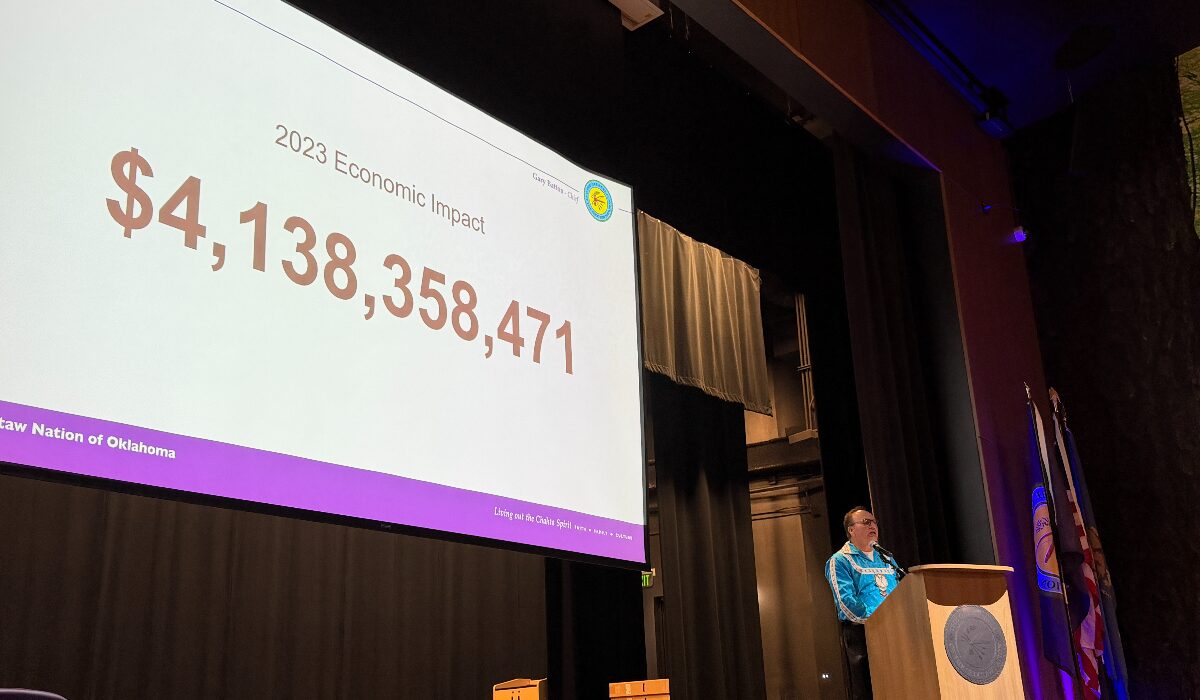
DURANT — The Choctaw Nation of Oklahoma generated a $4.1 billion economic impact on the state in 2023 — a 28 percent increase since 2021 — as tribal leaders touted record investments in jobs, education, housing and health care across southeast Oklahoma.
During a presentation March 3 at the tribe’s cultural center in Durant, the study highlighted findings from an economic report prepared by economist Kyle Dean, a former Oklahoma City University professor. According to Randy Sachs, director of public relations for the Choctaw Nation, the report was paid for by the tribe, with only the final final numbers released to the public.
Choctaw Nation Chief Gary Batton framed the milestone as both a fiscal benchmark and a cultural reflection of Choctaw values.
“We have become a major driver in the economy of southeastern Oklahoma and the state of Oklahoma,” Batton said. “And I don’t say that from an ego perspective. It’s because of all of you and our team making that happen.”
Dean’s report shows the tribe directly employed 10,234 Oklahomans in 2023 and supported 26,917 jobs overall while distributing $712 million in wages and benefits. The tribe’s casino operations contributed millions in gaming compact fees and funded infrastructure partnerships, while investments in education, workforce development and small-business support also expanded.
“That’s worth a big round of applause,” Batton said.
Partnership with Choctaw Nation fuels projects, growth in McAlester

Through the Choctaw Community Partnership Fund and Choctaw Development Fund, the tribe provided $3.6 million in contributions and community grants to cities, towns and counties within its reservation to support economic development, infrastructure and sustainability, including $5.2 million invested in Oklahoma highways and roads.
City of McAlester Economic Development director Billy Sumner said the tribe’s partnerships have played a significant role in helping the city complete infrastructure, tourism and community development projects that might otherwise have taken much longer — or might not have happened at all.
“Choctaw Nation is a huge partner for cities like McAlester,” Sumner said. “Small communities like us, Poteau, Wilburton, Stigler — we benefit greatly from these partnerships.”
One example is McAlester’s downtown streetscape project. The effort, which improved the stretch from Main Street to 2nd Street, was one of the first major initiatives the city worked on with the tribe. Sumner said the Choctaw Nation contributed significant funding to the project, helping the city modernize and improve its downtown area.
Another major partnership involved the construction of the city’s new airport terminal. Officials said the tribe contributed more than $250,000 toward the roughly $2.7 million project, helping the city complete the long-planned improvement.
“Without Choctaw Nation’s help, I don’t think we would have been able to cross the finish line on that project, either,” Sumner said.
The tribe has also invested heavily in community amenities. Most recently, the Choctaw Nation announced a $1 million donation toward McAlester’s library project, the largest single contribution the tribe has made through its community giveback efforts.
Sumner said the investments reflect a broader philosophy from tribal leadership, including Batton.
“What I think is great about the Choctaw Nation is they don’t focus on whether you’re actually a tribal member or not,” Sumner said. “If you’re part of the reservation, they look to benefit everyone within the community.”
In addition to direct partnerships on projects, the tribe also distributes funding to cities and counties through the Choctaw Community Partnership Fund. The funding, Sumner said, comes with no restrictions on how local governments use it.
“That money isn’t tied directly to a certain thing. There are no strings attached,” Sumner said. “It’s just money that’s given back to the communities and counties so they can use it on projects or things they need to better their areas.”
McAlester has used some of those funds for park improvements and other local initiatives.
Beyond direct financial contributions, officials say partnership with the Choctaw Nation has strengthened economic development across the region. Business leaders and potential investors often view the collaboration between tribal and local governments as a positive sign for long-term growth, according to Sumner.
“A lot of the businesses that are coming in love to see those partnerships and the working relationship that we have with the tribes,” Sumner said.
That relationship has also helped attract additional partners and funding sources, he added, since organizations often view tribal involvement as a sign of strong regional cooperation. Without those partnerships, the economic outlook for many southeast Oklahoma communities would likely look very different.
“If the Choctaw Nation and their partners didn’t have such a great working relationship, I think it would very directly negatively impact all of us,” Sumner said. “A lot of projects would simply be too large for us to accomplish on our own.”
The partnership has also extended to professional development opportunities for local leaders, including training, conferences and networking events funded or supported by the tribe. Sumner said those opportunities help strengthen leadership capacity across the region, making it a long-term benefit of the tribe’s investments.
“We’re greatly appreciative of everything the Choctaw Nation has done as a partner,” Sumner said. “They want to see not just the tribe succeed, but all of us within the region succeed.”
Last May, Dean also released a report, commissioned by the political group United for Oklahoma and the Oklahoma Indian Gaming Association, studying the economic impact of all tribal nations in the state. In that report, Dean found the tribes contributed $12.7 billion in 2023.
“In Oklahoma, we have the advantage that these tribes are located where they’re located because of federal treaties,” Dean told KOSU. “So if your tribe is in the local community, the tribal impact is going to continue in that local community (…) it’s a great benefit to the communities around the state.”
‘Guess where that goes?’
In 2023, the Choctaw Nation spent $72 million on education initiatives. The nation also awarded 12,368 college scholarships totaling $11.8 million in 2023, according to Dean’s report.
Batton said education has always been a “huge focus” for the tribe, and he pointed out the money doesn’t just go to tribal members.
“I don’t know if y’all have ever thought about this, but that’s not dollars that, yes, we give it to our tribal members. But guess where that goes? That goes to Southeastern Oklahoma State University. It goes to Eastern Oklahoma State College,” Batton said. “That goes to OU, to OSU, and again, we also give money to all 89 school districts that’s located in southeastern Oklahoma.”
Beyond higher education, the tribe funded summer school for 4,821 students across 52 schools and invested $4.6 million to implement Choctaw language instruction. The tribe also sent 2,000 youth to camps focused on STEM, coding, drone technology, stickball and golf.
“All of that’s 100 percent funded by the Choctaw Nation and our Tribal Council,” Batton said.
Batton also discussed the tribe’s gaming compact with the state, which has generated more than $422 million in exclusivity fees since leaders first signed it in 2004 after voters approved State Question 712. A federal judge determined in 2020 that the compact renewed following disagreements with Gov. Kevin Stitt.
Under state law, 33 tribal nations send exclusivity fees to the Education Reform Revolving Fund, the General Revenue Fund and the Oklahoma Department of Mental Health and Substance Abuse Services. ODMHSAS receives only $250,000 annually. Of the remaining fees, the ERRF receives 88 percent and the GRF receives 12 percent. In all, the state collected more than $221 million in fiscal year 2025.
“That’s just how we want to make sure that we not only help our family members but grow the economy as a whole,” Batton said. “We’re doing everything that we can to make sure to grow all of our education and our communities.”
‘We needed housing desperately’
Batton also highlighted the Choctaw Nation’s current housing initiatives for tribal members. In 2023, the tribe built 153 homes at a total cost of $24.5 million, according to Dean’s report.
The tribe operates programs that include affordable rentals, down payment assistant and closing cost payments, independent living for seniors and lease-to-purchase housing.
“Another focus of ours has been on homes. This council has really pushed to make a change in the economy and in local communities,” Batton said. “We needed housing desperately.”
In 2023, the tribe spent $24.5 million on 90 LEAP homes, eight affordable or independent living homes and 55 affordable rentals throughout the Choctaw Nation.
“But get this, since 2018, 1,335 homes have been built (and) 434 are currently under construction,” Batton said. “And I know from this council and the rest of our team, another 240 are going to be built from this point forward.”
With Oklahoma’s severe weather season arriving, Batton also discussed the tribe’s storm shelter program. The tribe installed 566 shelters in 2023 and has installed 7,713total since launching the program in 2012.
“If you’ve ever been in a tornado, it becomes mission-critical that you have a storm shelter,” Batton said.
Follow @NonDocMedia on:
Facebook | X | Text or Email
‘We are the biggest drug dealer in southeastern Oklahoma’
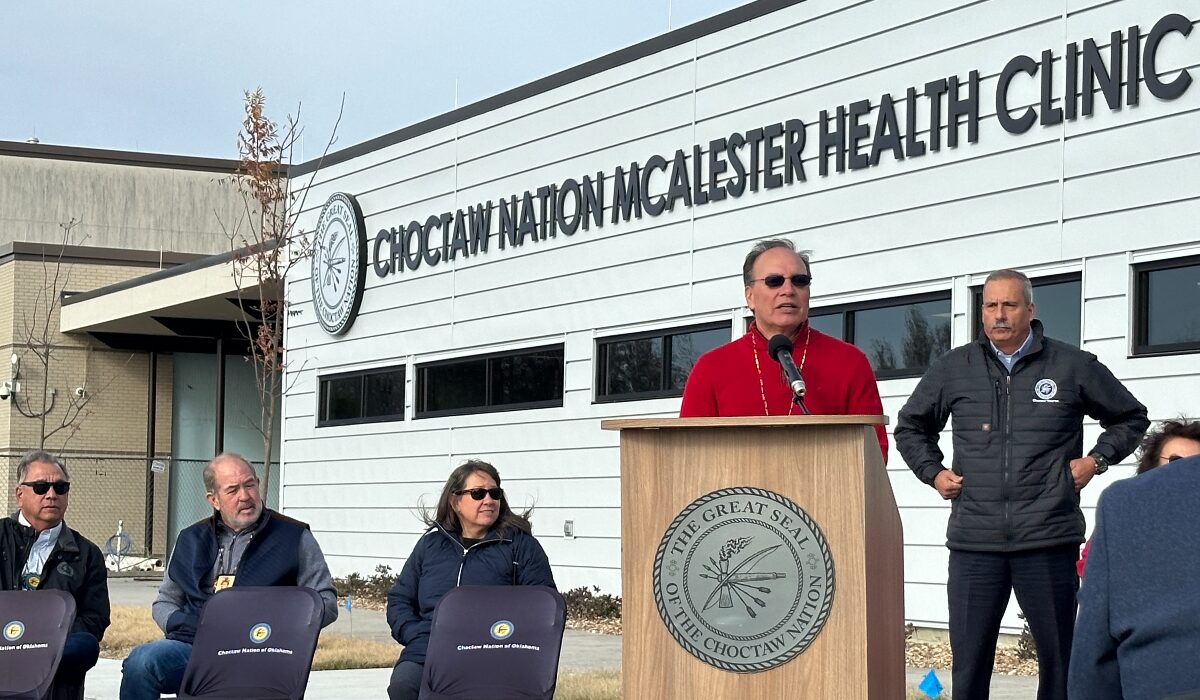
The Choctaw Nation became the first tribe in the U.S. to fund and build its own hospital in 1999, and health care needs and costs in southeast Oklahoma have grown exponentially since then.
According to Dean’s report, in 2023, the tribe spent $293 million on health care, supporting more than 1.1 million outpatient visits and distributing 1.6 million prescriptions. The tribe administered 12,600 flu shots to Oklahomans — not only tribal members — when supplies ran short elsewhere.
“I know my PR team usually doesn’t like when I talk about this, but we had over 1.1 million outpatient visits, and this is the part they don’t like me to joke about — because we give about 1.6 million prescriptions out each year,” Batton said. “We are the biggest drug dealer in southeastern Oklahoma.”
Through Choctaw Referred Care, the nation spent more than $12 million on specialty services provided by regional partners such as Saint Francis Health System and AllianceHealth.
Batton also highlighted Medicaid pass-through funding. For non-tribal patients, the federal government typically covers about 66 percent of Medicaid costs, leaving the state responsible for roughly one-third. For tribal members served through the Indian Health Service, the federal government covers 100 percent — saving Oklahoma taxpayers millions.
“If you’re a tribal member, guess how much it costs the state of Oklahoma: zero. A 100 percent pass-through,” Batton said. “That saves the people of Oklahoma, the taxpayers’ dollars, and, plus, we’re able to use our dollars to continue to deliver that service to all of our tribal members.”
His remarks come as the state is searching for ways to reduce Medicaid costs amid a projected $494 million funding shortfall for Fiscal Year 2027.
“I think it’s just another way that we look to partner and to save the state of Oklahoma’s dollars,” Batton said.