

In the coming weeks, members of the Edmond City Council say they must choose between four “bad options,” all of which would set a multi-year schedule for higher residential water bills to pay for extensive infrastructure projects and provide services to a growing customer base.
Regardless of how much council members choose to increase residential water rates for 2027 and beyond, Edmondites are already projected to see a 6 percent increase in what they pay for wastewater — or sewer — service. Edmond’s current base wastewater rate for most homes is $23.59, according to the city website. If city council adopts the new rate structure, residents would see a 6 percent increase in November.
“So on the wastewater side, you’re looking at about a 6 percent increase each year,” said Dan Jackson, a Willdan Financial Services consultant hired by the city. “The proposed rate would take effect in November of this year, and then we’re projecting 6 percent increases (annually) after that.”
Jackson presented four choices to the Public Works Committee in January so council members could address Edmond’s looming debt that has been accrued in pursuit of projects establishing water independence from Oklahoma City.
“Your cost of service is going up faster than what was projected in 2022, but that’s primarily due to the capital improvement projects,” Jackson said. “The biggest driver of this rate plan by far is the principal and interest on the new debt required to fund the capital improvement.”
Committee members moved to present all four water rate options to the Edmond City Council for further discussion. An increase to baseline water rates over the course of two years was favored by members, but a final decision will be made by the council. Edmond’s current minimum monthly water charge is $17.88 for most homes.
“The disadvantage is that the couple on Social Security or fixed income pays the same base charge as the family of six, and so that sometimes is perceived as not being fair,” Jackson said. “If you do [the two-year increase], your (base water) rate (…) would go to $25 in November of 2026, and $35 in 2027.”
At the January Public Works Committee meeting, Ward 3 Councilman Preston Watterson said stair-stepping the increase over two years would be one of his preferred pathways among “a bunch of bad options.”
FROM 2022:
Edmond water projects to provide independence from OKC, sustain long-term growth by Joe Tomlinson

Committee members expressed an interest in ensuring financial assistance remains available for residents in need. They also discussed the possibility of introducing surcharges for customers using high amounts of water.
Jackson’s presentation noted that prices for water resources across the United States are on the rise, with Edmond as no exception.
On average, utility providers are increasing rates 5 to 6 percent per year, a trend that is “expected to continue and may accelerate,” according to Jackson’s presentation. Jackson cited a prediction from the American Water Works Association that water and wastewater rates across the U.S. will triple over the next 15 years.
In many communities, the impact of AI data centers and the water usage required to cool their servers has quickly become a driver of increased rates. Some large centers can use the same amount of water as towns of 10,000 to 50,000 residents, according to the Environmental and Energy Study Institute.
“All we’re asking you is to pay what it is costing us. Remember, water is a business,” Jackson said.
Currently, most Edmond residents pay a base rate of $17.88, then $8.86 per 1,000 gallons, if the customer uses between 1,000 and 10,000 gallons monthly. According to a graph in Jackson’s presentation that compared water rates of cities in the OKC metro area, Edmond’s water rate stands as the second highest, just shy of Piedmont.
Jackson noted that low rates are not automatically better, explaining that if a city underfunds its water resources the quality of service can suffer.
“[Cities] have low rates because they’re literally not putting anything into their system,” Jackson said.
In 2023, the Edmond City Council approved a rate increase plan to raise water rates by 3 percent annually and wastewater by 2 percent annually for the next four years. The final increase in the 2023 rate plan is set to occur in November, requiring council members to decide on what increases will come in 2027 and beyond.
Among the water rate hike options presented by Jackson was what he called “the dental chair,” meaning the city could increase residents’ rates one time to cover all costs immediately. Selecting this option would raise the monthly base charge by 235 percent — $17.88 to $42.02 — and would not increase it again for three years.
Asked by Ward 2 Councilman Barry Moore, who chairs the Public Works Committee, if that option were typical of how municipalities handle such decisions, Jackson said virtually no cities opt for singular increases.
The other two options Jackson offered involved annual rate increases, one at a midpoint rate and the other at a higher rate. Both choices would still require the use of about $20 million in reserve funds to cover debts and obligations while residents stair-step into the full increases.
“There is no one right answer when it comes to setting a rate plan,” Jackson said.
‘It was always going to be painful’

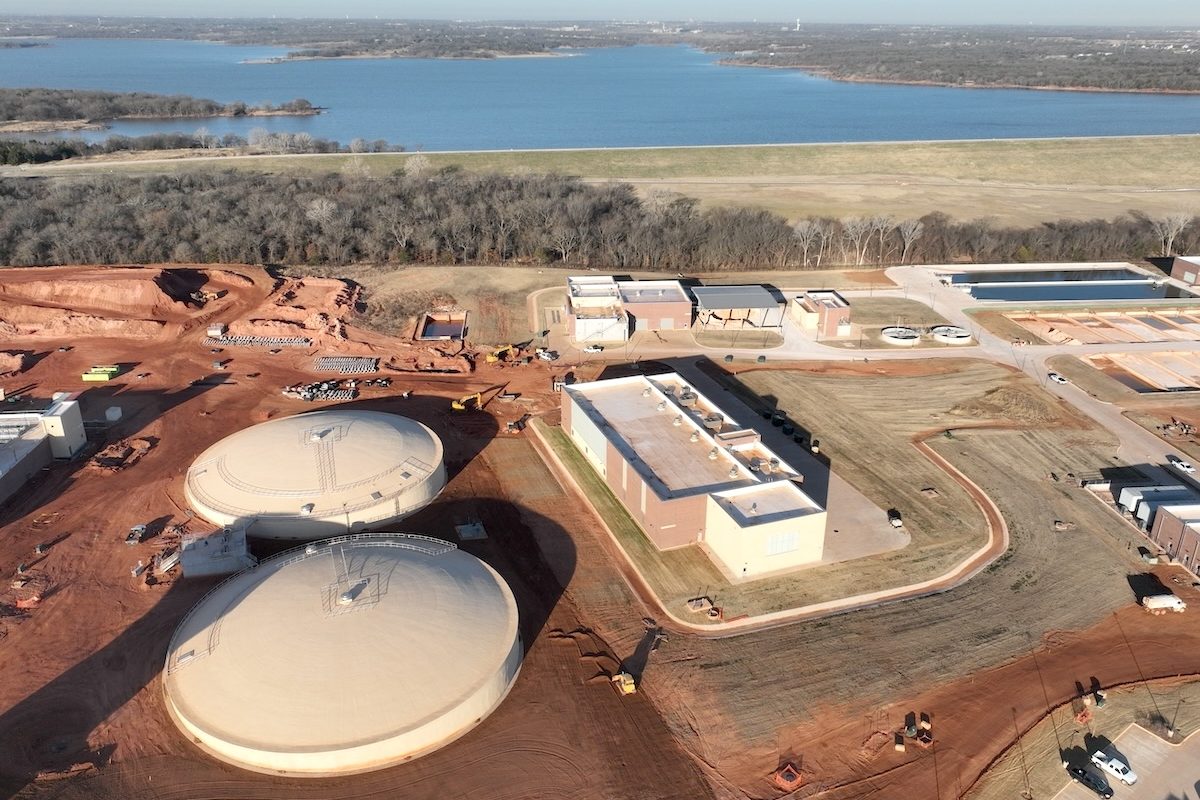
Edmond’s ongoing water projects are divided into four parts and are predominantly funded by loans from the Oklahoma Water Resources Board, which must be repaid over a 30-year period through water-use charges.
The project include:
- Expansions to the “water resource recovery facility” that will increase treatment capacity from 6 million gallons per day to 12 million and improve the treatment processes to comply with new discharge requirements from the Oklahoma Department of Environmental Quality and the federal Environmental Protection Agency. The $171.3 million project is expected to reach completion this month;
- Arcadia Lake water treatment plant improvements, which are divided into three phases. Upon completion, the existing 12 million-gallons-per-day (MGD) water treatment plant will be replaced by a new plant with a 30 MGD capacity, which can be expanded to 65 MGD as demand increases. The first phase, which is complete, cost $39.1 million. The second phase, carrying a cost of $203.6 million, is set to finish in December. The cost of the third phase is yet to be determined. This project received $12.5 million from a federal American Rescue Plan Act grant from the state;
- A new water intake structure and pump station, which is being constructed for $66.4 million and is expected to finish in the fall of 2027; and
- New water transmission lines, which will be installed to move water from the new “Arcadia Lake raw water intake and pump station” to the new water treatment plant and to convey treated water from the new water treatment plant to the entire City of Edmond via the “Interstate 35 storage and pumping complex.” This project is expected to reach completion in September 2027 at a cost of $53.6 million.
Some water infrastructure projects have also received federal funding, most recently $4 million through federal Community Project Funding.
When the projects are finished, the infrastructure is intended to serve Edmond’s growing demand for water and reduce the city’s reliance on outside supplies. Without self-sufficiency, the city purchases water from Oklahoma City during times of increased usage, particularly in the summer. Former Mayor Darrell Davis in 2022 described the rates charged by Oklahoma City as “hefty.”
With the third phase of water treatment plant improvements yet to be priced, Kris Neifing, Edmond’s director of water resources, said bids are expected to be awarded in June, which means the council must decide its rate increase plan in the next two months.
“We can’t secure the financing without rates in place that’ll pay for the financing to pay for the project,” Neifing said.
At the January Public Works Committee meeting, Watterson drew some laughter by asking a hypothetical question.
“So, if we have a bumper sticker on the bottom here, it would say, ‘We should have done this in 2019’?” Watterson asked.
At the committee’s February meeting, Neifing acknowledged the timeline.
“No matter what point in time we picked with this, it was always going to be painful,” Neifing said.
While gradually increasing rates could be better for residents’ bank accounts, that plan would require the city to dip into its water reserve fund, which currently holds about $71 million.
Neifing said city leaders hope to maintain a reserve fund that could sustain the system for 180 days.
“We don’t want to get down to where we’re at 90 days of operating reserve. That’s not a good idea, but we can get down there, and may, but we want to stay around that 180 mark,” Neifing said. “That’s the unofficial policy. Our debt coverage ratio is going to be the most important thing (…) The way it currently is, solid waste, electric, water and wastewater and sales tax are all lumped in to look at revenue for the debt coverage.”
Neifing said water rates were intentionally raised over the last seven years in an attempt to avoid a dramatic increase in the future.
“We knew there were big bills coming,” Neifing said. “It gave future councils a lot more flexibility of what this rate was going to look like, rather than holding the minimum amount and saying, ‘Well, we’ve got to do it all right now.’”
Meanwhile, the operating agreement between the city and the anticipated Uncommon Ground Sculpture Park obligates the city to pay up to $899,360 annually for maintenance. Between $400,000 to $500,000 is estimated for the park’s utility costs.
Asked in August about the utility agreement, Mayor Mark Nash said it’s “not as big as it might seem.”
“When you talk about $400,000 in utility expenses, what we’re doing in that case is you’re taking the money we generate to operate the park and we’re paying ourselves with it,” Nash said. “If you think about it, when we say we’re committed to paying whatever it is a year on expenses, well, part of it we’re paying right back to ourselves. Which in turn means that we’re decreasing what we’re paying out because we’re getting our own money back.”