


Although the Attorney General’s Office advised one year ago that language in Edmond’s city charter requiring candidates for office to be property holders is unconstitutional, leaders of Oklahoma’s fifth-largest municipality have yet to move toward making a revision.
Edmond’s inaction — despite multiple U.S. Supreme Court rulings in the 20th century — comes as another city in the region, Moore, reviewed the attorney general’s guidance and took action to remove similar language from its charter.
The antiquated “freeholder” verbiage has been in Edmond’s charter since its 1925 creation, and it became a point of contention in late 2024, when former Ward 1 Councilman Tom Robins resigned from the Edmond City Council to run for mayor.
Being an Edmond “freeholder” — or property owner — was listed among requirements for those seeking appointment to fill Robins’ seat in Ward 1, and it was again listed for the city’s 2025 election cycle filing period.
In December 2024, Edmond City Council Ward 3 candidate Corey Winston entered but quickly withdrew from the race to highlight the charter provision, which functionally implies renters are ineligible to hold office in a city known for opposition to apartment developments.
With the language’s history reflective of broader institutional discrimination, the situation piqued the interest of Rep. Erick Harris, an attorney and member of the Oklahoma Legislative Black Caucus who asked the Attorney General Gentner Drummond’s office to review the Edmond City Charter provision.
In a letter of counsel Feb. 13, 2025, deputy general counsel Kyle Shifflett responded by noting three cases in which the U.S. Supreme Court found that such language violated the equal protection clause of the 14th Amendment.
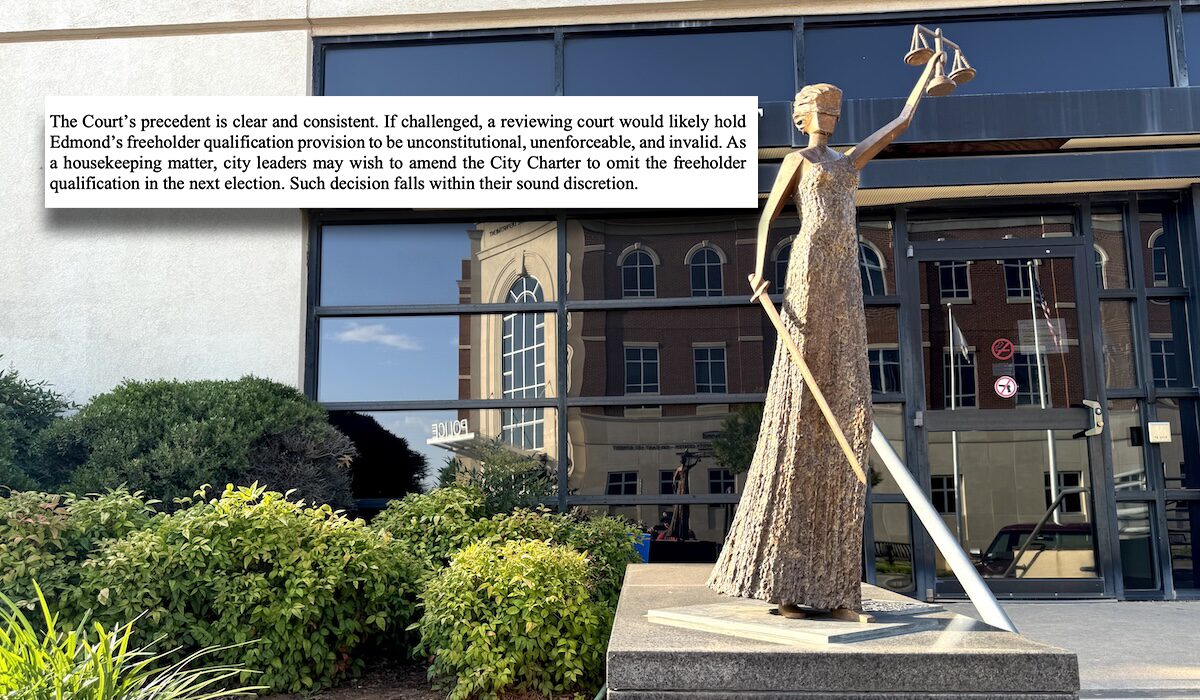
“The court’s precedent is clear and consistent. If challenged, a reviewing court would likely hold Edmond’s freeholder qualification provision to be unconstitutional, unenforceable, and invalid,” Shifflett wrote. “As a housekeeping matter, city leaders may wish to amend the city charter to omit the freeholder qualification in the next election. Such decision falls within their sound discretion.”
While it’s unclear if the City of Edmond has ever attempted to enforce the requirement and disqualify candidates from running, more than a year after Shifflett’s letter, Edmond leaders have taken no action to eliminate the unconstitutional provision.
During his 2025 campaign, Mayor Mark Nash supported amending the city’s charter, saying, “So why don’t we just fix it?”
But asked why that hasn’t happened during his first nine months in office, Nash said Monday that he and other council members have been “focused on addressing the issues most pressing to our residents since this council was seated in May 2025.”
“While there are many important matters worthy of attention, much of our time has been devoted to improving our budget process and strengthening fiscal transparency, advancing our roads program, supporting economic development, and addressing housing challenges,” Nash said.
Ward 1 Councilwoman Maggie Murdock Nichols, Ward 2 Councilman Barry Moore and other council members have also previously expressed support for changing the language.
On Monday, Murdock Nichols and Moore also said they “certainly” still believe the provision ought to be addressed.
“Any discussion on the process of revising the charter would need to take place in a public meeting,” Murdock Nichols said.
Nonetheless, Edmond’s inaction has puzzled Harris.
“The law is pretty clear on that issue,” Harris (R-Edmond) said earlier this month. “It would be, I think, helpful if that issue were addressed and they make whatever necessary changes are needed to ensure that the charter follows the Constitution as far as who can run for office.”
With two city council terms and the mayor’s term set to expire in May 2027, candidate filing for those offices will take place in December.
Moore struck identical requirement 6 months after AG letter

While Oklahoma’s seventh-largest municipality was not named in the letter of counsel, elected leaders and voters in the City of Moore amended their city charter to remove a similar “freeholder” requirement relatively quickly.
In August 2025, the Moore City Council placed seven items in front of voters, including a lodging tax, city employment reforms and an “amending candidate qualifications” question that removed the “freeholder” requirement. That amendment passed with 80.76 percent of voters in favor, by far the most for any of the proposed changes.
The issue was first brought to the Moore City Council’s attention in May by resident Justus Chandler, according to meeting minutes. Chandler addressed the city council during its May 5 public comment period.
In his remarks, Chandler said a provision requiring office holders to own property dissuades young people who may rent or live with relatives from pursuing a fundamental pillar of the democratic process.
“We are looking down on our youth today, in our municipality and in our community,” Chandler said. “That’s because of our freeholder clause in the city charter.”
At its next meeting two weeks later, the Moore City Council passed a resolution May 19 that sent removal of the freeholder language to a public vote.
Despite Moore’s proposition to remove its freeholder clause making it to the ballot and passing, Chandler later asked voters to deny the amendment because it established an age minimum for office at 25 years old. Previously, Moore’s charter specified no age minimum for council members.
While residency mandates are common for public offices, candidates for neither statewide offices nor legislative seats face a property ownership requirement in Oklahoma. The same is true for municipal offices like city councilor or mayor in each of Oklahoma’s 10 largest cities, except Edmond.