



On the heels of the municipal agency’s 2021 audit being released to start 2026, Tulsa Mayor Monroe Nichols has nominated three new members to the Tulsa Housing Authority Board of Commissioners, including his senior homelessness adviser, Emily Hall, former teacher Toneille Bent and attorney Seth Blanton.
Hall, who is the daughter of former Mayor Susan Savage, currently works as Nichols’ senior adviser for homelessness. She previously served as the president of the board of Housing Solutions Tulsa before she was succeeded in the role by current THA Board member Kim Holland. If appointed, Hall will replace THA Board member Debra Morrow Ingram, who has chaired the board since January.
“Access to housing is extremely important for all of our citizens of Tulsa. The Housing Authority plays a key role in providing access to housing,” Hall told city councilors during a Feb. 11 Public Works Committee meeting. “Tulsa Housing Authority provides the housing that meets people’s needs as they’re rebounding (from homelessness) and they’re looking for the most affordable place to live, as well as access to vouchers.”
District 3 Councilwoman Jackie Dutton, who chairs the Public Works Committee, briefly questioned why Hall, Nichols’ homeless adviser, was being appointed to the authority instead of his housing adviser, Gene Bulmash. With Hall also working for the mayor’s office, Councilwoman Laura Bellis noted that it seemed to be “standard practice” to have a city employee on a housing authority’s board.
“It seems like maybe something that’s been a standard practice other places, so to me, this seems like us kind of mirroring that,” Bellis said.
Nichols nominated Tonneille Bent, who currently serves on the Tulsa Women’s Commission, to succeed THA Board member Rick Neal, who announced he was retiring from the board in December.
“I am a longtime Tulsa resident. Born in Jamaica, but grew up in the city metro,” Bent told city councilors. “I have been an educator at schools, particularly in north Tulsa, and have also worked in the nonprofit space in education equity and now in mental health for the last — over a decade now.”
Committee members did not question Bent.
A partner at Rodolf & Todd, attorney Seth Blanton was admitted to the bar in 2019 after graduating from the Oklahoma City University School of Law. He is nominated to succeed THA Board member Lisa Albers.
“I have a little bit of a background in land use. I worked in the landlord-tenant clinic during law school,” Blanton said.
Councilwoman Karen Gilbert asked Blanton why he specifically wanted to serve on the housing authority’s governing body.
“It’s a very valuable [organization] for the city, obviously. I, obviously, would not be an attorney for the board whatsoever,” Blanton said. “That being said, it’s a very interesting one as a matter of legal makeup. It’s with the city, but there are state rules and regulations — there is state money involved, there’s federal money involved — it’s an interesting one that effects a lot of the population, too.”
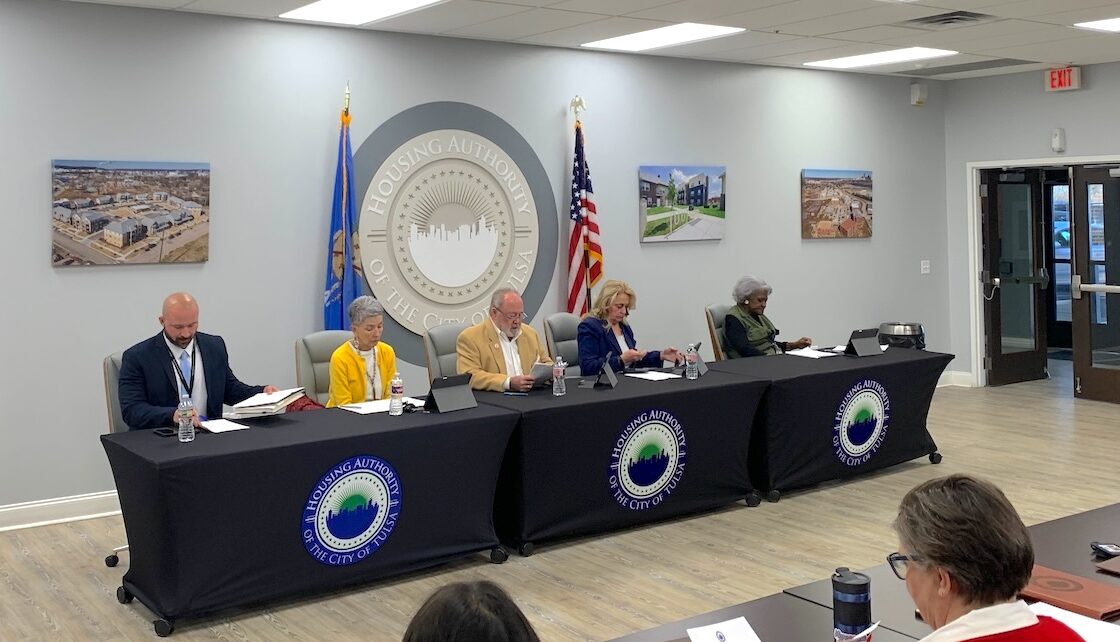
Nominees are scheduled to be voted on during the Tulsa City Council’s next meeting at 5 p.m. Wednesday, Feb. 25. The THA Board’s next scheduled meeting is 10:30 a.m. Thursday, March 12.
2021 THA audit released, some deficiencies found
The long-awaited release of the THA’s 2021 audit quietly arrived Jan. 20, with THA vice president of communications Ginny Hensley noting by email that the audit was now available on the authority’s website. As a public housing authority, THA is required to complete a federal audit annually, but for more than a year now, the agency has faced a four-year backlog that has raised eyebrows in the housing industry. The authority’s 2020 audit was released in December 2024, and 2025 concluded without another audit being released.
“I wanted to share that our 2021 audit is finalized and posted on our website,” Hensley wrote.
In their 2021 findings, auditors noted the untimeliness of THA’s audits as the agency’s one “material weakness in internal control over financial reporting,” a term used to refer to deficiencies that create a “reasonable probability” misstatements in an entity’s financial statements will not be “prevented, or detected and corrected, on a timely basis.”
“The authority did not submit the Dec. 31, 2021, audited financial statements to the Real Estate Assessment Center or the Federal Audit Clearinghouse by the extended due date of March 31, 2023,” the report notes. “In addition, during our testing of notes/developer fees receivable during the current year, we noted several material transactions that were not recorded in the prior year.”
The 2021 audit also restated THA’s fiscal position compared to what had been reported in its prior audit. The agency was actually found to have had an additional $5.15 million cash on hand when 2021 began, with $4 million more in “notes receivable” identified and $1.1 million in additional “developer fees” reported.
“During 2021, [THA] recorded corrections of errors for notes receivable and developer fee balances,” auditors wrote. “As only the current year is presented in these financial statements, prior period financial statements have not been restated. Instead, the correction has been recorded as an adjustment to the beginning net position for the year ended Dec. 31, 2021.”
The audit also found four “significant deficiencies in internal control over compliance,” a term that refers to deficiencies that are “less severe than a material weakness, yet important enough to merit attention by those charged with governance.” Those deficiencies involved:
- THA failing to conduct “reexamination of family income and composition at least annually” in five of 40 files tested, resulting in potential overpayments and questioned costs amounting to $6,553;
- THA failing to “annually adjust contract rent” at one of four buildings tested, resulting in questioned costs amounting to $5,685;
- THA failing to properly maintain tenant files to ensure applicants met all eligibility requirements, had their income verified and had medical expenses appropriately calculated into their assistance in three of the 40 sample files reviewed, resulting in questioned costs amounting to $4,164; and
- THA failing to make required monthly reserve fund payments on two of their four replacement reserve accounts, resulting in questioned costs amounting to $2,593.
The February meeting of the THA board was originally scheduled for Feb. 12, but was cancelled and moved to Feb. 5. The authority did not announce the change to press before the meeting was held. The status of the authority’s 2022 audit was not listed on the February meeting agenda.
Read the full 2021 Tulsa Housing Authority audit