

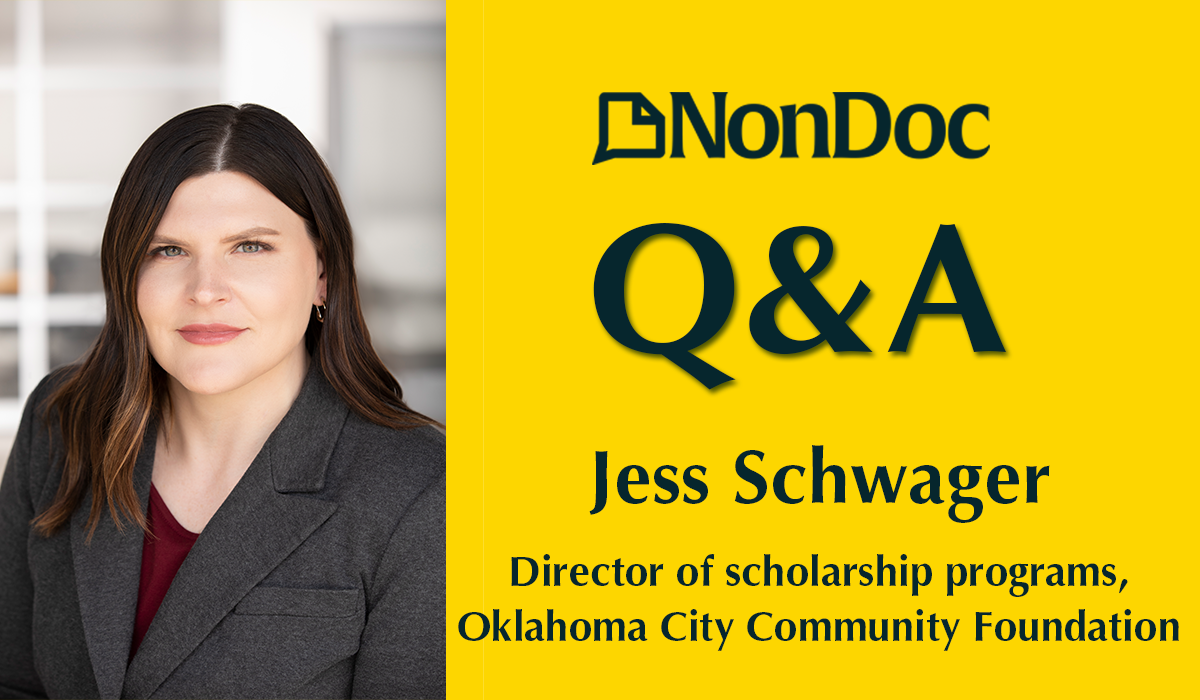

A former sports information director for an NCAA national championship team now leads the largest independent scholarship program in Oklahoma.
Jess Schwager is the director of scholarship programs at the Oklahoma City Community Foundation, which makes her no stranger to giving people money. Before joining the foundation, she served as the director of the scholarship office at the University of Oklahoma, a position she departed in 2019. Before diving into the scholarship world, she worked as a communications assistant for the Big 12 Conference. Schwager hails from rural Nebraska and attended the University of Nebraska at Lincoln, where she became a sports information director for men’s gymnastics and the 2009 NCAA national champion women’s bowling team.
Apply by Feb. 15
Those completing the Oklahoma City Community Foundation’s universal application for more than 200 scholarship opportunities face a Monday, Feb. 15, deadline.
The program she champions now supports more than 1,000 students per year. Last fiscal year, OCCF distributed more than $5 million in scholarship funds, according to its 2025 impact report. Students from 64 of Oklahoma’s 77 counties received funds. The majority of recipients are pursuing higher education degrees in STEM or health care-related topics.
Grown by private donations, OCCF’s program comprises more than 300 scholarship funds and encourages students to “attain the highest level of education and training.” Individual scholarships are tailored to students from a variety of backgrounds, including those re-engaging with higher education after a period away and students formerly in foster care.
In the following Q&A, Schwager discusses her background, her journey to OCCF and how working in media for an NCAA national champion still influences her now. Responses have been lightly edited for grammar and style.
You have worked in the scholarship arena since 2011. What led you to this career, and how did you join OCCF?
It has been a long and winding road. In the 1980s, my dad spent harvest seasons in Oklahoma and came home an OU fan, so I grew up chanting, “Boomer Sooner!” from the time I could talk. I always hoped to attend OU, but out-of-state costs were not feasible. Instead, I earned scholarships to the University of Nebraska at Lincoln. Throughout college, I worked for Nebraska’s athletic communications office, where I travelled nationally and built connections in Norman.
After graduation, I accepted a communications assistant position with the Big 12 Conference in Dallas, but I quickly realized I was ready to step away from the pace of athletics. Around that time, I became close with a family in Norman who told me about an opening in the OU Scholarship Office. I applied, went through two rounds of interviews and accepted the offer, moving to Norman in 2011.
Seven years later, when I learned about the scholarship director position at OCCF, I saw an opportunity to grow professionally and continue serving students, so I applied, and the rest is history. Along the way, I accomplished my childhood dream: I earned my master’s degree from OU in 2015!
How did growing up in rural Nebraska influence your view of the world as a whole and education specifically?
Growing up in rural Nebraska shaped my worldview in ways I carry with me every single day. Ranch life taught me early that showing up is not optional. It is simply what you do. If the neighbors’ cows are on the road, you stop and help. If a fence is down, you fix it. That rural mindset has shaped how I approach life. I commit, I follow through, and I show up even when it is inconvenient or uncomfortable. Life is not about perfection; it is about reliability.
Education was equally central to my life. In Nebraska, rural schools are largely funded by local property taxes, so families deeply value strong K-12 systems. I graduated with nearly the same 18 classmates I had known since kindergarten, supported by dedicated teachers, including my mom, who spent more than 40 years in the classroom. My dad did not have a high school diploma, but he modeled the practical intelligence and problem-solving skills that come from being a student of life. Both parents emphasized education as a way out, up, or forward, and my two sisters and I took that to heart. Together, we have earned a combined three bachelor’s degrees, three master’s degrees, one cosmetology license, an EMT certification and countless hours of ranch experiences.
Overall, growing up as a rural kid kept me grounded, taught me to value and show up for my community and showed me firsthand how transformative great educators and accessible pathways can be for students.
Did your time working in OU’s scholarship office shape your approach to the work you do now? If so, how?
Absolutely. I was fortunate to have a supportive manager and great teammates at OU, and I have carried that collaborative mindset with me to OCCF. My time at OU also strengthened my relationship-building skills, which are essential in my work today. I genuinely enjoy meeting people and forming authentic connections with students, parents, donors and community members across the state. I also gained valuable experience in strategic planning, higher education and financial aid processes, all of which translate directly to my work at OCCF.
At OCCF, you administer more than 300 scholarship funds tailored to a wide array of student backgrounds. How does the scholarship program meet student and community needs, and what accomplishments do you hope to contribute to 2026 and beyond?
Our team stays current on local, state and national trends. We use data to guide our scholarship programs and inform donors about community needs.
By collaborating with donors, school counselors and community partners, we ensure each fund honors donor intent while meeting the evolving needs of Oklahoma students. Looking ahead, we are focused on strengthening our data and impact tracking to better understand student outcomes, demonstrate the long-term value of scholarship support and align our programs with Oklahoma’s workforce priorities.
Can you tell us about some inspiring scholarship recipients and what they are doing now?
Yes! We are fortunate to stay connected with many current and former scholarship recipients, and we love celebrating their achievements. One alum is now an Oklahoma state representative, another is a Fulbright fellow in Luxembourg, one was elected OU’s Campus Activities Council chairperson, and another is an engineer who now serves on our OCCF Scholarship Committee. Sharing these successes with our generous donors is one of the best parts of our work.
What advice do you have for potential applicants seeking a scholarship?
I always tell students to slow down, read the instructions and make sure they actually answer the prompts. And of course, get everything in by the deadline. We send reminders, but with thousands of students and a small team, it helps when students take ownership of submitting their materials on time.
What advice do you have for potential donors hoping to make a difference through endowments at OCCF?
Endowed scholarship funds are an outstanding way to help students today and well into the future. Donors can see the immediate impact of their scholarship and know their funds will extend their legacy.
My advice to potential donors is to balance vision with flexibility and to lean on OCCF’s expertise to support their vision. Communities evolve, and allowing room for adaptability over time helps preserve donor intent while keeping the endowment able to address community needs.
I would also remind donors that their story matters. Sharing the “why” behind their gift matters to our team and to the students who receive their scholarships, and it inspires others to give. Endowments create legacies, and OCCF is uniquely positioned to help donors build a legacy that lasts.
How did your celebration of the Nebraska women’s bowling team’s 2009 NCAA championship compare to how you celebrate your wins now?
I love this question. I keep a bowling pin signed by the 2009 NCAA championship team in my office at OCCF, right next to my diplomas. Even though I was just the “media girl,” the coaches and players always made me feel like part of the team. They always made sure everyone who contributed was recognized. That stuck with me.
Now, whenever we have a win at work — big or small — I try to celebrate everyone who played a role. I do not always get it perfect, but I try my best to be intentional about showing gratitude to the people who make our work possible.
(Correction: This article was updated at 3:30 p.m. Friday, Feb. 6, to correct the date listed for an application deadline.)