


After the University of Oklahoma gained national notoriety last year for terminating a teaching assistant over a religious essay controversy, President Joe Harroz said he relied on OU’s Faculty Senate Executive Committee throughout the process — a claim the body quickly disputed in a formal resolution.
OU leaders published a statement Dec. 22 announcing the termination of Mel Curth, the teaching assistant who gave psychology student Samantha Fulnecky a zero on an assignment in which Fulnecky cited her Christian beliefs in a criticism of gender nonconformity. The statement released by Harroz’s office said university officials “engaged in repeated and detailed conversations with the Faculty Senate Executive Committee to ensure there is an understanding of the facts, the process, and the actions being taken.”
After a Jan. 30 meeting of the OU Board of Regents, Harroz said he met with the Faculty Senate Executive Committee twice.
“The best that you can do in these situations where you know that it’s going to be choppy in terms of politics is try and live in your values, your policies — be consistent and communicate in every way that you can — and try and go the extra step. And for us, that’s been to sit down with the Faculty Senate exec (committee) and have those conversations,” Harroz said. “We’ve built up, hopefully, trust that allows us — when we have difficult situations like this — to have those conversations in a way that shows I’m trying to lean into our values and trying to do the right thing.”
But the resolution passed by Faculty Senate members Feb. 13 disputed the sentiment of OU’s Dec. 22 statement, suggesting Harroz may not have built the trust he expected.
“The OU Faculty Senate Executive Committee and Faculty Senate were neither solicited for input on the decision nor endorsed the decision of the administration on this matter,” the Faculty Senate resolution stated. “The OU decision on this matter has had, and will continue to have, significant repercussions that negatively impact trust within the OU academic community.”
Similarly, Harroz said Jan. 30 that he had not held a meeting with either Fulnecky or Curth throughout the process.
“That’s not my role in these,” Harroz said. “As you see, there’s an appeal process going on right now that’s taking place. There are avenues and paths for those, and I don’t want to get myself involved in those processes.”
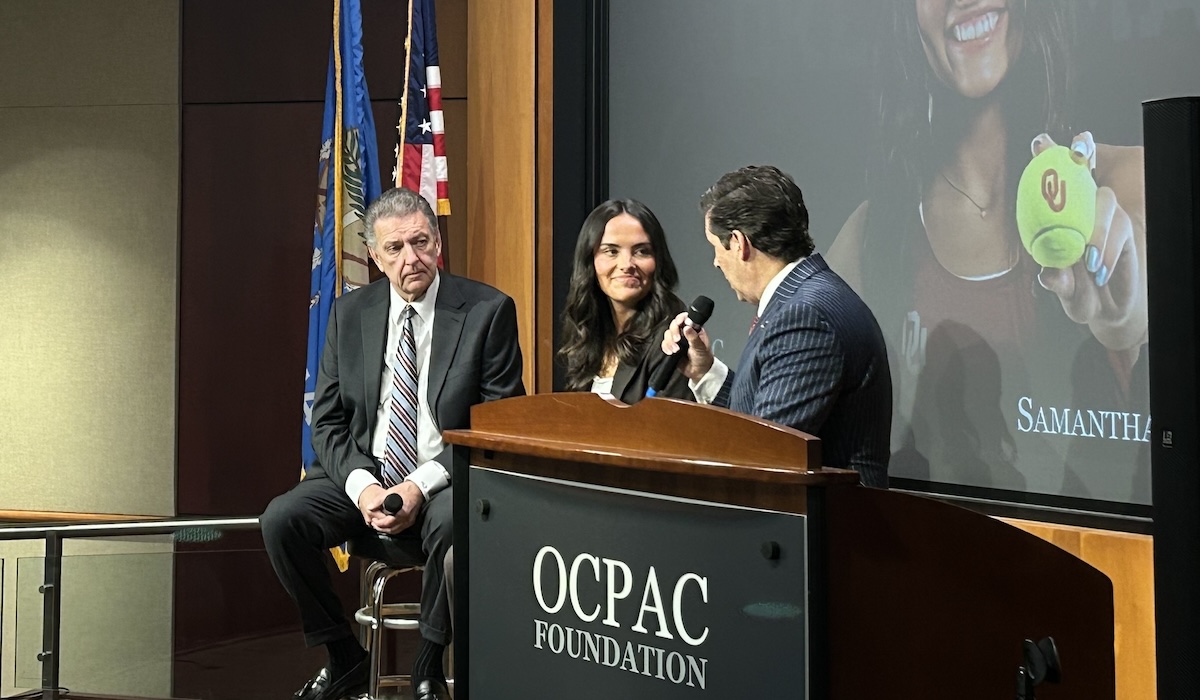
Harroz’s lack of involvement drew Fulnecky’s ire at a Dec. 3 meeting of the OCPAC Foundation.
“I still haven’t heard anything from the president, and I don’t think I will. The university released a statement on X in the midst of all this kind of blowing up on social media, and they said that they had been handling it well the whole time, and that they cared deeply about situations like this. And I don’t believe them,” Fulnecky told the crowd. “They didn’t say anything to me about what they were going to do to resolve the issue. I didn’t think they were going to do anything to resolve the issue at all. I figured, you know, they didn’t care. The president didn’t say anything to me about it. I’m sure if it was any other religion, he would be very apologetic, and he would get on the phone with them immediately and apologize that they hired someone that would do that, and I got nothing.”
While Fulnecky may have gotten nothing in the way of recognition from the president, she got her grade back, and the university dismissed her instructor. A little over a month after being given zero credit on a response paper where Fulnecky criticized gender nonconformity — citing her Christian faith as evidence for the merits of traditional gender roles — Fulnecky’s essay grade was removed from her transcript.
Curth, meanwhile, was dismissed from her teaching duties, a decision she is appealing, her attorney announced Dec. 30.
“Ms. Curth fully denies that she engaged in any discriminatory behavior. It is her position that the investigation was flawed, failed to consider all possible motives and issues, and that new evidence has come to light that undermines the investigation’s conclusion,” Brittany Stewart posted Dec. 30. “Rather than engaging in discrimination, Mel Curth has been the target of a political movement that seeks to silence and/or oust LGBTQ people from academia. Ms. Curth will continue to fight back against these harmful allegations.”
Fulnecky, an OU junior who has expressed intent to go to medical school, was enrolled last semester in a psychology class called “Lifespan Development.” Fulnecky explained at OCPAC that the class would routinely read articles and submit written responses to them, which were intended to be short, “thoughtful reactions” to the article, according to a rubric posted by OU’s chapter of Turning Point USA. The essay for which Curth assigned Fulnecky a zero was written in response to an academic article about how gender roles affect relationships among children. Fulnecky told The Oklahoman she believed her essay had received a zero out of 25 points because it referenced her Christian beliefs, violating her rights to free speech and practice of religion.
Fulnecky’s 650-word essay said “gender roles and tendencies should not be considered ‘stereotypes,'” as “women naturally want to do womanly things because God created us with those womanly desires in our hearts.”
“Society pushing the lie that there are multiple genders and everyone should be whatever they want to be is demonic and severely harms American youth,” Fulnecky wrote in what was perhaps the essay’s most controversial paragraph. “My prayer for the world and specifically for American society and youth is that they would not believe the lies being spread from Satan that make them believe they are better off as another gender than what God made them.”
Curth began her feedback with a caveat: “Please note that I am not deducting points because you have certain beliefs, but instead I am deducting point (sic) for you posting a reaction paper that does not answer the questions for this assignment, contradicts itself, heavily uses personal ideology over empirical evidence in a scientific class, and is at times offensive.”
Curth took particular issue with Fulnecky’s characterization of “multiple genders” as “demonic,” calling it a “highly offensive” statement amid “contradictory” claims.
“You argue that abiding by normative gender roles is beneficial (it is perfectly fine to believe this), but to then say that everyone should act the same, while also saying that people aren’t pressured into gendered expectations is contradictory, especially since your arguments reflect a religious pressure to act in gender-stereotypical ways,” Curth said.
Megan Waldron, the other teaching assistant responsible for instructing the course, also gave Fulnecky feedback agreeing with Curth’s grading.
“I concur with Mel on the grade you received. This paper should not be considered as a completion of the assignment. Everyone has different ways in which they see the world, but in an academic course such as this you are being asked to support your ideas with empirical evidence and higher-level reasoning,” Waldron wrote. “I find it concerning that you state at the beginning of your paper that you do not think bullying (‘teasing’) is a bad thing. In addition, your paper directly and harshly criticizes your peers and their opinions, which are just as valuable as yours.”
OU faces criticism from across political spectrum
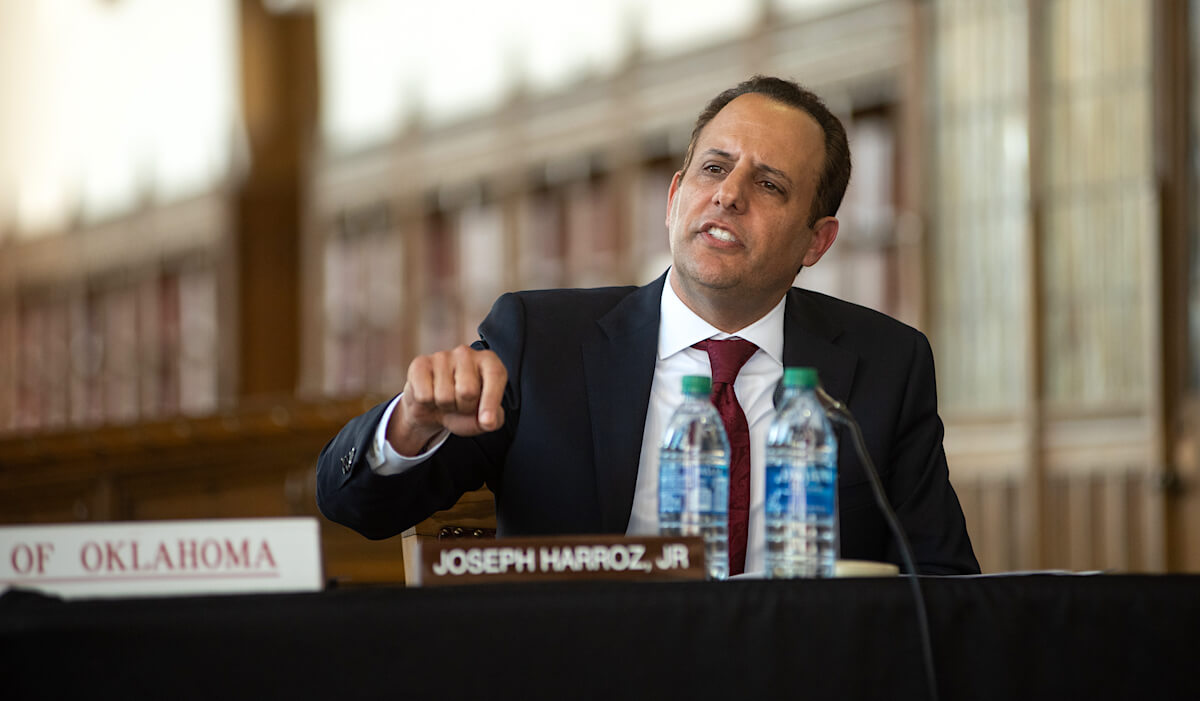
More than any prior non-football development during Harroz’s six-year tenure as president, last year’s essay controversy thrust OU into the national spotlight.
The resulting discourse typically split along ideological lines, with right-leaning commentators generally supporting Fulnecky and criticizing Curth, while left-leaning commentators largely criticized Fulnecky and defended Curth. OU caught heat from across the spectrum and was lambasted for abridging academic freedom one way or another.
Noting the polarization often defining American life, Harroz characterized Fulnecky’s situation as “inevitable.”
“We’re going to have these sorts of issues arise. It’s inevitable in our society today,” Harroz said Jan. 30. “So (what) we try and do is do a couple things. One, lean into our values — free speech and expression, civil discourse, those areas. You know, we also want to make sure that we’re doing things in a way (…) that is pursuant to a process.”
Harroz said the political nature of the controversy made it all the more important to consult the Faculty Senate Executive Committee throughout the process that reviewed and ultimately ended Curth’s employment.
“Part of this also is to make sure that you involve the faculty and those that have backgrounds in these areas that can help you navigate them,” Harroz said. “Because, I mean, as you’ve seen, it’s fraught with anxiety across the entire — there is such a divide in the country, and so the idea is to follow the policies and make sure you’re engaging with the academic enterprise in those conversations.”
However, OU’s chapter of the American Association of University Professors condemned the decision — as did the national AAUP president. OU AAUP released an open letter to Harroz on Jan. 2.
“According to OU’s Dec. 22 statement, the Faculty Senate Executive Committee ‘was engaged in repeated and detailed conversations’ about the facts and processes leading to Ms. Curth’s dismissal. Yet OU has not informed OU faculty more broadly about the exact policies or criteria behind their determination of arbitrary grading or decision to dismiss the instructor,” the letter said. “We also do not know whether the Faculty Senate Executive Committee had meaningful input or oversight in the process, nor do we know the extent of OU’s interactions with political actors that may have influenced its decision-making.”
The letter called for the university to:
- “Release full details on the policies and processes that resulted in Mel Curth being placed on administrative leave and dismissed from instructional duties. Faculty and instructors are particularly perturbed about the lack of transparency and confusion about OU grading policies, including whether they could be summarily put on administrative leave due to a complaint of supposed ‘religious discrimination’ before a final decision is made on a grade appeal;
- Publicly reaffirm the right of OU faculty and instructors to teach, grade, and research free from political interference, unlawful mandates such as supposed ‘religious discrimination,’ or pressures that inhibit authentic engagement based on the highest scientific and scholarly standards; and
- Work with the campus community to develop a Harassment Response and Prevention Plan that provides clear guidelines for faculty, staff, chairs, and administrators for responding to political attacks.”
The resolution passed by the OU Faculty Senate said the body “fully endorses the requests for action outlined by the OU AAUP” in the open letter.
The letter also mentioned a petition to reinstate Curth that, at the time, had collected 23,786 signatures. According to the OU AAUP, 185 OU faculty members had signed the petition, as had 116 OU staff members, 336 graduate students, 793 undergraduate students and 1,780 alumni.
Todd Wolfson, the national president of AAUP, characterized the situation as an “ongoing academic freedom crisis” and “an egregious violation of widely accepted principles of academic freedom and due process” in a letter Jan. 15.
“An instructor’s freedom to teach includes the right to assess student academic performance. Under no circumstances should administrative officers on their own authority substitute their judgment for that of the faculty concerning the assignment of a grade. The review of a student complaint over a grade should be by faculty, under procedures adopted by the faculty, and any resulting grade should be by faculty authorization,” he wrote. “We are gravely concerned that a climate of escalating authoritarian assaults on academic freedom is normalizing politicized interference in classroom teaching.”
Harroz and OU are not just facing criticism from those who disagree with the university’s decision, however. Speakers at OCPAC, who unanimously supported Fulnecky, also criticized OU’s response.
“They didn’t fix the problem. The university is the problem, and the dearth of leadership right from the president down is the problem,” said Sen. Shane Jett (R-Shawnee). “We have every intention of holding them accountable, so that we get leadership in the president’s office who actually cares about the taxpayers and the values that they think that they care about.”
Former Superintendent of Public Instruction Ryan Walters also submitted a video message to praise Fulnecky and lambast OU.
“You see this nonsense at OU. Look, everybody involved in this situation that did this to Samantha should be fired immediately,” Walters said. “It’s not tough. It’s called the First Amendment. It’s called academics. It’s called a taxpayer university. And if OU wants to continue down this road, they should lose taxpayer funding.”
At that, the assembled crowd began applauding.
Stewart, Curth’s attorney, mentioned Walters in her Dec. 30 Facebook post about her client’s situation.
“The complaining student sent an email to OU to institute the complaint against Ms. Curth while cc’ing overtly political actors, such as disgraced former Oklahoma Superintendent Ryan Walters, who is known for his virulent anti-LGBTQ positions,” Stewart said. “Despite this fact, investigators failed to examine whether the student may have had an ulterior motive in pursuing such a complaint. Furthermore, the university has continued to issue public statements regarding the investigation, despite confidentiality rules that kept Ms. Curth from being able to discuss any details of the situation, while the student was going on a circuit of local and national television interviews.”
OU student: ‘I’ve seen everything online’

Fulnecky started gaining attention Nov. 25 after The Oklahoman reported an OU student had been failed for a “Bible-based essay.” OU’s Turning Point USA chapter then posted Fulnecky’s essay and the teaching assistants’ feedback Nov. 27, igniting a firestorm of discourse. The post has now been viewed more than 47 million times.
According to a press release from OU, Fulnecky initiated a formal grade dispute and a religious discrimination claim Nov. 30. At the time, the university said Curth had been placed on administrative leave. On Dec. 22, the university announced it had sided with Fulnecky in the grade dispute, and the discrimination investigation had concluded, although the university does not release the results from such investigations.
“At the same time of the investigation, the provost — the university’s highest ranking academic officer — and the academic dean reviewed the full facts of the matter,” said Jen Hollingshead, OU vice president for marketing and communications. “Based on an examination of the graduate teaching assistant’s prior grading standards and patterns, as well as the graduate teaching assistant’s own statements related to this matter, it was determined that the graduate teaching assistant was arbitrary in the grading of this specific paper. The graduate teaching assistant will no longer have instructional duties at the university.”
Fulnecky faced criticism online for the quality of her paper’s argument and writing, which she addressed in a Q&A session with Jett at the Dec. 3 OCPAC meeting.
“I’ve seen everything online about people saying that it was bad writing and that I didn’t follow the instructions — I don’t know how to write a research article or a research essay,” Fulnecky said. “It wasn’t a research essay. I was asked to give my opinion, and I gave my opinion. I’ve gotten 100 percent on every essay I bring in that class. We have these reaction papers all the time. I’ve gotten a hundred on all of them.”
Fulnecky said the zero brought her class average down from a 97 to a 94. Speaking with assembled media after the OCPAC conversation, Fulnecky said she felt her response paper had the same quality as her previous assignments, and she said “a couple” of her previous responses had mentioned God, but had not discussed her religious beliefs as explicitly. She said those essays received full marks.
“I wasn’t being like, ‘This is what God says about this,'” she said of her previous essays. “[In an] essay asking about our families and about siblings and things like that, I think I mentioned that I grew up knowing about God, or something like that. Very mild compared to this topic and the stance that I took on this topic, as far as God.”
Fulnecky said she saw speculation online that she had planned to write an incendiary essay about gender in a scheme to get her transgender instructor fired, but she insisted she did not know her professor was trans until after she wrote the essay.
“I had no idea that the TA was transgender until people started looking into it and things — ’til it blew up on social media, and then everyone found out about that,” she said.
Asked if Fulnecky ever questioned her professor’s gender identity based on Curth listing the pronouns “she/they” alongside her name on OU’s grading system, as seen in the screenshots posted by Turning Point USA, Fulnecky said she “didn’t care.”
“It’s an online class, and I just turned in my assignments, went about my day,” she said. “It didn’t matter to me. I would never look into that. Doesn’t matter. I didn’t have any interaction with the TA until this experience.”