


Since it was approved by voters in 2000, the Tobacco Settlement Endowment Trust has sought to improve “the health and quality of life” of Oklahomans. Now, after a high-profile dispute over a request to fund a hospital last legislative session, a leading House member wants a “TSET reset” that would move the mission of the $2 billion fund toward expanding access to higher education.
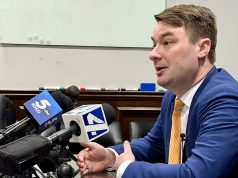
“We’re the only state that still has our corpus (from the 1998 tobacco company Master Settlement Agreement) and has grown it,” said House Appropriations and Budget Committee Chairman Trey Caldwell (R-Lawton). “But how do we get more bang out of the buck? That’s where the ‘TSET reset’ comes in, which is the endeavor that would, within the next 10 years, mean every single kid in the state of Oklahoma, if they want, can either go to college for free, vo-tech for free or (have) an apprenticeship.”
As Caldwell pushes HJR 1077 to send his proposal to a vote of the people, he has also filed HB 4003, which would create a fund for the State Department of Health to issue “legacy grants” to entities currently receiving TSET funding. Still, others worry Oklahoma’s public health efforts and local initiatives will be dramatically reduced under Caldwell’s proposal. TSET itself has been advertising on social media about its impact, driving more than 300,000 views each to 15-second videos about a sidewalk project in McAlester, a walking loop in Pryor and a playground in Tishomingo.
“TSET was established by Oklahoma voters with a mission to invest in projects and initiatives that improve (the) health of our state,” said Thomas Larson, TSET director of public information. “TSET has diligently carried out the mission for over 25 years, including the recently announced $150 million in TSET Legacy Grants — the largest health initiative of its kind in state history.”
Each year, TSET distributes tens of millions of dollars in grant and contract funding to schools, nonprofits, research projects and advertising campaigns aimed at advancing public health. While advertising contracts promote healthy habits like quitting tobacco use and drinking more water, grant funds typically reimburse local agencies and communities for health-related projects after their completion.
Caldwell, whose 2025 attempt to make TSET board seats replaceable mid-term was ruled unconstitutional, wants TSET’s mandate to shift so that most of the fund’s annual profits would lead to expansion of the Oklahoma Higher Learning Access Program. Commonly known as Oklahoma’s Promise, OHLAP offers qualifying state students a tuition-free college education.
“Our projections are it would take approximately eight years before we reach enough distributions where we could pay for every single kid in Oklahoma to go to college,” Caldwell said. “But just in year one, we can double OHLAP.”
In FY 2025, there were 15,438 Oklahoma students who participated in OHLAP, according to the State Regents for Higher Education. Caldwell said if voters ultimately approve his HJR 1077 to redirect TSET funding toward OHLAP starting in Fiscal Year 2028, the Legislature would run a bill doubling the family income limit for OHLAP participation.
“We spent $88 million last year on OHLAP, and that covered every kid in Oklahoma that qualified, whose parents make less than $75,000 a year, plus every school teacher’s child,” Caldwell said. “We think we could bump it up to $150,000 or $170,000 in year one — somewhere in that ballpark.”
As an agency governed by a board appointed by seven different state officials, TSET manages a roughly $2 billion fund, which grows each year owing to annual payments of about $60 million from tobacco companies. The fund’s investment earnings are considered unrestricted and are allocated by the agency.
According to an audit of Fiscal Year 2025 TSET finances, the fund earned $40.1 million in interest, $43.4 million in dividends and $69.2 million in realized gains. TSET spent $87.5 million that year. The audit found the endowment carried a total balance of $2.1 billion in assets, with $1.72 billion secured as “nonspendable” in the corpus.
Caldwell’s legislation, HJR 1077, would ask voters to amend the Oklahoma Constitution to eliminate the TSET Board of Directors — but retain its Board of Investors — and change how the fund’s annual earnings are allocated. While 20 percent of the earnings would be deposited into the constitutionally protected corpus, 80 percent would be transferred to the State Regents for Higher Education to pay for OHLAP scholarships. Any earnings beyond the money necessary to fund OHLAP fully would be deposited into the Education Reform Revolving Fund, which is a primary revenue source for common education in the state. (HJR 1077 would also authorize TSET to purchase and hold real property, stocks and other equity investments.)
According to a fiscal impact report prepared by House staff, reductions in administrative spending as a result of the proposal would save TSET between $4 million and $6 million annually. Those savings alone would be enough to fund 667 to 1,000 additional Oklahoma’s Promise scholarships, according to the analysis. House fiscal director John McPhetridge‘s report does not estimate how many scholarships could be generated from having 80 percent of TSET dedicated to OHLAP, but it said earnings directed from TSET to Oklahoma’s Promise would be “significantly larger,” likely $60 million or so.
If approved by the Legislature, Caldwell’s bill would trigger a public vote on a state question. Voters approved creating TSET in 2000 as a constitutional trust after the 1998 “Master Settlement Agreement,” in which four major tobacco companies agreed to provide settling states annual payments in perpetuity for the harm done to citizens by their products. The settlement also restricted tobacco marketing and prohibited settling states from making certain legal claims against the companies. An additional 40 tobacco companies have since signed onto the agreement.
Smoking rates down nationally
Oklahoma remains near the bottom of U.S. states in terms of overall health. But the percentage of Oklahomans who smoke has been cut roughly in half since TSET was established in 2001. According to America’s Health Rankings, as of 2024, 14.1 percent of Oklahomans smoke, which still marked the 10th-highest rate for smoking in the nation that year.
Caldwell is also running HB 4003 as a companion measure that would only take effect if HJR 1077 is approved by voters.
In addition to eliminating statutory references to TSET’s board of directors, HB 4003 would create the “TSET Legacy Effort Revolving Fund,” which would provide the State Department of Health funds — perhaps $25 million, Caldwell suggested — to continue health initiatives currently funded by TSET. (It would also allow up to 10 percent of the value of the TSET trust fund to be invested in venture capital opportunities.)
“TSET’s not all bad. I’m not saying that,” Caldwell emphasized. “I just think there’s more efficient, effective ways that we could manage the state’s $2 billion asset.”
Caldwell’s upper chamber counterpart, Senate Appropriations and Budget Committee Chairman Chuck Hall, is the Senate author of both pieces of legislation. Caldwell said he and Hall (R-Perry) came up with the idea over lunch with Jeff Peters, OU’s vice president of government affairs, following the November groundbreaking of the Stephenson Cancer Center in Tulsa.
“We were sitting there thinking, well, what’s the No. 1 thing that reduces smoking rates?” Caldwell recalled. “Well, the No. 1 thing that reduces smoking rates, according to [a study showing an inverse relationship between educational attainment and smoking prevalence], it’s a college degree. That was the seed of the ‘TSET reset.'”
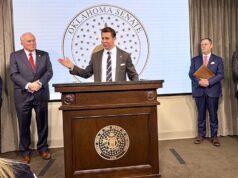
Senate President Pro Tempore Lonnie Paxton (R-Tuttle) said Tuesday he will review Caldwell’s proposal more deeply if it reaches the upper chamber.
“I think it’s still being worked on. I can make arguments in all sorts of directions with TSET,” Paxton said. “Oklahoma is one of the only states in the nation — maybe the only one — that has been able to sustain the funding that’s coming in on the tobacco settlement into something that has turned into a $2 billion-plus savings (account). Most states just spend it as they get it. So my compliments to the Legislature then and the voters who constitutionally lock-boxed that in.”
Still, Paxton noted how lawmakers unsuccessfully asked TSET to help fund a pair of major projects last session: a refurbishment of the OSU veterinary hospital and a new pediatric heart hospital at OU.
“While we’ve had some frustrations with the TSET board with some of the things they’ve spent money on, that’s all in the constitution,” Paxton said. “I don’t want to dismantle something because we’re temporarily frustrated with the current board. However, I do want to look at and see all of the options. That’s over $2 billion now. Are there other places in the state that we can spend that? We could maybe break some of that off, but I would stay pretty firm that it’s constitutionally protected and not just given to the Legislature.”
‘A big bunch of people that have wanted to tap TSET for a long, long time’

Redirecting TSET expenditures is not a new desire for many Republican lawmakers.
In 2020, nearly 59 percent of Oklahoma voters rejected State Question 814, which would have sent 75 percent of the annual Master Settlement Agreement funds toward paying for the state share of Medicaid expansion costs, which have partially led to a $494 million Oklahoma Health Care Authority funding gap that legislators are grappling with this session.
“There’s always something there,” Paxton said of ideas about putting TSET dollars toward other state needs. “But I will remind everybody it wasn’t that long ago that it went to the voters and asked them if we could use TSET [funds] back then to fund Medicaid expansion, and the voters soundly rejected that. So whatever we do, we have to keep that in mind that voters are pretty protective of that fund, and whatever we do is going to have to be something the voters are going to vote for. The Legislature can propose it, but the voters are the ones who are going to make that decision.”
Last May, Rep. Meloyde Blancett (D-Tulsa) said Caldwell’s HB 2783 — which attempted to make TSET board members’ seven-year terms “at the pleasure of their appointing authority” — was “retaliatory” because TSET did not provide $50 million for the University of Oklahoma’s new pediatric heart hospital.
Earlier this session, however, Blancett said she does not consider Caldwell’s new proposal to be “retaliatory” because of its end goal: to fund OHLAP and provide tuition-free college and university access to all students who are four-year graduates of Oklahoma high schools.
But Rep. Jacob Rosecrants (D-Norman) was firm in his opposition to HJR 1077’s proposed changes, saying it follows “kind of a pattern.”
“There is a big bunch of people that have wanted to tap TSET for a long, long time,” Rosecrants said. “I think this is just more of that.”
Caldwell said his proposal this year is connected to the law struck struck down in January only insomuch as it continues his push to make TSET have “accountability to the voters.”
“(The) Supreme Court said we need to take it back to the voters, and that is what we are going to do,” Caldwell said.
Caldwell’s current proposal to dedicate TSET to OHLAP has put higher education leaders in the awkward position of desiring additional scholarships for more Oklahoma students while wanting to avoid the prickly political pitfalls of the potential state question.
“We are for anything that provides more opportunity and access to Oklahoma colleges and universities,” said Sean Burrage, chancellor of the State Regents for Higher Education.
Through a spokesperson, OSU President Jim Hess declined to comment on Caldwell’s proposal. OU President Joe Harroz noted a complicated dynamic: On the one hand, TSET grants currently support research at OU and OSU, but on the other, expanding OHLAP would be a major win for higher education in the state.
“I want both things to happen. I would like to have the money from TSET to go toward cancer research and other areas, including all of those areas that touch what the tobacco settlement has historically done, and I would also like to see the increasing of the adjusted gross income from $60,000 to $100,000 for household income for Oklahoma’s Promise,” Harroz said Jan. 30.
Asked if both options could be realistic, Harroz said he believes so, but he said it’s a question for legislators to figure out.
“I would hope so. It is under our strategic plan to try and provide advocacy to get that done,” Harroz said. “Now, as between those two choices, that is for the policymakers to decide. (…) Increasing the AGI is important for Oklahoma. We saw Texas do this on their similar program. I think we need to do it in Oklahoma.”
Gov. Kevin Stitt has challenged both Harroz and Hess to dramatically increase OU and OSU enrollment among Oklahoma residents. Asked his thoughts about Caldwell’s TSET proposal Feb. 9, Stitt said he would like to see “some reform” proposed to voters.
“Generally, do I think TSET uses the money wisely? Not really. So I would love for it to be more controlled,” Stitt said. “There does seem like there needs to be some reform with that. I do not know exactly what Caldwell has in mind or how we can get that across the finish line, but locking that money up more like I said in my sovereign wealth fund. Maybe we put it in my sovereign wealth fund and protect Oklahomans for the future, and whether it goes to education or to supplement other revenue sources and lower taxes, those are great ideas.”
Paxton also noted that Stitt — who spoke at a TSET function Jan. 14 announcing “legacy grant” awards — called for creating some sort of Oklahoma “taxpayer endowment fund” in this year’s State of the State address.
“The governor has an idea about his ‘sovereign wealth fund’ and using this to go into that fund,” Paxton said. “We’ll work that out.”
Asked about the topic March 11, House Speaker Pro Tempore Anthony Moore (R-Clinton) said he “loves the TSET reset.”
“I could not be more proud of the opportunities we have to really make a generational impact for Oklahoma,” Moore said.
House Speaker Kyle Hilbert (R-Bristow) said he expects a “robust conversation” about TSET, The Oklahoman reported in January.
“These are public funds, and as such, we should frequently have discussions if these public dollars are best spent on multimillion-dollar administrative budgets and advertising campaigns or make a direct impact for Oklahomans,” Hilbert said.
TSET awarded $70.1 million in grants and contracts across the state in Fiscal Year 2025, according to its annual report presented to its board of directors Feb. 20.
The largest category of expenditures was $25.6 million for “health communication,” which included $20.1 million to VI Marketing and Branding for various advertising initiatives like the “Tobacco Stops with Me” campaign that launched in 2007-2008 and has won numerous awards promoting the Tobacco Helpline.
According to TSET’s annual report, the campaign has inspired conversations between parents and children about vape and tobacco use among nearly 75 percent of Oklahomans. Nearly 30,000 people registered for help quitting tobacco, and operating the Oklahoma Tobacco Hotline cost $5.9 million.
Through the TSET Healthy Living Program, which is “designed to prevent cardiovascular disease and cancer,” $5.4 million was awarded to 27 grantees in 28 counties for programming that included:
- A walkability audit that inspired the City of Enid to repair sidewalks;
- Free transportation for Stroud Senior Citizens Village residents to the grocery store twice a month; and
- Working with the Norman City Council to pass three tobacco ordinances, including a prohibition on new tobacco retailers within 300 feet of a school or park.
TSET also spent $13.7 million for research. The TSET Cancer Research Program at Stephenson Cancer Center received $5.5 million for research. In collaboration with TSET, it launched a mobile lung cancer screening program. According to TSET’s annual report, the partnership with the cancer center also led to a breakthrough in pediatric leukemia treatment that improved the three-year relapse-free survival rate from 88 percent to 96 percent. The Oklahoma Center for Adult Stem Cell Research received $3.1 million. The TSET Health Promotion Research Center received $5 million.
While Caldwell praised certain TSET-funded projects as being important, he emphasized his concern with the agency’s advertising campaigns and sidewalk projects.
“What I’m saying is we’ve seen tobacco rates come down predominantly based on education numbers and overall trending in the whole country, and I think we should give a little bit of credit to TSET as well. But I think now it’s time to review, in 25 years, OK, is this still the best way to use this massive asset the state of Oklahoma has? Are we using it the best way? (…) I’m going to ask the Oklahoma voters, which is a better use of this money: commercials, billboards, sidewalks? Or, eventually, every single kid in Oklahoma not having to worry about having crippling debt for the rest of their life from higher ed?”
While expansion of Oklahoma’s Promise is attractive across the aisle, using TSET money to fund it remains controversial.
“Horrible idea. The beautiful thing about TSET is that it is separate. It is aside. There is no legislative control,” said Sen. Mark Mann (D-OKC).
Rosecrants expressed concern about TSET becoming a “cash cow.” Blancett and Mann both suggested that the Legislature needs to raise revenue if it wants to expand OHLAP.
“If we want to fund stuff, we need to figure out how to raise revenue, not dip into things like that,” Mann said.
But Caldwell said using TSET’s annual earnings to expand OHLAP’s capacity and impact would bring major economic returns.
“We’re always trying to get economic development,” Caldwell said. “When you can walk into that board and you say, ‘Hey, look, over the last decade, our education rate in the state of Oklahoma — our college degree rate — has went from 29 percent to, let’s say it gets it to 40 (percent).’ OK, now we’re up there with states like Ohio and New York and Massachusetts and the overall amount of education in the state.”
He said Oklahoma’s recent efforts to land high-tech manufacturing facilities and other major employers have been hampered by the state’s educaation shortcomings.
“That’s something we hear every day when we go into an economic development meeting: ‘Do you have an educated, qualified workforce?’ And that’s why we lose a lot of projects, because we don’t. They love the work ethic, they love the people in Oklahoma, but at the end of the day, we lose projects on that. I’ll tell you another thing that is going to help us when we go to economic development meetings is we can look across the table and be like, ‘Oh, by the way, every one of your employees — their children — can go to college for free if they choose to go to a public college in Oklahoma. And I think that alone will help us close economic development projects. I think it’s a rising tide that will lift all the boats in Oklahoma.”