

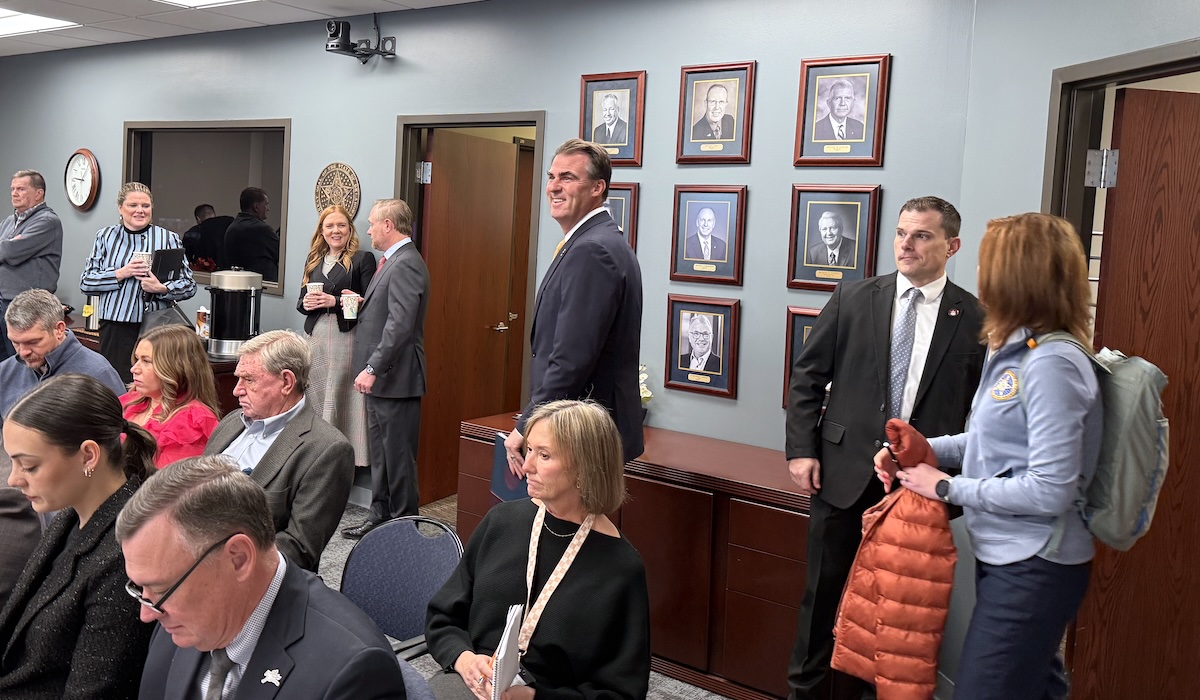

Before Gov. Kevin Stitt kicked off his 77-county farewell tour, he signed several executive orders directing agencies overseeing industries to conduct reviews and make changes.
So far in 2026, Stitt has issued eight new executive orders, six in the days leading up to the 2026 legislative session and two more in the first week after the Legislature convened. (He also amended his December order regarding abortion.)
From a comprehensive review of welfare programs administered and overseen by state agencies to performance-based funding for higher education institutions, the orders affect several agencies but mostly focus on new internal reviews. Stitt also directed state agencies to create “one-stop shop” digital portals to enhance two of his go-to policy planks: school choice and business-friendly efficiencies.
To stay apprised of the changes Stitt is seeking, read on for details about each order.
Stitt seeks outcome-based funding, elimination of some tenure in higher ed

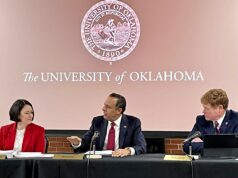
Saying he wanted to “continue our progress as an outcome-based system,” Stitt announced two executive orders at the Oklahoma State Regents for Higher Education meeting Feb. 5.
First, Stitt called on public colleges and universities to consider post-graduate wage and employment outcomes when adding or sunsetting academic programs.
“Just last month, you guys led — and it was hard decisions, and I know that — to close 41 degree programs, and you put 193 more on action plans,” Stitt said. “This is important to always be thinking about how we are utilizing state resources to align with workforce (needs) and to make sure we are taking care of the taxpayers’ money.”
Alongside that, he wants the state to develop a performance-based funding plan to “maximize the state’s return on investment” by meeting workforce needs, considering affordability and spurring innovation. To that end, he called for the regents “to enhance tracking of post-graduate wages, job types, hours worked and employment locations for better return-on-investment analysis.”
Under Executive Order 2026-08, Stitt has directed the State Regents for Higher Education to create a “performance-based funding plan” by Oct. 1 and to make recommendations to the Legislature for statutory changes allowing its adoption by Jan. 1, 2027 — the waning days of Stitt’s gubernatorial term.
“The intent of this order is to provide a roadmap for the regents to change its higher education funding formula to produce improved outcomes within the areas strategically important to the state, as identified in the PBF plan,” the order states.
Stitt also wants OSRHE to conduct a feasibility study on creating 90-credit-hour “accelerated” bachelor’s degree programs. In January, the OU Board of Regents approved reducing the credit hours required to graduate from eight degree programs. According to a press release, OU will be America’s first R1 research university to have such programs.
According to Stitt’s order, such pathways have “emerged in competitive states” as a way to “reduce degree completion lengths, lower student costs and more rapidly connect graduates to the workforce.”
“Once you have conducted a feasibility study, I will need your help to make sure the vision cascades throughout the entire education system,” Stitt said. “Massachusetts, they have got a pilot program and a 90-hour bachelor’s program. Maine, Indiana, Utah — they are already working on this as well. I do not want to get behind.”
HB 3315, filed by Rep. Ryan Eaves’ (R-Atoka), would direct the OSRHE to conduct a feasibility study for 90-credit-hour bachelor’s degree programs. The House Postsecondary Education Committee recently advanced the bill.
Stitt also filed Executive Order 2026-07, which “encouraged” the state regents to adopt several tenure reforms “to the extent permitted by law.”
The order suggests prohibiting new lifetime tenure appointments at regional universities and community colleges. It recommends that research universities continue to offer faculty tenure so long as there is a post-tenure performance review at least every five years, which would also be applicable to existing OU and OSU professors with tenure.
“No job funded by taxpayers should be exempt from regular, meaningful performance reviews,” Stitt said in announcing his order. “Do not let someone teach no classes and bring no research dollars in. That is pretty silly.”
Perhaps hyperbolically — but to the irritation of academics — Stitt suggested that tenured professors “just sit there.”
American Association of University Professors’ President Todd Wolfson said in a press release that Stitt’s order sends a message that Oklahoma no longer values academic freedom as a core public good.
“Public colleges and universities are among the last remaining institutions dedicated to truth-seeking and civic education, and attacks on academic freedom are attacks on democracy,” Wolfson said.
One-stop shop, scholarship tax credits
To make it easier to evaluate schools, Stitt wants state education agency leaders to create a “one-stop digital portal.”
On Jan. 27, Stitt signed Executive Order 2026-03, which directs Secretary of Education Daniel Hamlin, alongside the State Department of Education and State Superintendent of Public Instruction Lindel Fields, to create a school choice hub within 90 days.
“Every Oklahoma child deserves access to the best education possible, no matter their ZIP code or family income,” Stitt said. “This will increase our understanding of available learning environments for families.”
The hub would support policymakers’ evaluation of Oklahoma’s education system and would help parents while they are making decisions for their families, according to a press release.
In the executive order, Stitt also announced that he notified the federal government of the state’s intent to participate in the federal tax credit scholarship program established by H.R.1, colloquially referred to as “the One Big Beautiful Bill.” The program would allow “scholarship granting organizations” and donors to receive federal tax credits for contributions to educational scholarships or vouchers. In Oklahoma, a primary “scholarship granting organization” is the Opportunity Scholarship Fund.
HB 3704, authored by Rep. Denise Crosswhite Hader (R-Piedmont) and Senate Majority Floor Leader Julie Daniels (R-Bartlesville), also declares the state’s intent to opt into the program and directs the governor to submit necessary forms.
‘Trampolines, not hammocks’: Stitt orders review of welfare programs
A week before news broke that Oklahoma’s error rate could threaten federal funding for welfare programs, Stitt signed Executive Order 2026-02 on Jan. 26, directing state agencies to conduct a comprehensive review of the Supplemental Nutrition Assistance Program (SNAP), Temporary Assistance for Needy Families (TANF) and other programs.
The order directs Oklahoma’s Department of Human Services, Department of Health, Health Care Authority and Employment Security Commission to review the programs they oversee for error rates, fraud protocols, eligibility rules and benefit cliffs that could disincentivize work.
“I am instructing our agencies to take steps to reduce fraud and errors, seek federal flexibility and design incentives that act as trampolines, not hammocks,” Stitt said in a statement.
The agencies are directed to apply for waivers and alternative program arrangements that reduce federal involvement. Agencies are also directed to “ensure all eligible adult recipients are directed toward opportunities for employment, job readiness or education that promote economic independence.”
In a press release, Stitt said state government “is not a jobs program and it cannot solve all societal issues.” He went on to call for private-public partnerships and nonprofit involvement.
“Many of the needs Oklahomans face can be met by the local church, nonprofits and neighbors,” Stitt said. “I encourage the Oklahoma faith-based and nonprofit community to join with the Office of Faith Based Initiatives to help meet the needs of Oklahomans.”
‘Guardrails are necessary’: Stitt seeks consumer protection
Stitt’s first executive order of his final year in office was aimed at ensuring “Medicare Advantage is fulfilling its promise” and that consumers can receive high-level care.
Executive Order 2026-01, signed Jan. 23, prohibits Medicare Advantage plans and representatives from providing benefits such as bribes or inducements to influence plan selection. It directs plans to be “truthful in all marketing and enrollment practices,” prohibits high-pressure tactics and misleading representations and requires that plans annually maintain written arrangements with providers, services, vendors or contractors, including an agreed fee schedule.
“It is becoming increasingly apparent that guardrails are necessary to ensure Medicare Advantage is fulfilling its promise to consumers and is operating with full transparency,” Stitt said.
Secretary of Health Clay Bullard, whom Stitt appointed to lead the Health Care Authority in October 2025, said the order requires companies to keep their promises in plain language.
“Oklahoma’s seniors and health care providers deserve better,” Bullard said. “We believe more transparency and better contracting will secure the care and payments they deserve.”
The order also requires that Medicare Advantage plans:
- Do not deny or delay payment for services covered under traditional Medicare based on “medical necessity” if adequate documentation is provided;
- Do not impose new provisions, such as prior authorization requirements, that are more restrictive than traditional Medicare;
- Comply with prompt-pay statutes requiring that clean claims be paid within 14 days;
- Provide annual reports to the Oklahoma Insurance Department; and
- Maintain provider networks that ensure access to care in counties where plans are sold.
The order directs the Oklahoma Insurance Department to establish a complaint and enforcement mechanism for possible violations of “these consumer protections.”
In response to the order, Insurance Commissioner Glen Mulready said that as Medicare Advantage enrollments increase, oversight is critical.
“This executive order is an important step toward protecting Oklahoma consumers and the medical professionals who care for them,” Mulready said.
Health agencies to review polices, practices to safeguard ‘medical freedom’
Stitt wants state health agency leaders to conduct a review of policies and practices related to “personal freedom” for patients.
On Jan. 30, Stitt signed Executive Order 2026-06. The order directs the heads of the State Department of Health, Health Care Authority, Department of Mental Health and Substance Abuse Services, Department of Rehabilitation Services and the Department of Human Services, to review policies, regulations, procedures and practices related to medical freedom, informed consent and parental rights.
“From banning vaccine mandates in our schools to rejecting WHO overreach, Oklahoma has led the nation in protecting personal freedom,” Stitt said in a press release. “This order builds on that legacy, aligning our policies with science, transparency and the will of our people.”
The order directs agencies to submit the report to legislative leaders and the governor within 180 days. The report should contain recommendations for changing a “policy or practice that runs afoul of or promotes a practice or position contrary to the principles articulated in this order.”
Two months after the report is issued, agencies are directed to revisit and revise formal positions as necessary.
$1 fees, entrepreneurial ‘mindset’
One of Stitt’s early 2026 executive orders seeks to make it easier to start a business in Oklahoma.
Executive Order 2026-04, which Stitt signed Jan. 29, creates “a one-stop shop for entrepreneurs,” and a new executive branch position, “chief entrepreneurial officer of Oklahoma.”
“As a business-friendly state, we know that our entrepreneurs are the key to Oklahoma’s lasting prosperity. That is why I am taking steps to set them up for even greater success,” Stitt said.
The online “one-stop shop” would provide entrepreneurs with information on how to start a business, including guidance on regulations like permits and licenses. It would also provide information on “certified incubators” that assist aspiring entrepreneurs.
The order also directs the chief entrepreneurial officer and secretary of state to submit a proposal to the governor and legislative leaders to reduce all filing fees for new business formation to $1.
The Oklahoma Tax Commission, alongside the chief entrepreneurial officer, is directed to evaluate options to decrease tax burdens for businesses in their first two years through state tax filing waivers or deferrals.
Stitt also wants to promote entrepreneurship-focused learning. The order directs the State Department of Education, in consultation with the chief entrepreneurial officer, to integrate financial literacy, project-based learning, real-world problem solving and an “entrepreneurial mindset” into the existing K-12 curriculum.
‘Increased transparency’ for civil asset seizures, forfeitures
The governor is directing law enforcement agencies to submit an annual report to the commissioner of public safety on asset seizures and forfeitures.
Signed Jan. 30, Executive Order 2026-05 directs agencies to catalog their inventory and revenue generated through the sale of seized or forfeited property, along with a “detailed accounting” of how the proceeds were spent.
“Civil asset forfeiture is a powerful tool, so it needs to be wielded with maximum transparency to ensure individual property rights are respected,” Stitt said. “Increased transparency in this practice will protect against abuse, real or perceived, and will build greater trust between our dedicated officers and the communities they serve.”
The commissioner will publish the information from the annual reports for public consumption, according to Stitt’s statement.
In September, the Oklahoma Department of Public Safety agreed to return $62,000 and guns that were seized during a traffic stop, according to KJRH. In 2018, Oklahoma law enforcement seized $9.5 million in cash and property, according to Oklahoma Watch. But that was the most recent year for which statewide data is available, the outlet reported.