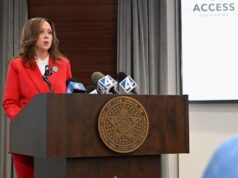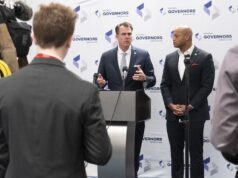




Oklahoma Attorney General Gentner Drummond announced that settlements totaling more than $25 million have been reached with three of the nation’s largest poultry processors in a two-decade-old Illinois River lawsuit.
Tyson Foods, Cargill and George’s Inc. also agreed to permit a special master to review their records concerning the application of chicken litter, a low-cost organic fertilizer rich in nitrogen, phosphorus and potassium, to farm fields in the water basin located in northeast Oklahoma.
“For more than 20 years, this case has hung over the heads of poultry growers in eastern Oklahoma. I’ve heard from families who were unsure whether they would be able to continue operating from one year to the next,” Rep. David Hardin (R-Stilwell) said in a statement. “These settlements bring long-needed clarity. They provide a framework to address water quality concerns in the Illinois River Watershed while also giving producers and integrators the stability they need to keep doing business in our state.”
This story was reported by Gaylord News, a Washington reporting project of the Gaylord College of Journalism and Mass Communication at the University of Oklahoma.

While the settlements resolve those companies’ liability, questions still remain for the families whose contracts were at risk of being pulled by Tyson and who now await U.S. District Court for the Northern District of Oklahoma Judge Gregory Frizell’s approval before knowing the full impact on their farms and livelihoods.
“Although a lot of anxiety has been lifted, it’s not gone,” said LouAnn Hays, an Oklahoma poultry farmer who grows for Tyson Foods and whose seven-year contract was pulled following Frizzell’s initial order. “The big thing is whether the judge signs it. If he does, we’ll have our contract renewed. Right now, Tyson is saying they’ll renew contracts, which is what we needed. Financially, that means if they follow through, we won’t be filing for bankruptcy.”
For Hays and many other Oklahoma poultry farmers growing for the large companies named in the lawsuit, the repercussions extended beyond adjusting to the structured requirements within the order — it could cost them their farms entirely.
After the initial order was filed, Tyson pulled out of nearly 50 farms in the region, putting those who had financed their farm through personal loans in future financial trouble.
“It would take everything we have. After seven years of working on a farm we thought would be ours, we could end up with nothing,” Hays said. “We’ve done well, but we still have payments — $100,000 a year. Over seven years, that’s $700,000, and we could end up with nothing to show for it. That’s the reality, and it’s happening right now.”
Drummond: ‘Corporate accountability is not option’

The 2005 lawsuit centers on concerns about clean, usable water and the economic future of Oklahoma’s poultry industry, much of which is based in rural communities along the Illinois River watershed, including Adair, Delaware, Cherokee and Ottawa counties.
Oklahoma v. Tyson Foods Inc. was filed by then-Attorney General Drew Edmondson in an attempt to reach an agreement through mediation, which he was ultimately unable to do in the remaining six years of his tenure as the state’s top lawyer.
Edmondson’s case was based on an earlier, separate lawsuit. The City of Tulsa sued Tyson, Cargill and three other poultry producers, alleging they contaminated the Eucha-Spavinaw Watershed with excess phosphorus. The case resulted in a $7.5 million settlement.
The state’s lawsuit featured no major updates for nearly two decades and across multiple attorney general administrations before Frizzell ruled in 2023 — just nine days after Drummond was sworn in — that the poultry companies were still liable for pollution.
On June 17, 2025, Judge Gregory Frizzell issued a finding of fact that the ongoing pollution of the Illinois River Watershed constituted irreparable harm and that the poultry companies violated Oklahoma statutes prohibiting pollution of the state’s air, land and waters.
In recent weeks, Drummond reached settlement agreements with Tyson, Cargill and George’s, while Cal-Maine, Peterson Farms and Simmons remain subject to the original order.
Under the three separate settlements, Tyson will pay $19 million, Cargill will pay $6.5 million and George’s will pay $5 million, with the most notable difference in each agreement being the role of the special master.
In the original order, a special master and a watershed monitoring team had several responsibilities, including “making periodic inspections of each company farm, contract grower farm, or land application site shall occur as often as is necessary to determine compliance (…) at least once every year.”
But those on-site visits are off the table in the settlements Tyson, Cargill and George’s signed.
RELATED
Birthday Rant: At Lake Tenkiller, we have lost something special to pollution by Andrea Hancock

Instead, their settlements give the special master authority to obtain records from the three companies, including from vendors and contractors, to ensure compliance. The special master then will review the records to verify that the companies’ actions align with their certifications.
“In the event that the special master wishes to conduct an onsite inspection, the special master must show the court by a preponderance of the evidence why such an inspection is necessary to effectuate the terms of this consent judgment,” the settlements state.
After reaching a settlement with George’s in January, Drummond emphasized the settlements’ importance for Oklahomans in a Feb. 12 press release announce that Tyson and Cargill also had settled.
“For over two decades, Oklahoma has fought to protect the Illinois River Watershed and the natural resources that sustain our communities,” Drummond said. “The decision to settle by Tyson and Cargill makes one thing unmistakably clear: Corporate accountability is not optional, and protecting Oklahoma’s water can, and must, go hand in hand with a strong poultry and agricultural industry. These settlements provide a path to move forward together, giving certainty for growers, protecting jobs and safeguarding Oklahoma’s waters for future generations.”
One company not included in the settlements is Simmons, the poultry integrator for which longtime Oklahoma farm family member Megan Langley operates her breeder farm. For Langley, the most concerning aspect of the litigation is the potential change to how poultry litter can be applied to land. She said the rule feels brand-based, not science-based.
“If I buy litter from my neighbor who isn’t growing for one of the defendants, I can spread it under normal regulations, and that’s the part that makes absolutely no sense,” Langley said. “It’s not really about regulating litter. It’s about the brand name.”
Langley and many other farmers affected by the lawsuit operate breeder farms, which produce fertilized eggs that are sent to hatcheries and eventually raised as broilers for meat production. Because they are unable to fully apply their litter as natural fertilizer, some farms are forced to sell it, hoping to find buyers willing to take it.
Breeder litter is less nutrient-dense than broiler litter, containing lower levels of nitrogen and phosphorus, making it more difficult to sell.
Still, Langley said litter application was never unregulated.
“Before all this, we had to do soil samples. We had to do litter samples. We had to have a nutrient management plan showing where we could and couldn’t spread on our farm, whether there were slopes draining into a stream, which there aren’t on our place. We had to follow all those guidelines,” Langley said. “Now, because we operate a breeder farm, nobody really wants breeder litter. So we’re left with litter and nowhere to take it.”