


On Feb. 12, tribal prosecutors charged Elizabeth Poteete with first-degree murder in Cherokee Nation District Court for allegedly killing her husband, former Cherokee Nation Supreme Court Justice and Tribal Councilor Troy Poteete. Her initial court appearance in Tahlequah is set for 10 a.m. Tuesday, March 3, and she is being held without bond.
At about 6 p.m. Thursday, Feb. 5, Elizabeth Poteete called 911 to report “a male walking outside her residence,” and Sequoyah County Sheriff’s Office deputies were dispatched, according to the probable cause affidavit from Cherokee Nation Deputy Marshall Patrick Hunter. Officers reported finding nothing suspicious, contacted Troy Poteete and notified him that they believed his wife was “having a mental episode.”
Around 11:17 p.m., Elizabeth Poteete called 911 again to report that she “had shot her husband with a handgun multiple times,” according to the affidavit, and deputy sheriffs were dispatched again. Upon arrival, Poteete admitted to shooting her husband, and officers attempted to perform “life saving measures” on Troy Poteete. He was pronounced dead at 11:36 p.m.
In his affidavit, Hunter described Elizabeth Poteete’s statements about the shooting “after she waived her Miranda rights.”
“Poteete stated she was afraid for her life after her husband, T.P, stated his girlfriend and another individual were going to come shoot her. Poteete said that prior to the shooting she retrieved a handgun from a filing cabinet in their residence and stood approximately four to five feet away from T.P, who was sitting in his chair,” Hunter wrote. “T.P had his CPAP machine on and at first Poteete stated T.P. was snoring but then Poteete stated she could not recall if in fact he was snoring. Poteete stated she shot him and saw him go back in the chair. Poteete was unsure how many times she shot but believed it was multiple times. Poteete then said she called 911 and placed the handgun on the floor under the couch in the residence.”
While the affidavit details what Elizabeth Poteete told Hunter during his interview, it does not analyze the credibility of her claims.
Under federal law, the maximum sentence the Cherokee Nation District Court can issue for a murder conviction is three years. A charge in Cherokee court does not prevent additional charges from being filed in federal court.
Troy Poteete praised as ‘esteemed historian and preservationist’
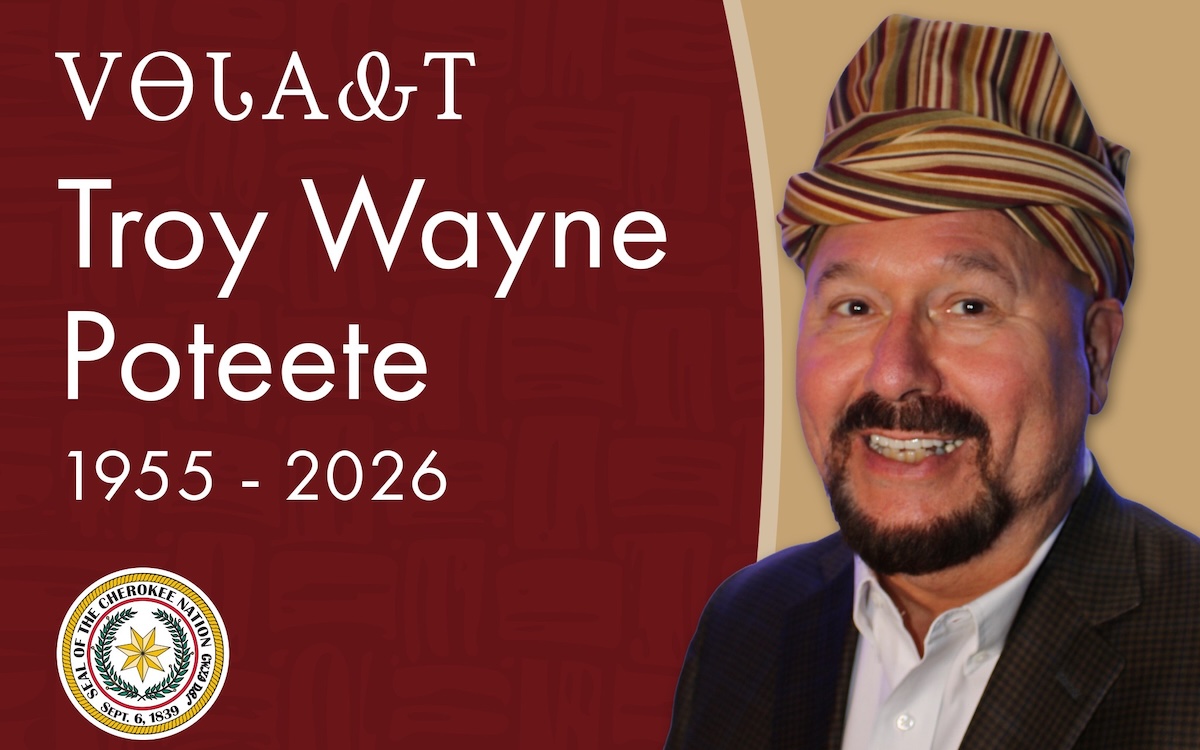
Troy Wayne Poteete, 70, served on the Cherokee Nation Tribal Council from 1991 to 1999 and on the nation’s Supreme Court from 2007 to 2017. He remained active with the Cherokee Nation after his retirement, serving as the executive director of the National Trail of Tears Association at the time of his death, according to an obituary in the Cherokee Phoenix.
Following the announcement of his death, Poteete was praised by Cherokee Nation Principal Chief Chuck Hoskin Jr. in a statement.
“Troy Wayne was instantly recognizable wearing his distinctive traditional turbans — head wear in homage to our ancestors. Beyond his service to tribal government, Troy Wayne was an esteemed historian and preservationist of Cherokee life and culture,” Hoskin said. “Troy Wayne’s passing represents a significant loss of institutional knowledge and cultural passion. Today we take pause and honor his legacy of leadership and life’s work.”
Former Principal Chief Chad Smith, who appointed Poteete to the Supreme Court, also posted a lengthy statement on Poteete’s online obituary.
“He is one of the rare individuals about whom we can say, without hesitation, that our nation is stronger and better because he walked among us,” Smith wrote. “He should be remembered as the Honorable Justice Troy Wayne Poteete. Principal Chief John Ross often signed his letters, ‘Your humble servant.’ Justice Poteete was, in that same spirit, a humble servant of the Cherokee people.”
Read the probable cause affidavit