

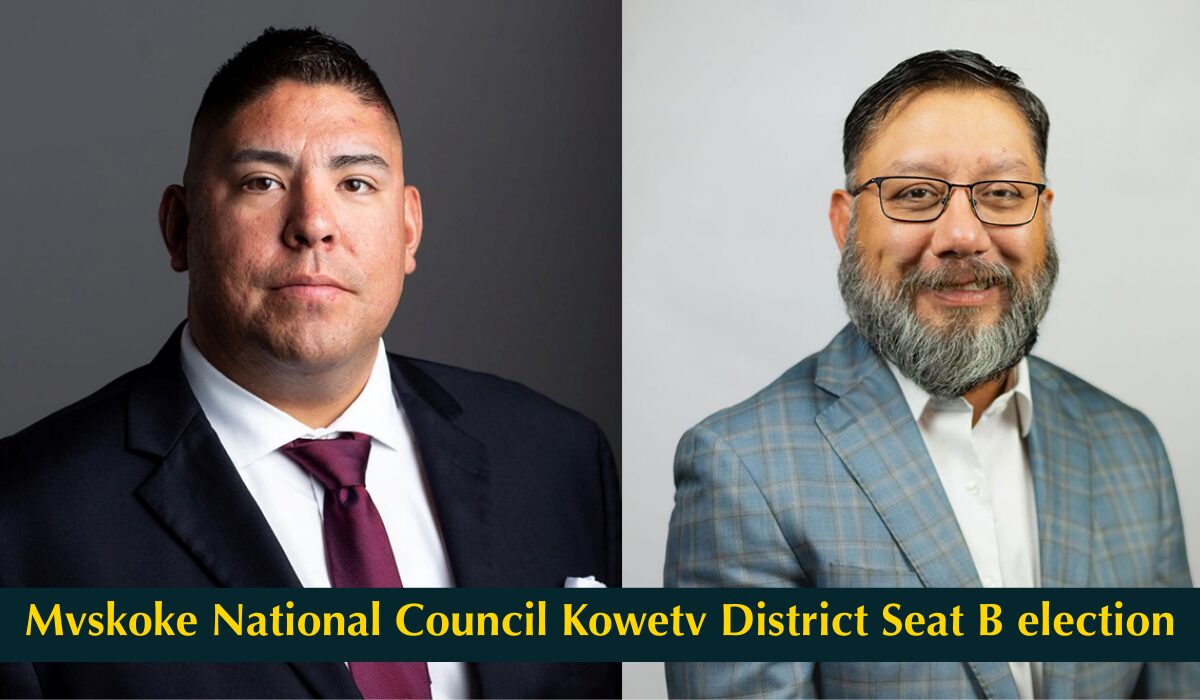

Seeking the open Kowetv District “B” seat on the Muscogee National Council, candidate James Factor may have the endorsement of departing Rep. Mark Randolph, but Timothy Jackson Jr. is hoping his third run for the position will be the charm.
The Kowetv District, formerly known as the Wagoner District before it was renamed in January 2024, covers the northeast section of the Muscogee Nation Reservation and contains portions of Wagoner, Mayes and Rogers counties in northeast Oklahoma. The Muscogee Nation holds elections every two years for its National Council, which has eight districts, each with an “A” seat and a “B” seat. While council candidates are required to live in their district, every Muscogee citizen may vote in every council election — for now. This year’s Sept. 20 ballot contains a question that would reinstitute district-based voting if passed.
Jackson, 36, is the CEO of Narcomey Construction in Tulsa and belongs to the Weogufkee Tribal Town and the Bird Clan, according to his “meet the candidate” video with Mvskoke Media. He graduated with his bachelor’s degree in engineering and construction management from Oklahoma State University in 2014.
This year marks the third time Jackson has run for the Kowetv District B seat. Twice before, he unsuccessfully challenged Randolph, who announced in June that he would not seek reelection.
Randolph has endorsed Factor, a former member of the Seminole Nation Gaming Commission from 2006 to 2009 and the owner of Tribal Gaming Ventures since 2018. He belongs to the Tukabatchee Tribal Town and the Green Leaf Ceremonial Grounds, as stated in his video interview with Mvskoke Media. Factor also attended OSU before moving on to Saint Gregory University in Shawnee and graduated with a Bachelor’s Degree in business administration.
This election cycle, discourse has been dominated by the Muscogee Nation Supreme Court’s recent ruling that the descendants of Muscogee Freedmen, people of African descent owned as slaves by members of the Muscogee Nation prior to the American Civil War, are entitled to tribal citizenship under the nation’s 1866 treaty with the U.S. In their campaigns, both Factor and Jackson have weighed in on how to proceed after the monumental decision.
Factor did not respond to requests for an interview, but Jackson spoke with NonDoc ahead of the Saturday, Sept. 20, election. Early voting runs from Sept. 17 and 18.
Jackson: Business key to tribal sovereignty
In his interview with NonDoc, Jackson said separating government from business is his bare-bones perspective to increase tribal sovereignty.
Jackson said he would like to see the Muscogee Nation’s boards — such as those over housing, land management and utilities — be self-sufficient and not rely on federal funding.
“You have to build legitimate business boards that aren’t under the direct oversight of the executive branch and don’t have direct influence from legislators,” Jackson said. “I know that sounds crazy, because I’m running to be a legislator, but I am not going to impose my business acumen onto our boards. There’s a reason we pay these people hundreds and thousands of dollars, and if they can’t produce fruit, then they must be replaced.”
Instead of watching new chiefs appoint new leadership for Muscogee Nation boards and agencies, Jackson said he would like to see board members outlast the terms of chiefs if they are performing well.
“If you had legitimate authority boards for these programs, these departments, they could outlive the politicians, and they can continue to thrive,” Jackson said.
While Factor did not respond to requests for an interview with NonDoc, he said during his interview with Mvskoke Media that he believes the Muscogee Nation should invest in its own data centers — a controversial industry that has drawn tension in some Oklahoma communities.
“That ties into data sovereignty, that ties into our health information and our tag information that the (Oklahoma) Turnpike Authority tries to get. DOGE is trying to get all our information,” Factor said during the interview. “AI will help us free up a lot of processes that our employees will benefit from.”
Factor said his plan would not replace any employees, and he believes “it will create efficiencies that get our employees back out into the community, doing work with the people where they should be.”
Factor: ‘We have to figure out a way to move forward’ on Freedmen issue
In July, the Muscogee Nation Supreme Court issued a landmark ruling requiring the nation to extend tribal citizenship to the descendants of Muscogee Freedmen, regardless of their blood quantum, under the Treaty of 1866. A rehearing was denied in August, causing some Muscogee citizens to suggest an effort to recall or remove their Supreme Court justices.
Muscogee Nation Principal Chief David Hill signed an executive order Aug. 28 that halted the issuance of membership cards to Freedman applicants until the nation reviewed and amended laws to comply with the court order. Functionally, the ruling also means Freedmen are not be able to vote in the Sept. 20 election.
Asked if he supported the Supreme Court decision during his interview with Mvskoke Media, Factor said the nation has three coequal branches of government, and he said the judicial branch made its decision.
“The appeal was denied, so now we have to figure out a way to move forward and incorporate everyone,” Factor said.
Jackson said he supports the court’s interpretation of the 1866 treaty, but he said there needs to be better documentation used in the process of membership.
“My family had to show lineage back to the Dawes Roll. And the scary part about the Freedmen is all they have to do is show a lineage back to a slave,” Jackson said. “What documentation do they have to vet that truly? How do we prevent those who can falsify the documents, or how do you truly know that individual didn’t say, ‘Oh, that name right there matches the name of my kinfolk,’ and go ahead and borrow that name?”
Despite Jackson’s claim that “all” Freedmen descendants must do is prove lineage back to a slave, Hill’s executive order is clear that the Muscogee Nation Citizenship Office must adopt new policies to vet such applicants.
“This will require the administration, the citizenship office and the National Council to work on the necessary amendments and/or adoption of new laws to incorporate the qualification requirements under Article II of the Treaty of 1866 and to adopt appropriate policies and procedures establishing the necessary evidence and documentation that (the) citizenship office would require to consider applications in a standard and consistent manner,” the executive order said.
Jackson called the current Freedmen movement “modern inclusivity,” which is being seen “across the board on all levels of government and America.”
“Why weren’t they fighting it like this 20 years ago, 30 years ago?” Jackson said. “Why didn’t Congress question our modern-day constitution when it was sent off to be ratified? Why weren’t these questions posed then?”
Jackson said any divide in the tribe, on any subject, will never go away.
“There’s always been a divide amongst our people with the Upper Creeks and the Lower Creeks,” Jackson said. “That was always there before we came over here, and we were still that way.”
Jackson said the best way to increase involvement in tribal government is to decrease the current blood quantum requirement to hold office from a quarter to an eighth. The current one-quarter quantum requirement to seek office has long limited the Muscogee National Council candidate pool.
“A lot of the voter apathy comes from the simple fact that they don’t want to participate in the tribal government because they can’t run or represent the government,” Jackson said. “Because we are seeing the same names over and over, and there are more people who are qualified, and that’ll probably eliminate a lot of the negativity.”
(Correction: This article was updated at 4:45 p.m. Sunday, Sept. 14, to correct reference to the dates of early voting. NonDoc regrets the error.)