


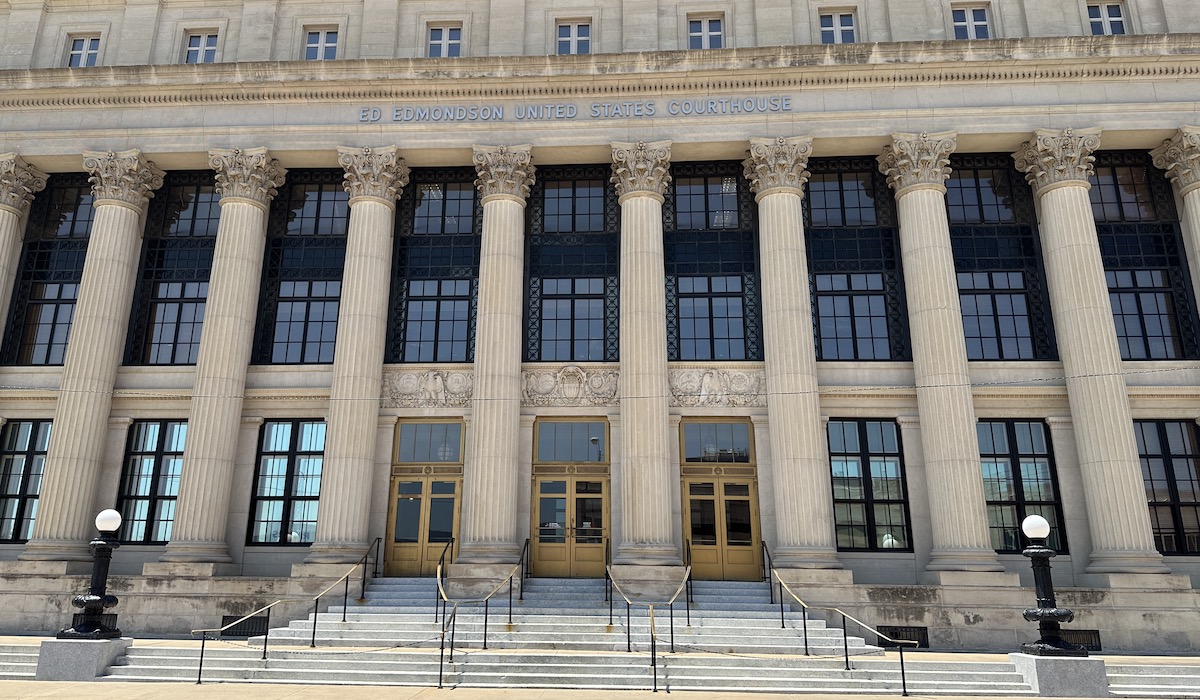
In the U.S. District Court for the Eastern District of Oklahoma, Magistrate Judge Gerald L. Jackson has recommended that a lawsuit brought by the widow of Bobby Barrick be dismissed, finding that three law enforcement officers “were acting under tribal authority” when they allegedly tased and struck the Choctaw Nation citizen who had been detained by others at a closed gas station.
Barbara Barrick filed a lawsuit in 2023 under 42 U.S.C. 1983, a provision of the Ku Klux Klan Act of 1871 which allows individuals to sue state officials for the violation of their constitutional rights. The act was “designed to empower the federal government to protect the civil and political rights of individuals,” according to the U.S. House’s Office of the Historian. Barbara Barrick initially filed her suit against the McCurtain County Board of Commissioners, the county sheriff, three deputy sheriffs and a state game warden, but only Deputy Matthew Kasbaum, Deputy Quentin Lee and Warden Mark Hannah remain as defendants.
Attorneys for the defendants argued the section of federal law was not applicable to the officers who interacted with Barrick because they “were not acting under color of state law.” Jackson ultimately agreed, recommending the suit be dismissed.
“The undersigned magistrate judge finds [the cross-commissioned police officers] were acting under tribal authority, and plaintiff cannot maintain a viable claim against them pursuant to Section 1983,” Jackson wrote. “The undersigned magistrate is acutely aware that the above finding may have far-reaching implications for tribal citizens in the Eastern District of Oklahoma, every square inch of which continues to be reservation land. The correct legal conclusion here carries the implication that tribal members in the Eastern District of Oklahoma have fewer constitutional civil rights protections than non-tribal members, and leaves no check on the actions of cross-commissioned state officers who encounter tribal members.”
Section 1983 explicitly limits its application to officials acting “under color of” — or acting out the power of — either a state, territory or Washington D.C. Jackson found that state employees, when interacting with a tribal citizen under a cross-commission issued under a cross-deputization agreement, are not exercising the power of the state, but rather they are acting under tribal authority. Under Jackson’s interpretation, state officials exercising tribal authority are not “acting under color of state law” and therefore can never be sued under Section 1983 for those acts.
The magistrate’s recommendation was first reported by Erin Christy of KJRH, with Choctaw law student Crispin South noting in follow up reporting that it is unclear whether lawsuits like Barrick’s could be successfully brought in the Choctaw court system under existing Choctaw law.
“The Choctaw Nation has waived its sovereign immunity in some circumstances to allow lawsuits, but not others,” South told KJRH. “I think [this particular issue] is a gray area where it hasn’t been litigated. It is not really clear under tribal law whether such a lawsuit would be able to proceed because we have not developed that type of case law.”
Choctaw Nation of Oklahoma senior executive officer of legal and compliance Brian Danker released a short statement on the magistrate judge’s recommendation.
“Tribal members have many avenues to pursue justice, including through our robust tribal court system,” Danker said. “As the Choctaw Nation is not named in the suit and it is part of ongoing litigation, we cannot comment further.”
‘Please don’t kill me’: Dismissal could limit constitutional civil rights
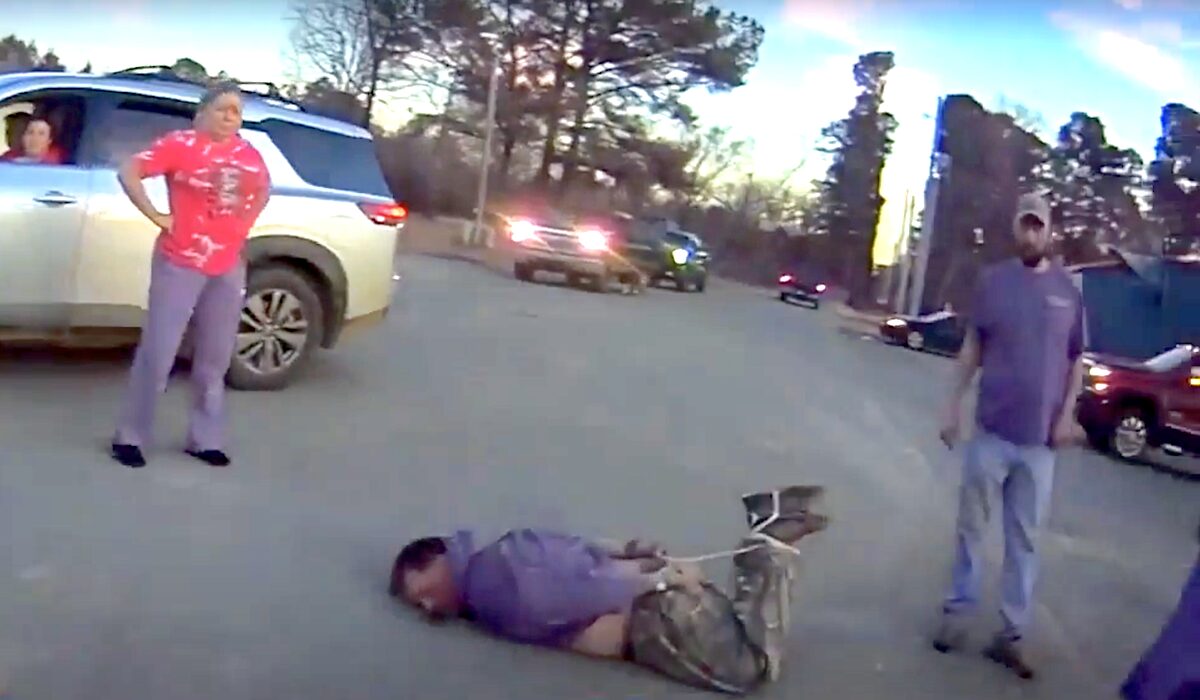
Before sunrise on March 13, 2022, Kasbaum “responded to a call to help Barrick, whose truck was stuck in the mud,” according to the “undisputed facts” outlined in Jackson’s July 9 report and recommendation. Later that day, Barrick was dropped off at a closed convenience store in Eagletown where he ran through the building’s glass front door, got into a “semi-tractor trailer rig” and jumped onto a woman’s car — all while making “statements about someone or multiple people trying to kill him.”
Contractors at Lori’s Corner Store eventually “hog-tied Barrick with his hands behind his back and his ankles bound together.” Kasbaum and Lee, the McCurtain County deputy sheriffs, were dispatched to the scene along with EMS services. When they arrived, Kasbaum and Lee untied Barrick and then handcuffed him before placing him in one of their vehicles.
Jackson’s recommendation was vague about the details of Barrick’s death, likely because summary judgement rulings require judges to limit themselves to facts agreed upon by both parties. Barbara Barrick alleged in her complaint that the law enforcement officers used Tasers and a neck restraint when a struggle ensued. She alleged that officers were instructed to deactivate their body-worn cameras, although Kasbaum told KJRH that his was inadvertently turned off during the altercation.
“Though the parties disagree on the specific details, Barrick was noncompliant with officers, continuing to struggle with them as they attempted various methods to subdue him, including screaming, yelling and rocking back and forth. During the continued altercation, Barrick fell unconscious, at which time the EMTs on site assessed him and transported him to McCurtain Memorial Hospital, where he was placed on a ventilator,” Jackson wrote. “He was later transferred to Paris Regional Medical Center, where he ultimately died. Barrick’s cause of death was listed as acute respiratory failure due to acute kidney injury. Contributing factors included bipolar disorder, schizophrenia, and hypertension.”
Barrick’s attorneys had argued in their initial complaint that Kasbaum, Lee and Hannah — the state game warden who also arrived on the scene — gave Barrick conflicting instructions to both stay in and get out of the vehicle, causing Barrick to plead for EMS workers’ assistance. The complaint accused Kasbaum and Lee of using stun guns on Barrick four times, causing him to “fall face down on the parking lot,” dragging him from the vehicle, “unreasonably” striking him with a baton and restraining him with various dangerous techniques before he was given medical treatment.
If the federal district court judge agrees with Jackson’s analysis, Barrick’s allegations would not go before a jury, and the federal case would be dismissed.
While a decision from the Eastern District of Oklahoma is not binding on the Northern District of Oklahoma, judges tend to find neighboring district’s decisions highly persuasive. If either side appeals the district court’s eventual ruling, the appeal would head to the 10th Circuit Court of Appeals in Denver, Colorado, and a decision there would establish binding precedent in every court in Oklahoma unless the U.S. Supreme Court weighs in on the issue.
With eastern Oklahoma affirmed as a series of Indian Country reservations where ongoing uncertainty over criminal jurisdiction has increased the need for local, county and state law enforcement to be cross-commissioned as officers for sovereign tribal nations, the Barrick lawsuit becomes the latest in a series of court cases that carry major ramifications.